

The international benchmark is the Web Content Accessibility Guidelines (WCAG) maintained by the W3C. Compliance ensures equitable access for people with visual, hearing, motor and cognitive impairments.
Think of it as building ramp access and braille signage in public buildings. Wheelchair ramps ensure that everyone can enter public spaces safely and independently.
How it works
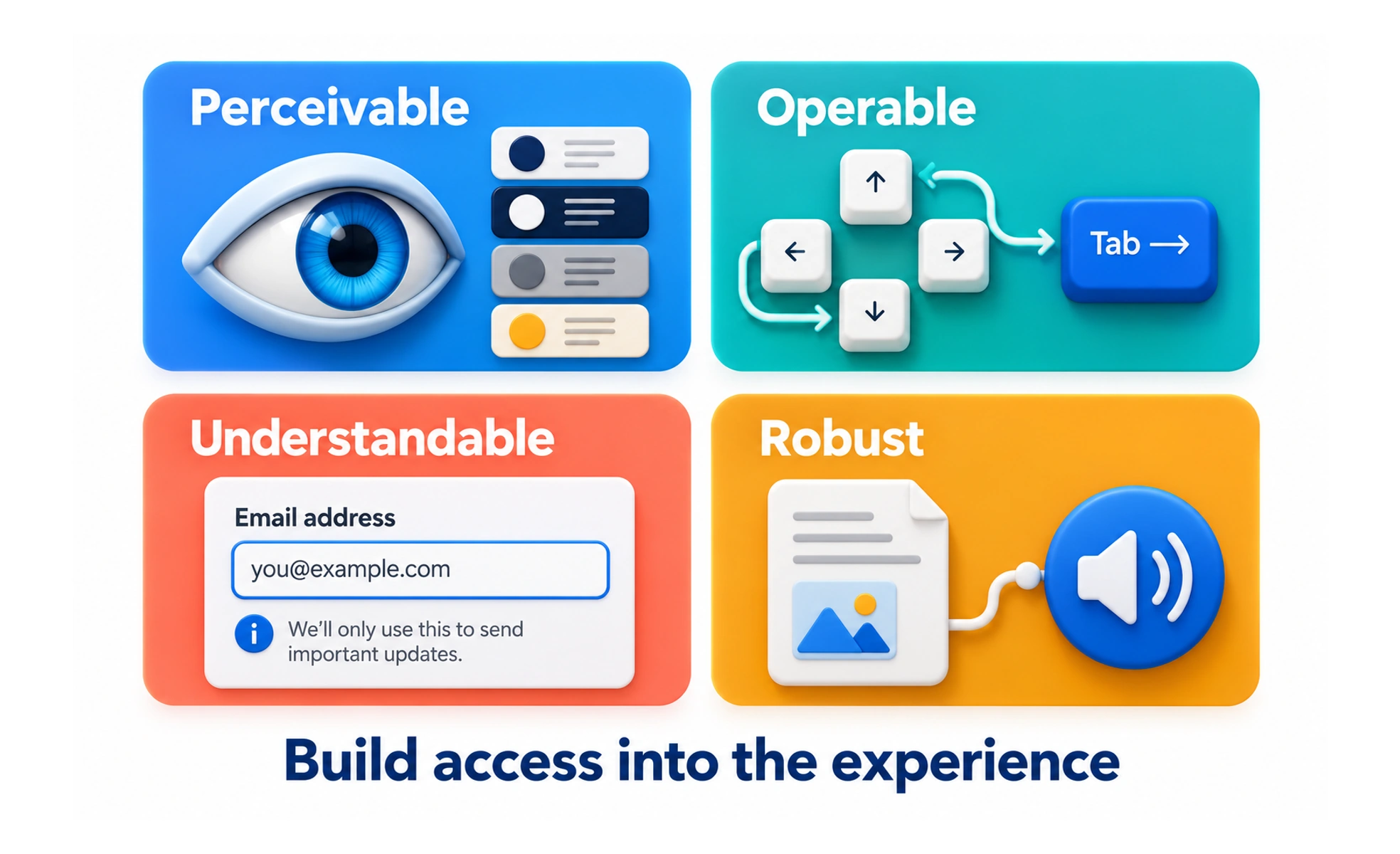
The WCAG framework organizes digital accessibility around four fundamental design principles known as POUR.
- Perceivable requires that all information and user interface components are presented in ways users can perceive.
- Operable ensures that interface navigation and controls can be operated entirely via keyboard or assistive hardware.
- Understandable mandates that text content is readable and interfaces operate in predictable, consistent manners.
- Robust demands that software code is compatible with diverse assistive tools like screen readers and braille terminals.
When to use it
Incorporate accessibility standards into design systems and code reviews from day one.
- Color palette selection ensures text meets minimum contrast ratios of 4.5:1 for normal body copy under WCAG AA.
- Form design and validation provides clear text labels, visible keyboard focus rings and programmatically linked error messages.
- Public sector and enterprise contracts requires formal Voluntary Product Accessibility Templates (VPAT) for procurement.
- Multimedia production provides accurate closed captions for audio and descriptive transcripts for video content.
Common mistakes
Teams frequently treat accessibility as a superficial checklist rather than an integrated engineering discipline.
- Relying solely on automated audit tools, which catch only thirty to forty percent of real accessibility defects.
- Removing visible keyboard focus outlines because designers think focus rings look visually unappealing.
- Writing useless alternative text like 'image' or file names instead of describing the informational meaning of graphics.
Frequently asked questions
Key takeaways
- Accessibility standards ensure people of all abilities can perceive, operate and understand software.
- The global benchmark is WCAG, structured into conformance levels A, AA and AAA.
- Most commercial products target WCAG Level AA as their standard legal and ethical benchmark.
- Accessible design improves usability for everyone, including mobile users and elderly customers.