

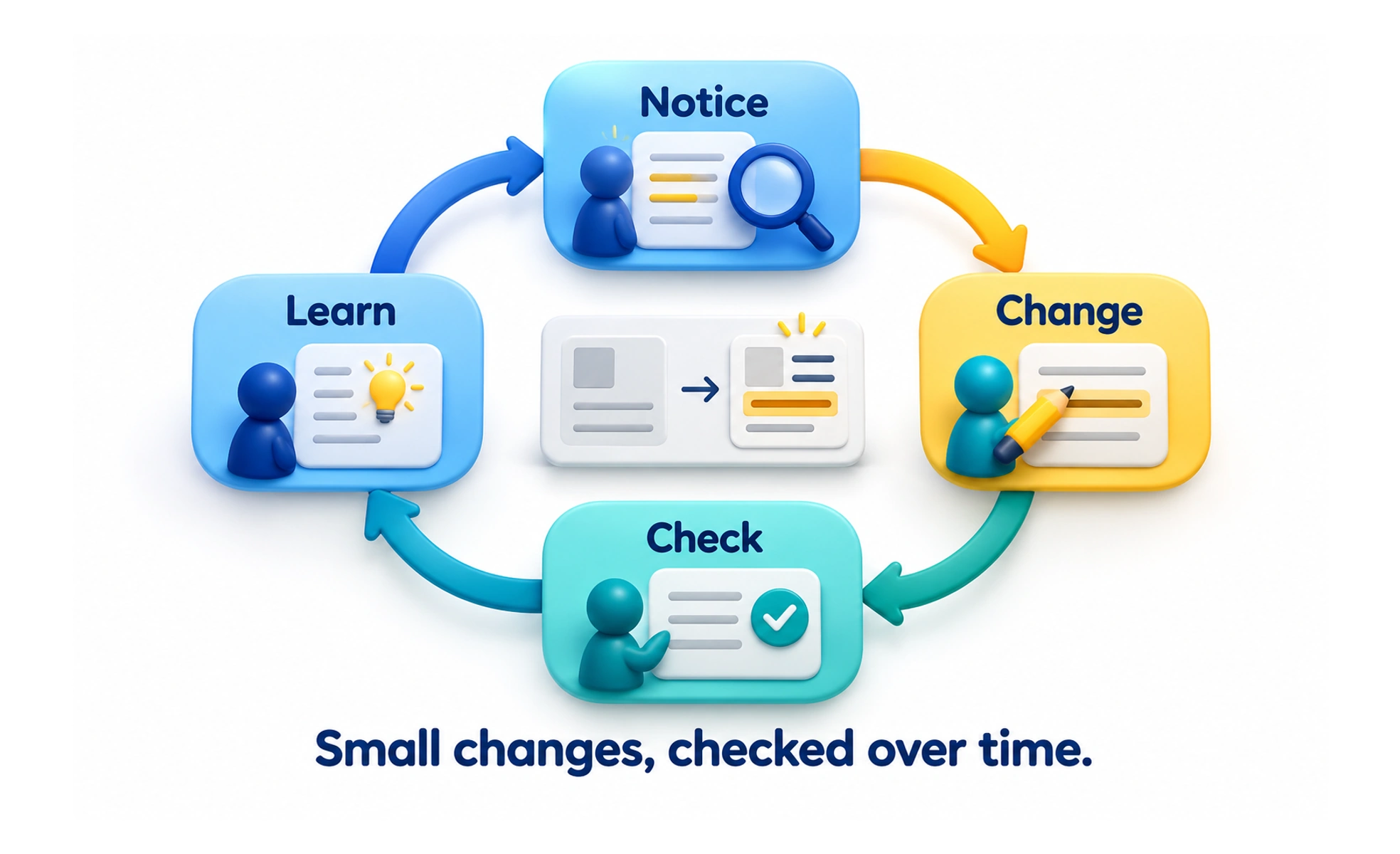
Instead of treating a launch or process change as the final answer, a team observes results, learns from feedback, and adjusts. The cycle is most useful when improvements are connected to a clear problem and evaluated with appropriate evidence.
Maintaining a garden means noticing what is growing, removing what harms it, and adjusting care over time. A team improves in a similar cycle: observe, make a considered change, and see what the system does next.
Choose a meaningful opportunity
Use user feedback, support contacts, analytics, quality reviews, and team observations to locate a problem worth addressing. State who is affected and how success would look. This keeps improvement work grounded in outcomes rather than activity for its own sake.
Make a change that can be evaluated
Small changes are easier to understand and reverse than broad bundles of unrelated work. Define a measure or observation that fits the goal, and note what else could affect it. Not every change needs an experiment, but teams should know what evidence would change their view.
Review results and unintended effects
After release, check the intended outcome and look for regressions or effects on other users. A faster flow can still create more errors; fewer clicks may not mean a clearer experience. Combine measures with qualitative evidence where appropriate.
Make learning part of normal work
Record what changed and what the team learned, then decide whether to keep, adjust, or reverse the change. Improvement should not become pressure to constantly modify stable experiences. Sometimes the evidence says to leave a feature alone.
Frequently asked questions
Key takeaways
- Start with a clear problem and a meaningful outcome.
- Prefer changes whose effects can be understood.
- Check intended results and unintended consequences.
- Use evidence to continue, adjust, reverse, or stop.