

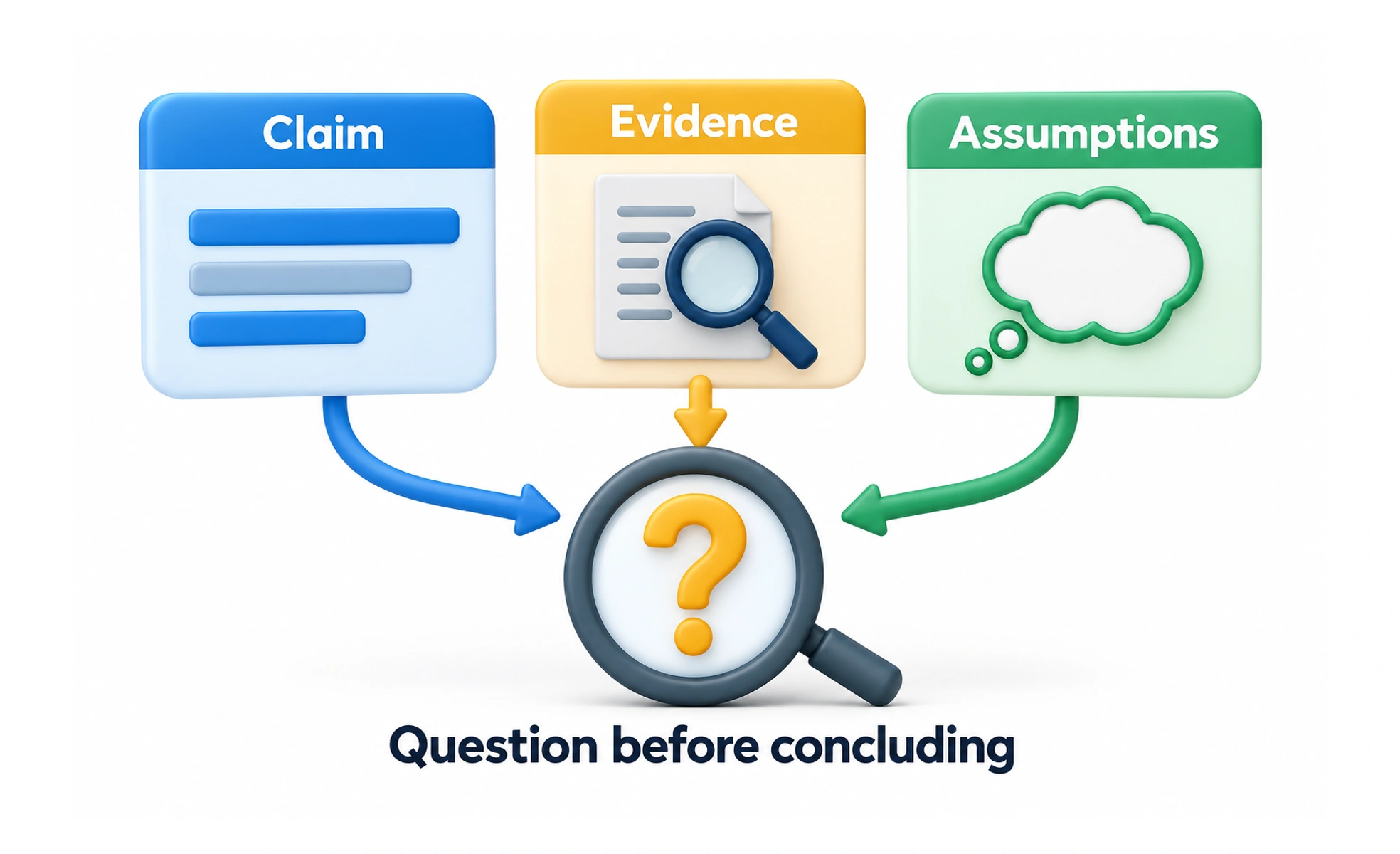
In product design, it prevents teams from building features based on cognitive bias, vanity metrics or executive whim. It tests whether customer data truly supports proposed solutions.
Think of it as a judge in a courtroom. The judge does not accept emotional assertions at face value. They demand cross-examined evidence before delivering a fair verdict.
How it works
Critical thinking examines problems systematically through disciplined analytical inquiry.
- Questioning hidden assumptions asks what beliefs must be true for a proposed solution to succeed.
- Evaluating evidence quality distinguishes between rigorous behavioral research and polite user interview feedback.
- Recognizing cognitive biases spots confirmation bias, sunk cost fallacy and availability heuristic in team debates.
- Assessing second-order consequences anticipates how a UI change might create unexpected downstream problems.
When to use it
Apply critical thinking during high-stakes design reviews, data analysis and roadmap prioritization.
- Evaluating telemetry anomalies investigates whether a conversion spike was real or caused by bot traffic.
- Interpreting research findings ensures design teams do not cherry-pick quotes that merely support preconceived ideas.
- Challenging executive feature demands politely probes the business rationale and customer evidence behind sudden requests.
- Architectural trade-off reviews weighs technical simplicity against ideal interactive polish before committing code.
Common mistakes
Practitioners often mistake cynicism or obstructionism for genuine critical thinking.
- Being chronically negative and shooting down ideas without offering alternative evidence-based solutions.
- Paralysis by analysis, demanding endless data before making decisions on reversible, low-risk changes.
- Blind trust in numbers, forgetting that quantitative analytics can measure broken metrics with mathematical precision.
Frequently asked questions
Key takeaways
- Critical thinking evaluates evidence, questions assumptions and identifies logical fallacies.
- It protects product teams from confirmation bias, executive whims and misleading vanity metrics.
- Always investigate the second-order consequences of design decisions on user behavior.
- Critical thinking is constructive and evidence-focused, not cynical or obstructionist.