

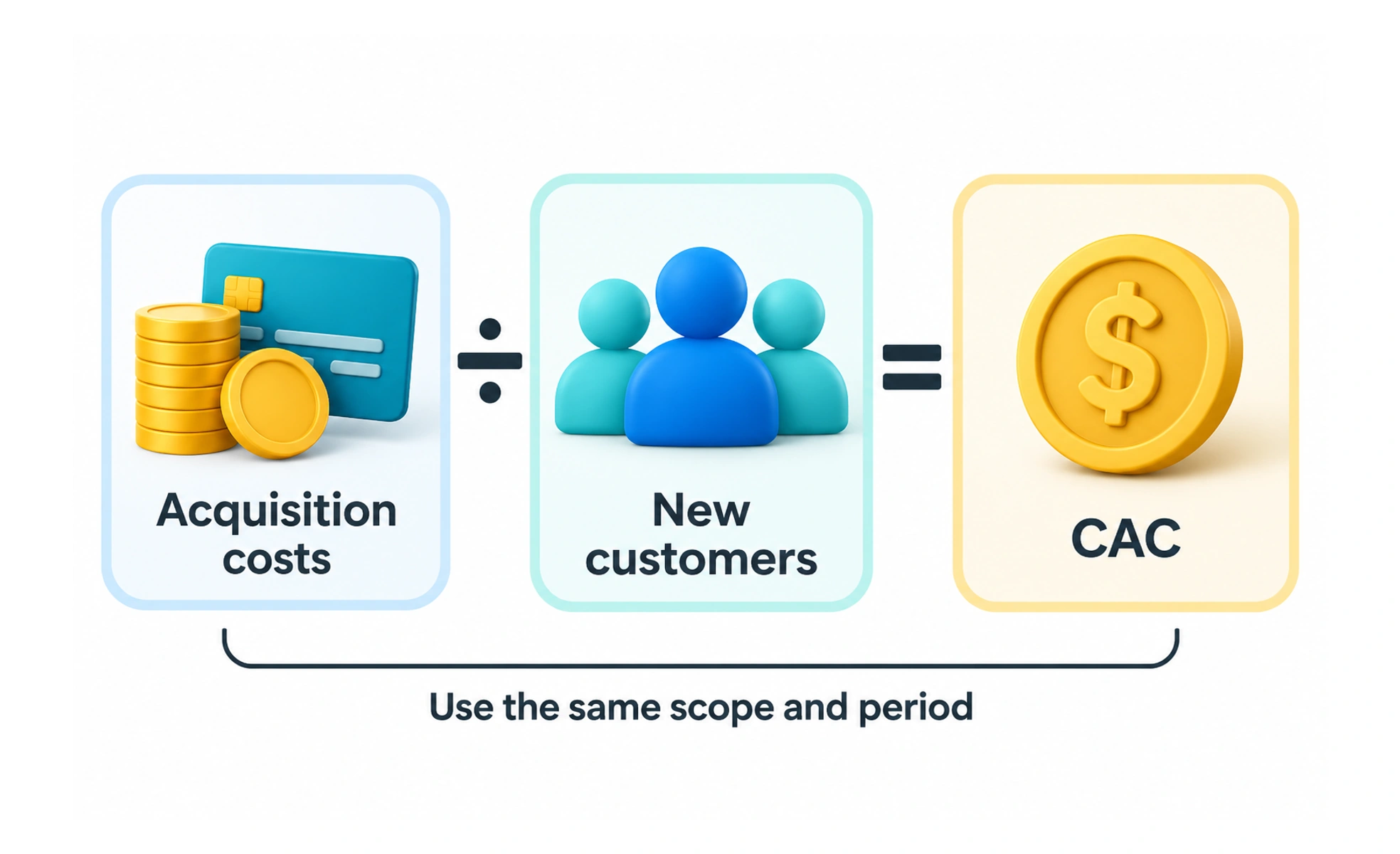
Customer acquisition cost estimates how much a business spends to gain a customer. It is commonly calculated from relevant acquisition costs divided by acquired customers, with scope and timing defined carefully.
A shop can compare the cost of a promotion with the new customers it brings, while recognizing that not every visitor or purchase can be attributed neatly to that promotion.
Define costs and customers
Specify whether the numerator includes advertising only or also sales staff, tools, agencies, and other related costs. Define the acquired customer, such as a new paying account. A cost per signup or lead is a different measure and should be labeled accordingly.
Match timing and attribution
Acquisition spending may produce customers later, especially when sales cycles are long. Choose a period or cohort approach that acknowledges that delay. Channel attribution can also be uncertain when someone sees several messages before deciding to purchase.
Compare useful segments
A blended average can hide large differences between channels, customer groups, or sales motions. Compare acquisition cost with the actual value and service costs of those groups. Avoid precise claims about return when either attribution or future customer value remains highly uncertain.
Example: a trial campaign
A campaign might generate many low-cost trials but few paying customers who remain. Track the progression from qualified interest to payment and continued value. Comparing campaign spending only with registrations could make an ineffective channel appear efficient.
Frequently asked questions
Key takeaways
- State included acquisition costs and the customer definition.
- Account for sales-cycle delays and attribution limits.
- Inspect relevant channels and cohorts.
- Evaluate acquisition alongside durable customer value.