

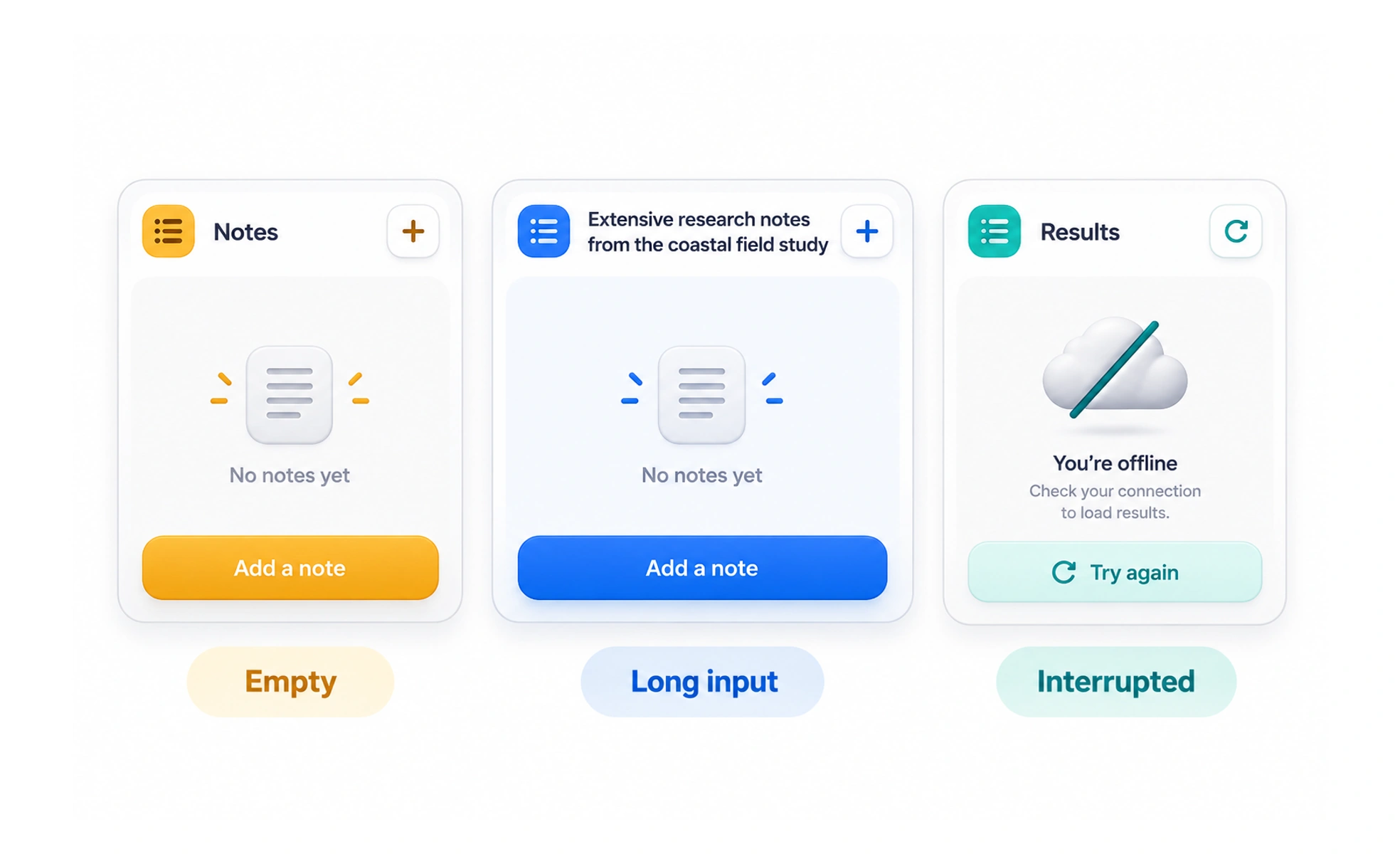
An edge case is a condition near the limits of an expected behavior or input. Examining it helps teams find assumptions that may fail outside the most familiar task flow.
A shelf may hold an ordinary box easily but behave differently when loaded near its limit. Interfaces also need attention at the boundaries of their assumptions.
Look for boundaries and transitions
Consider empty and maximum-length values, the first and last item, expired sessions, midnight, and changing permissions. State transitions can be especially revealing because the interface may still hold information from the previous state. Boundary conditions are often more useful than an arbitrary collection of unusual examples.
Avoid dismissing real people as exceptions
A long name, unfamiliar script, assistive technology, or small screen may be ordinary for the person using it. Calling a condition an edge case should not justify excluding an audience. Investigate whose needs are affected and how the condition relates to the product’s supported scope.
Prioritize by consequence
Combine evidence about frequency with the impact of failure and the cost of handling it. Rare data loss or private-information exposure can be serious enough to address immediately. Use sensible fallbacks and explicit limits where the product cannot support a condition fully.
Example: changing accounts
A delayed profile response may arrive after someone signs into a different account. If the interface accepts it, the old person’s details can appear in the new session. Checking request ownership and clearing account-specific state addresses a boundary that a fresh-page happy path would miss.
Frequently asked questions
Key takeaways
- Inspect boundaries and state transitions.
- Consider whose ordinary needs the label may hide.
- Prioritize using consequence as well as frequency.
- Provide deliberate handling or clear supported limits.