

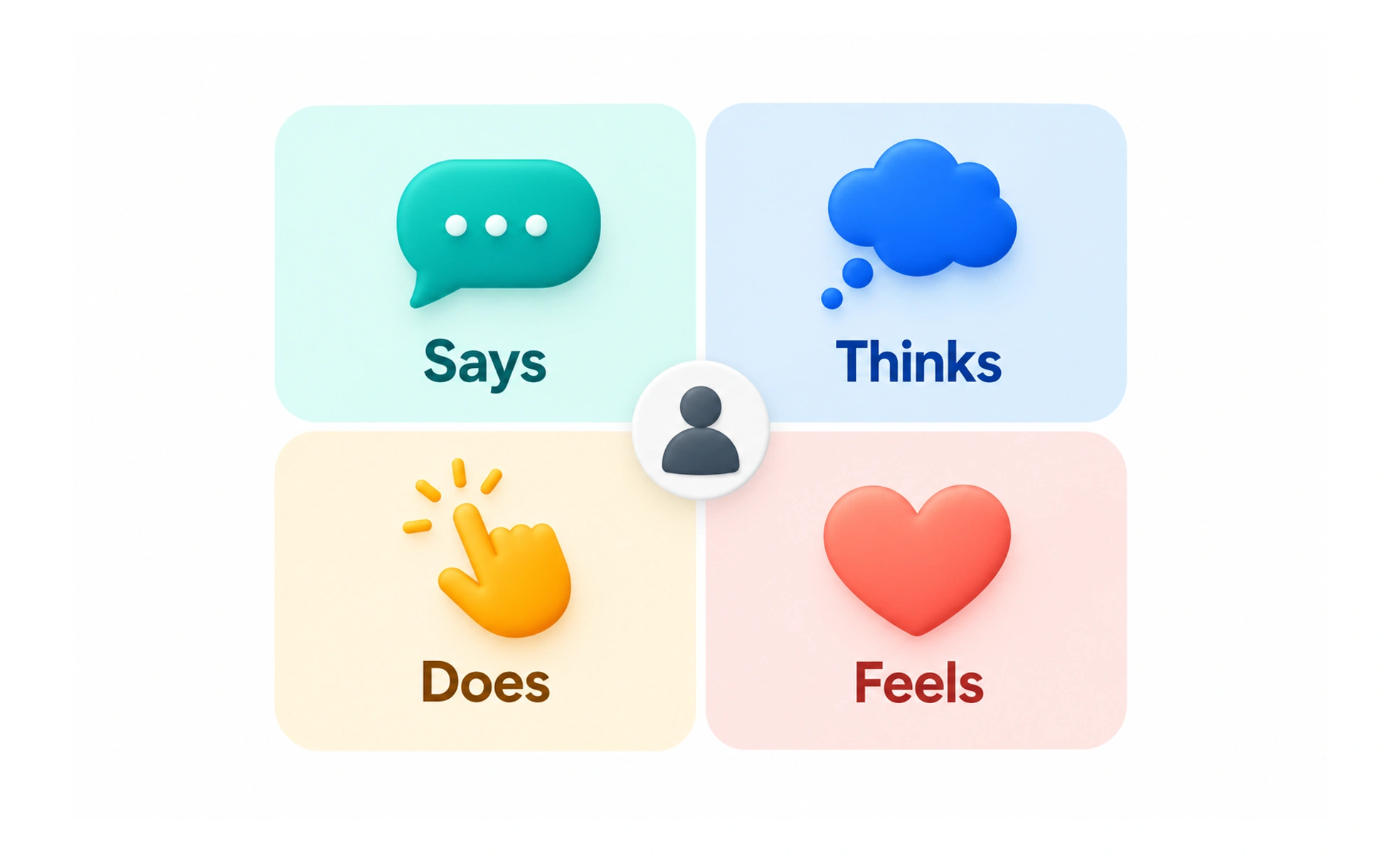
It is a shared research aid, not a personality profile or a way to read someone’s mind. A useful map makes evidence and uncertainty easier to discuss. An attractive map filled with invented emotions can instead make assumptions look established.
Define whose experience you are mapping
Choose a person or a clearly described group and a relevant situation. “Customers” is usually too broad. “First-time customers arranging an evening pickup” provides a useful boundary.
Keep different experiences separate when combining them would hide important needs. The person collecting an order and the person paying for it may have different concerns.
Organize evidence without inventing it
A common layout separates what a person says, thinks, does and feels. Use actual quotations for speech and observations for actions. Thoughts and emotions need a clear basis, such as the participant’s own explanation.
Mark a team interpretation as an interpretation. If an area is empty, record the question you need to investigate instead of filling it with a convincing guess.
Example: arranging an evening pickup
A participant says they cannot leave work early, checks several pickup times and asks whether someone else may collect the order. The map brings these details together.
The team identifies an unanswered question about collection by another person. It can investigate that need and review the policy. Writing “impatient customer” would add a judgment without explaining the actual constraint.
Use the map to guide learning
Discuss what the map changes about the next decision.
- Link entries to their research source.
- Separate observation from inference.
- Keep meaningful differences between participants.
- Update the map when new evidence arrives.
An empathy map is not normally a timeline. Use a journey map when the order of activities and changes across time are the main question.
Frequently asked questions
Key takeaways
- Bound the map to a person or relevant group and situation.
- Distinguish quotations, observations and interpretations.
- Leave unknowns visible rather than inventing feelings.
- Use the map to identify questions and decisions.