

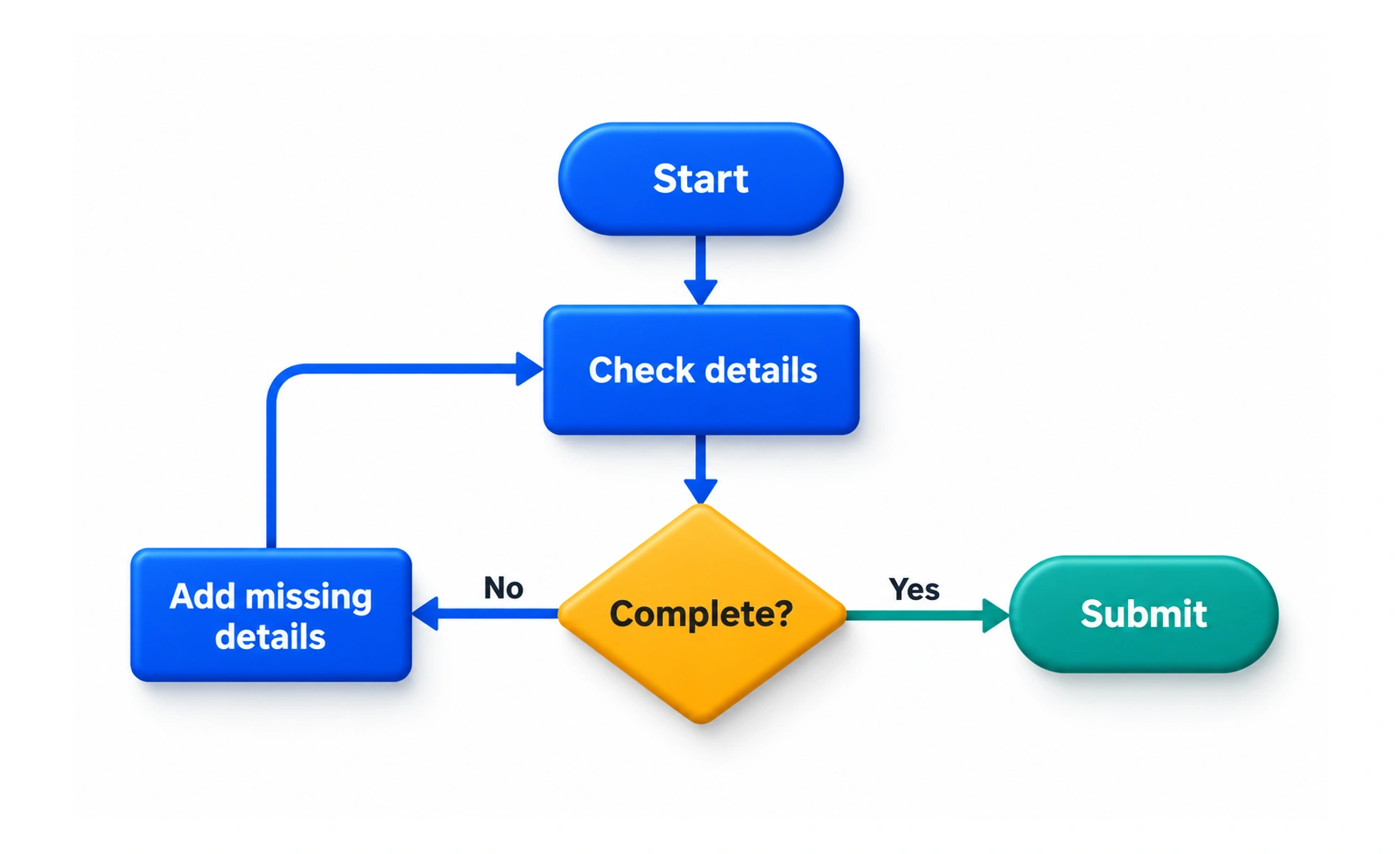
Teams use flowcharts to make a process visible before building or changing it. A useful diagram shows where a flow begins and ends, what choices affect the route, and where people or systems hand work to one another. It should clarify complexity, not reproduce it without explanation.
A flowchart is like a set of directions with forks in the road: each arrow shows where to go next based on what happens.
Choose a question the diagram will answer
A flowchart can map a customer task, a service process, or system logic. Define its audience and scope first. If it tries to describe every exception across an organization, it may become too dense to help anyone make a decision.
Use shapes consistently
Common conventions use rounded shapes for start or finish, rectangles for actions, diamonds for decisions, and arrows for direction. A team may adapt these conventions, but explain the legend and use each shape consistently so readers do not have to guess what it means.
Make branches and handoffs explicit
Label decision branches with concrete outcomes such as yes and no, or with the condition that selects each route. Show who or what owns a step when a handoff matters. Include meaningful error and recovery routes rather than drawing only the ideal journey.
Keep the diagram readable
Arrange steps in a predictable direction, reduce crossing lines, and break a large process into linked views. Provide a title, context, and date or version when the diagram guides implementation. Review it with people who perform the process to catch missing steps.
Frequently asked questions
Key takeaways
- Define the audience, scope, and question before drawing.
- Use a clear, consistent visual language for steps and decisions.
- Label branches and include important error or recovery paths.
- Validate the map with people who know the real process.