

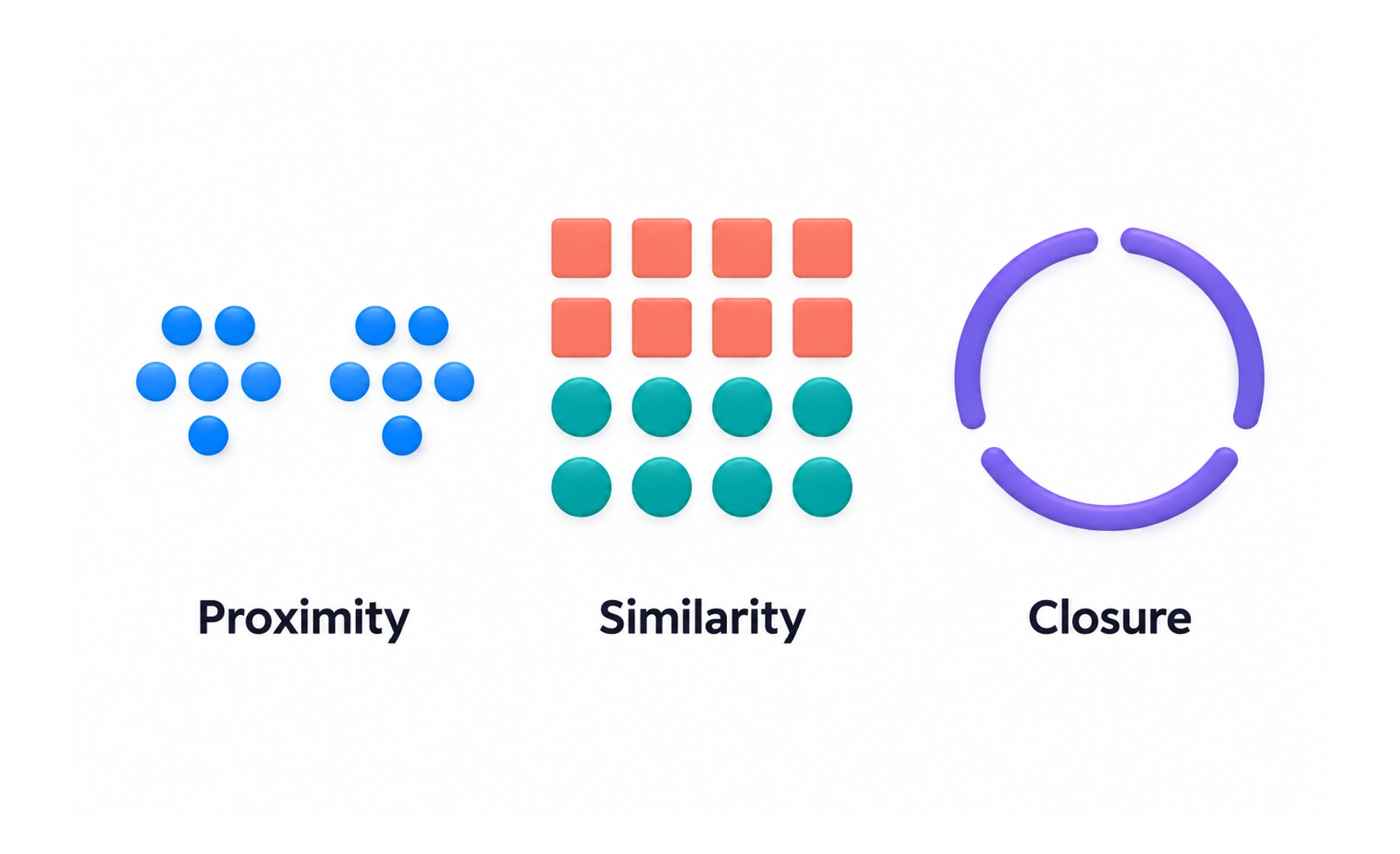
Originating in early twentieth-century German psychology, the core insight is that the whole is different from the sum of its parts. Key principles include proximity, similarity, continuity, closure, and common region.
Think of it like this. When looking at a constellation, your brain connects isolated stars into the shape of a bear, even though they are just scattered dots in space.
How it works
Proximity groups nearby items together. Similarity groups items with matching colors or shapes. Common region groups items inside a shared border card. Closure completes missing visual outlines automatically.
When to use it
Apply Gestalt rules to structure form fields, design dashboard card groups, create scannable table layouts, and align button toolbars.
Common mistakes
Placing form labels closer to the previous input field than to the field they describe, which violates proximity and confuses users.
Frequently asked questions
Key takeaways
- Human brains automatically group visual elements based on spatial and visual patterns.
- Proximity and common region are the strongest tools to organize layout without clutter.
- Consistent styling signals shared functionality to users instantly.