

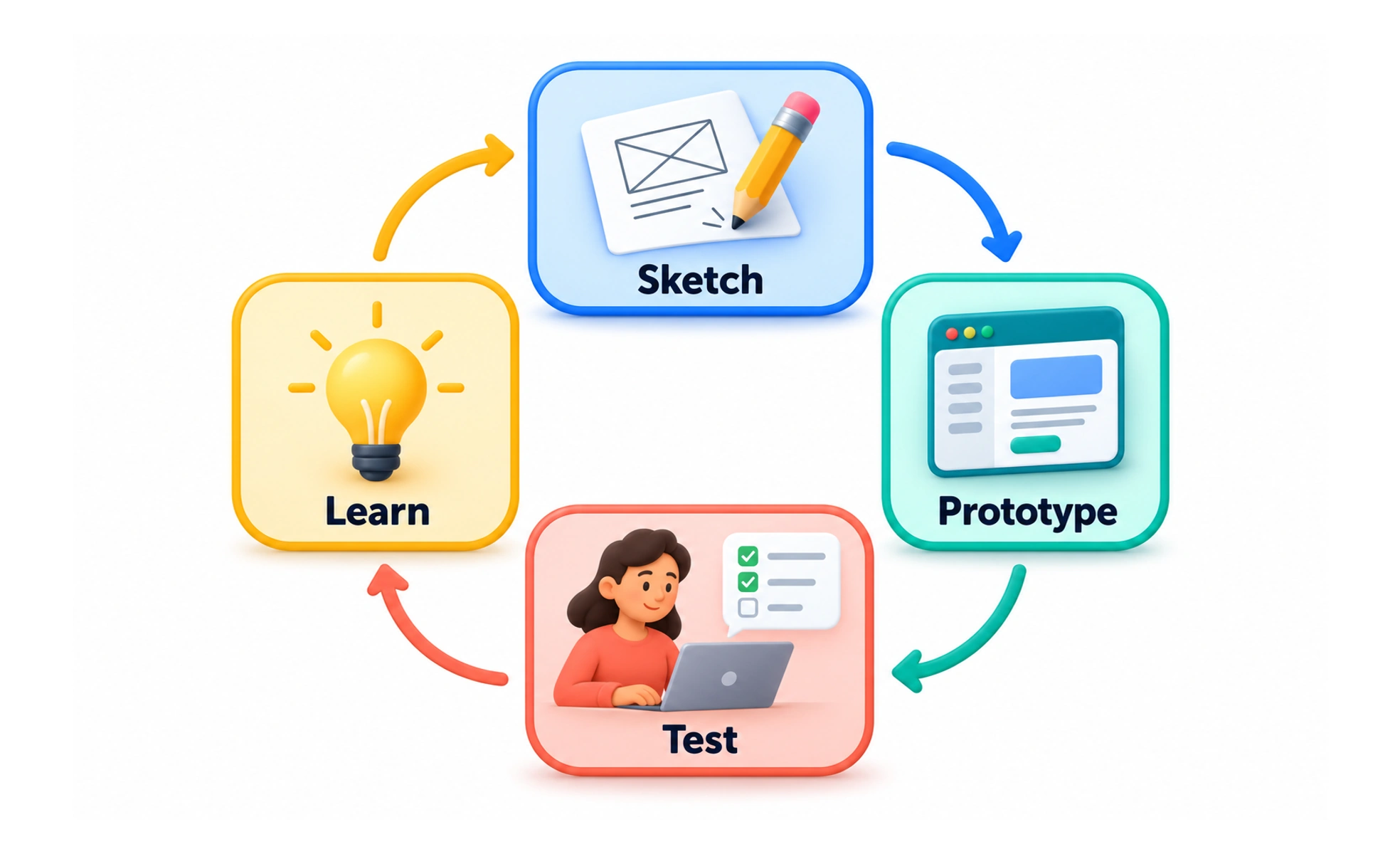
Rather than attempting to build perfection on the first pass, teams release small increments and gather user feedback. Each cycle reduces design uncertainty and uncovers unexpected usability insights.
Think of it as a sculptor carving a statue from raw stone. The artist first chips away rough outlines, then carves main features and finally polishes fine surface textures over many passes.
How it works
The iterative design loop operates as a repeating four-stage evolutionary cycle.
- Hypothesis formulation defines the core problem assumption and articulates what behavioral change is expected.
- Rapid artifact creation builds the minimum necessary prototype or code change to evaluate the hypothesis.
- Empirical usability testing observes real users attempting realistic tasks with the interactive prototype.
- Insight synthesis and adjustment evaluates task success rates and modifies the interface based on observed friction.
When to use it
Apply iterative loops throughout every phase of the digital product lifecycle.
- Early concept exploration sketches dozens of diverse UI wireframes to uncover non-obvious solution paths.
- Complex checkout optimization tests incremental form refinements to systematically reduce funnel drop-off rates.
- Design system component creation refines button states and accessibility contrast ratios across multiple sprint cycles.
- Post-launch conversion tuning leverages A/B experiments to continuously polish onboarding flows and copy clarity.
Common mistakes
Teams often misunderstand iteration by mistaking random churn for deliberate learning.
- Iterating without user feedback, changing UI layouts based solely on internal stakeholder opinions.
- Abandoning prototypes too early, discarding promising conceptual directions after a single minor test stumble.
- Failing to define measurable success criteria, making it impossible to judge whether an iteration improved usability.
Frequently asked questions
Key takeaways
- Iteration improves digital products through continuous cycles of designing, testing and refining.
- Each cycle reduces risk by replacing subjective team opinions with objective user behavior data.
- Start with low-fidelity prototypes to iterate rapidly before committing expensive engineering time.
- Define clear success metrics before launching an iteration to evaluate genuine progress.