

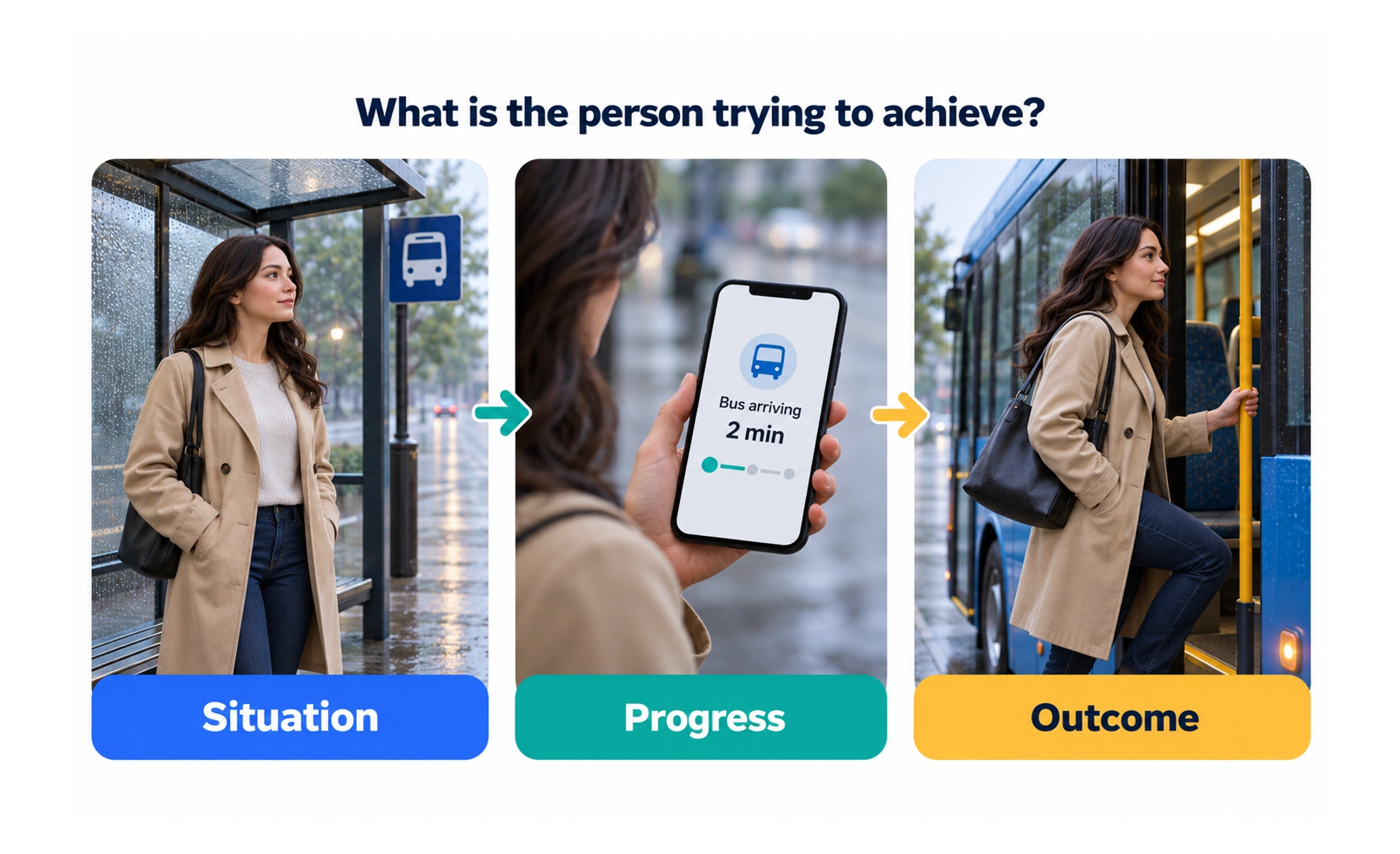
Often abbreviated JTBD, the framework shifts research from a person’s demographic label or requested feature toward the reason they seek a solution. A job can involve practical, emotional, and social needs. Understanding the situation helps teams compare alternatives and design for the underlying outcome.
People do not hire a drill because they want a drill; they need a way to make a hole in a particular situation. The useful question is what progress they are seeking.
Describe the situation and progress
A job is not simply a task written as a feature request. Explore what was happening, what triggered the search for help, and what a person hoped would be different. The context can explain why the same person chooses different solutions at different times.
Look beyond a product category
People may use a service, a workaround, advice, or no solution at all to make progress. Interviewing about real past behavior can reveal these alternatives. Ask what made the person act and what trade-offs they considered instead of asking only what feature they want.
Include functional and emotional outcomes
A practical outcome may be finishing a task faster, while emotional or social outcomes concern confidence, stress, or how someone is perceived. These dimensions can shape adoption. Do not assume one outcome matters to everyone; look for patterns and meaningful differences.
Turn evidence into product choices
Use observed jobs to identify unmet needs, compare alternatives, and frame opportunities. A job statement is a research synthesis, not proof that a market is large or that a particular feature will work. Validate demand and test solutions with the people and situations involved.
Frequently asked questions
Key takeaways
- JTBD asks what progress a person seeks in a specific situation.
- Study past behavior, triggers, alternatives, and trade-offs.
- Consider functional, emotional, and social outcomes.
- Treat job statements as evidence-based framing, then validate solutions.