

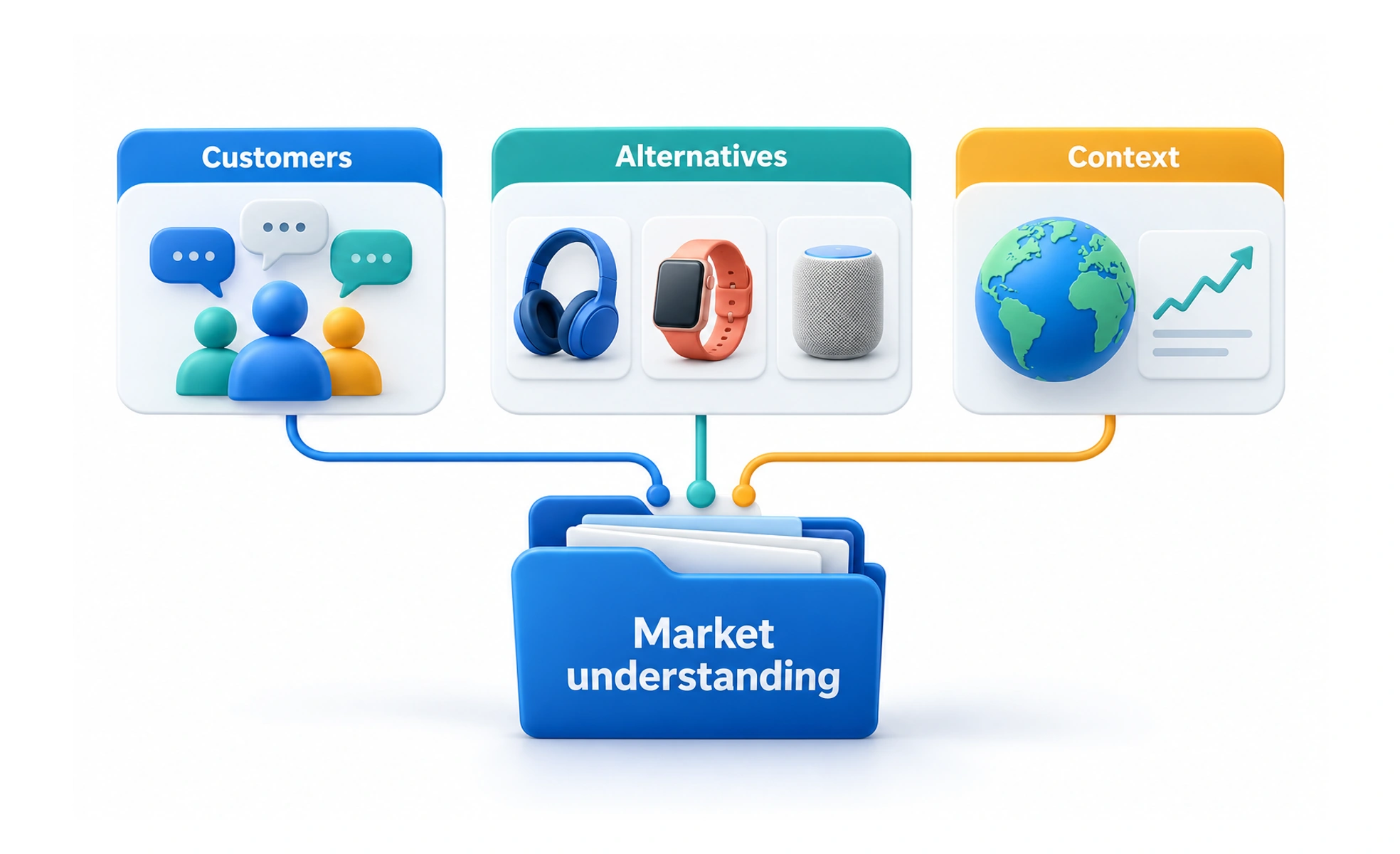
It examines market size, pricing trends, customer demographics and competitive positioning. This ensures teams build products that have viable commercial demand.
Think of it like this. Before opening a bakery on a high street, you check how many people walk past, how many bakeries already exist, and what neighbours are willing to pay for bread.
How it works
Market research gathers both primary and secondary data to understand commercial landscapes and customer demand patterns.
- Primary research gathers original proprietary data through tailored buyer surveys, focus groups and executive stakeholder interviews.
- Secondary research analyzes published market reports, industry benchmarking papers, financial filings and public census datasets.
- Competitor analysis audits rival feature sets, pricing models, go-to-market messaging and verified market share estimates.
- Market segmentation divides the total audience into distinct groups based on company size, budget, geography and procurement habits.
When to use it
Market research is essential whenever high-stakes business bets and long-term capital investments are being evaluated.
- New market entry evaluates whether total addressable demand and purchasing willingness justify building entirely new product lines.
- Product pricing decisions determine what subscription models and price tiers customers perceive as fair value versus prohibitive cost.
- Positioning changes uncover underserved market niches that entrenched enterprise competitors routinely ignore or overcharge.
- Investor presentations require credible third-party market data to demonstrate growth potential and market opportunity.
Trade-offs
Market research guides broad commercial viability, but cannot replace user experience research.
- Focuses on buyers over end users, which risks optimizing for purchase decisions rather than day-to-day software usability.
- Historical orientation relies on past sales data, which can miss disruptive new interaction patterns and technical paradigm shifts.
- High cost and time can slow down nimble product teams if over-relied upon for small interface decisions and daily iterations.
Frequently asked questions
Key takeaways
- Market research verifies whether commercial demand exists before building features.
- It combines primary surveys with secondary industry analysis and competitor audits.
- Market research evaluates buyers, while UX research evaluates how end users interact.
- Sound product decisions require both market viability and product usability.