

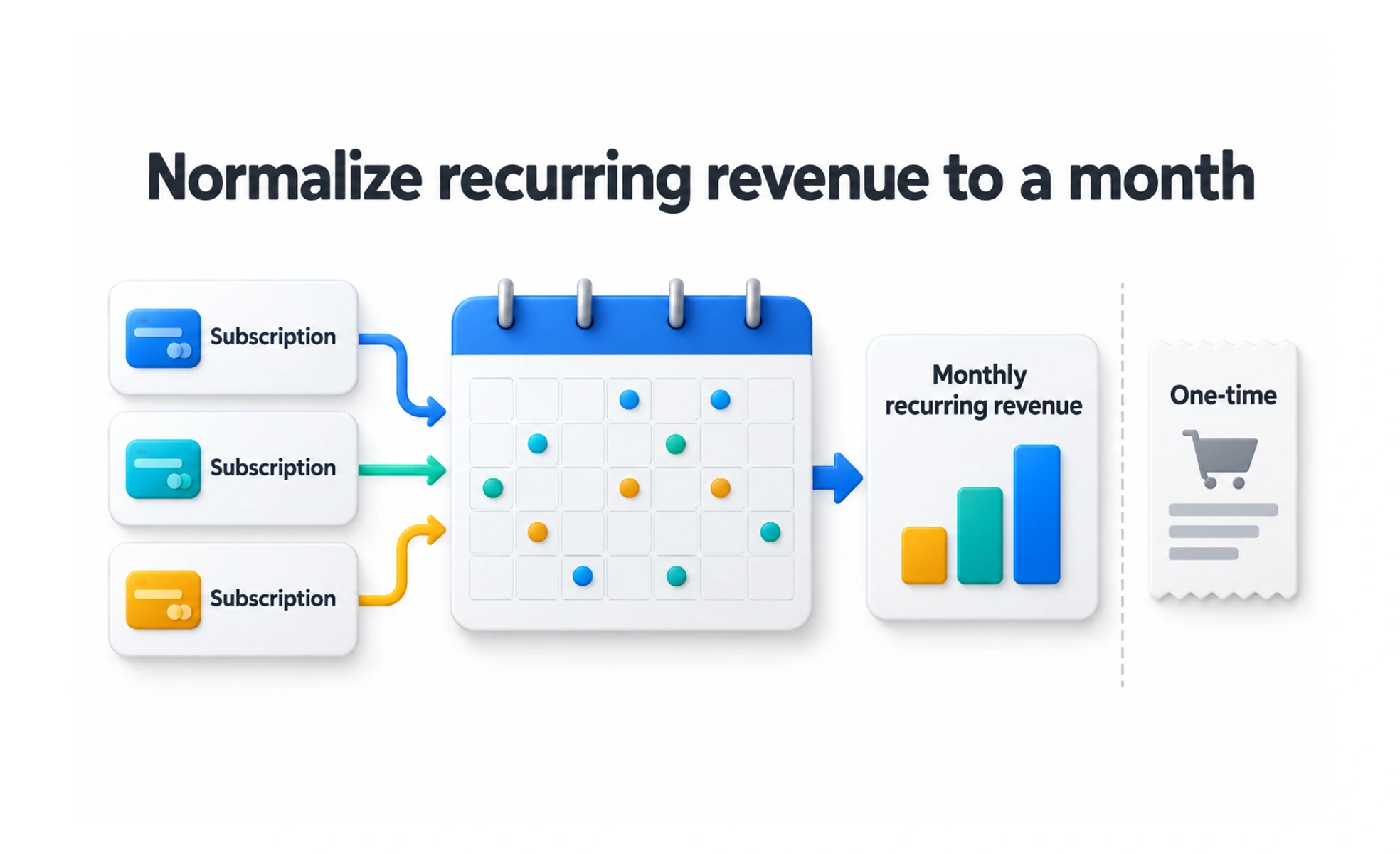
Monthly recurring revenue is a normalized monthly measure of recurring subscription revenue at a defined time. It helps teams understand the ongoing subscription base while keeping one-time revenue separate.
A household can express an annual membership cost as a monthly equivalent. That comparison is useful even though the payment may happen once a year.
Normalize billing periods consistently
Convert recurring plans to a monthly basis under documented rules. An annual recurring charge may be divided across twelve months for this measure. Identify how discounts, trials, taxes, and variable charges are handled so the result has a stable meaning.
Separate recurring value from payments
An annual payment can arrive in one month while contributing a monthly equivalent to MRR. The measure therefore differs from monthly cash receipts and accounting revenue. Keep these concepts clearly labeled in dashboards and discussions so people do not interpret one as another.
Track the drivers of change
New subscriptions and upgrades can increase MRR, while cancellations and downgrades can reduce it. Show those movements alongside the total. Investigate billing-data changes or duplicate subscriptions before treating an unexplained increase as product growth.
Example: comparing two months
A subscription product may gain new customers while existing customers downgrade. The net total can rise despite a problem in the existing base. A movement breakdown and customer research provide more useful context than celebrating the headline percentage alone.
Frequently asked questions
Key takeaways
- Normalize recurring plans using documented rules.
- Keep MRR separate from cash and accounting revenue.
- Inspect new, expansion, contraction, and churn movements.
- Validate billing data before interpreting growth.