

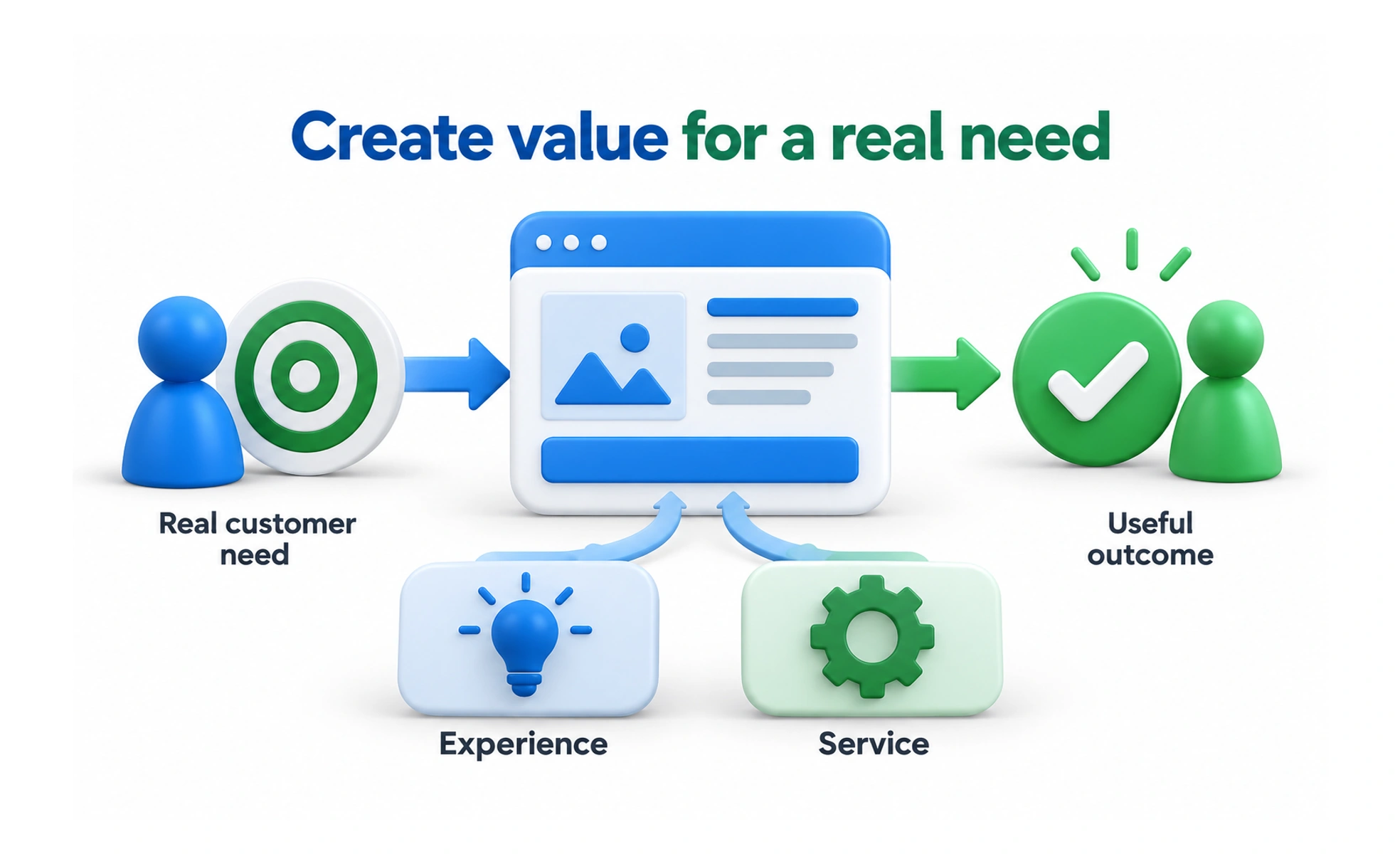
A product is an offering created to meet a need or help a particular group achieve an outcome. It may include software, services, physical goods, support, and the operations that make the experience possible.
A public transit pass is more than a card: it depends on routes, vehicles, payment, information, and support. A product is often a similarly connected experience.
Define the product around an outcome
Describe who it serves, what they are trying to accomplish, and what value the offering provides. A feature is one capability within a product, not necessarily the product itself. Starting from outcomes helps teams avoid measuring success only by the number of screens or features delivered.
Consider the whole service
People experience the interface alongside onboarding, policies, customer support, billing, reliability, and other operational elements. A breakdown outside the screen can still prevent the intended outcome. Map the relevant service so teams understand what must work together.
Balance value with feasibility and responsibility
A product needs a reason for people to choose it and a way for the organization to deliver it sustainably. Consider technical constraints, cost, accessibility, privacy, and unintended effects. A need can be real while a proposed solution remains unsafe, unaffordable, or impractical.
Learn throughout the product lifecycle
Products evolve as people, competitors, technology, and organizational priorities change. Use research and operational signals to decide what to improve, maintain, or retire. State the product’s scope and assumptions clearly because the word “product” can refer to very different offerings in different fields.
Frequently asked questions
Key takeaways
- Define a product by the need and outcome it serves.
- Include services and operations around the interface.
- Balance user value, delivery feasibility, and responsibility.
- Revisit scope and decisions as evidence changes.