

Discovery is the learning side of product work the phase where teams figure out what to build and why before they build it. It asks "what problem are we solving and for whom" rather than "how do we implement this."
Think of it like this. A chef does not decide on the menu by guessing what guests want. They taste the ingredients, talk to customers, learn what sold well last season, and adjust the dish after a trial run. Discovery is tasting and adjusting before plating , building the wrong dish perfectly is still the wrong dish.
How it works
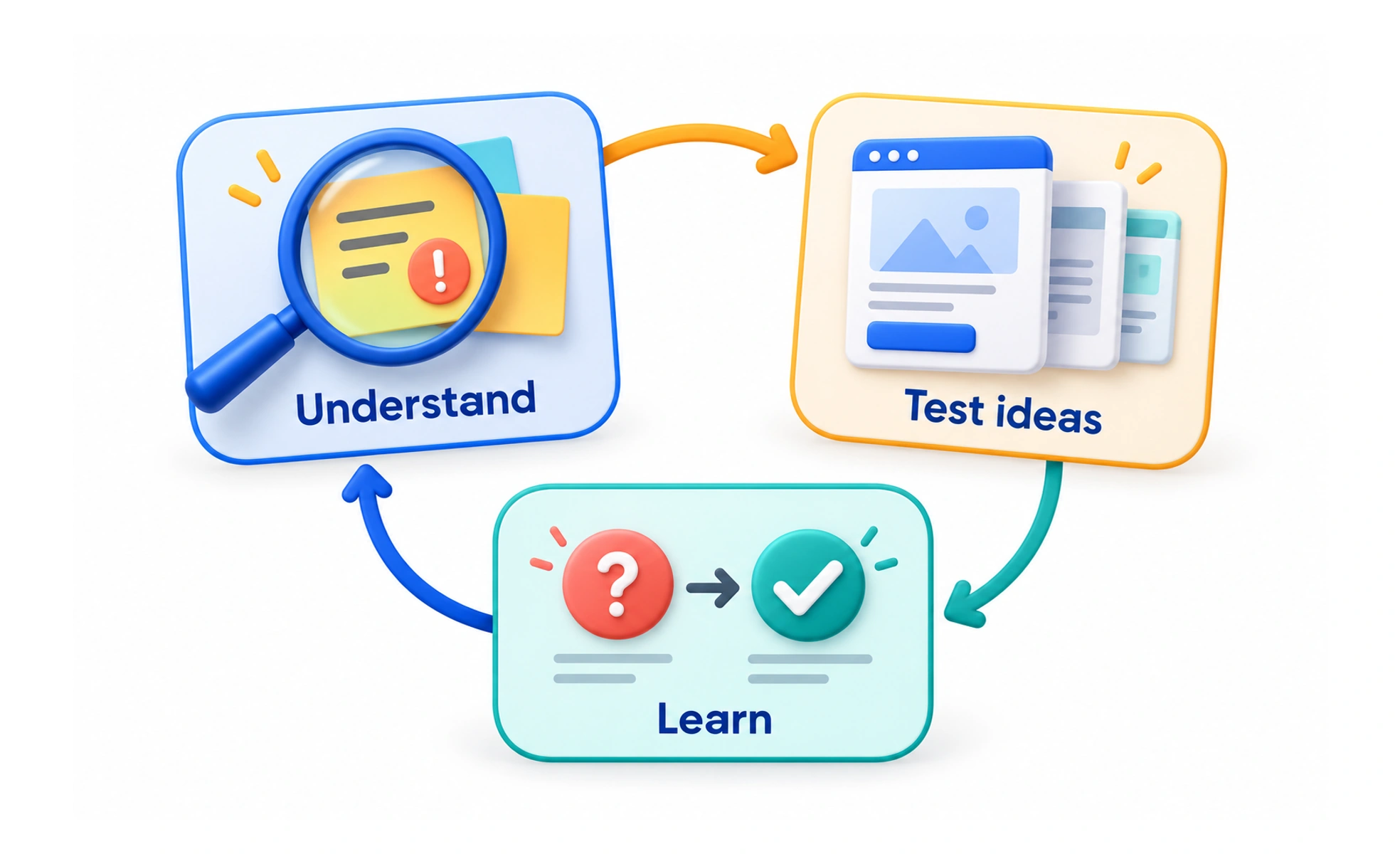
Discovery works as a loop, not a straight line. It starts with understanding the problem , talking to users, looking at data, reading support tickets, noticing where people struggle. From that evidence, the team frames opportunities: specific, testable ways the product could be better. Next comes solution exploration. The team sketches, prototypes, and tests ideas cheaply before committing to build. Lightweight experiments , fake door tests, clickable prototypes, small A/B tests , surface whether an idea resonates before engineering spends weeks on it. Finally, the team decides. Ideas that pass the evidence get marked for delivery. Ideas that fail get killed or iterated. Nothing moves forward on opinion alone. The loop continues after launch too: real usage is the strongest discovery signal, and it feeds the next round of questions.
When to use it
Discovery earns its place whenever a decision is uncertain and expensive to reverse. Early in a project, it identifies which problems are real and which assumptions are dangerous. Mid-project, it checks whether a proposed solution actually makes sense to the people it is for. After launch, it measures whether the thing shipped helped, and surfaces the next unsolved problem. Discovery is not worth doing when the answer is already known, when the cost of simply building and measuring is lower than the cost of studying first, or when the study exists only to justify a decision that was made upstream. In those cases, build and learn is cheaper than research and hope.
Common mistakes
The most expensive discovery mistake is skipping it entirely , building from assumptions and paying for the wrong thing. A close second is confirmation bias: designing tests that only prove the team was right, rather than genuinely trying to learn. Discovery theatre is another trap , running interviews, holding workshops, and collecting research without ever making a decision or changing direction based on what was found. Testing only at the end, after the build is mostly done, makes findings expensive to act on. And vague problem framing , exploring solutions without a clear statement of the problem , produces scattered results that cannot inform a real decision.
Frequently asked questions
Key takeaways
- Discovery is the ongoing practice of learning what to build before building it , not a one-time phase.
- Build the wrong thing perfectly is still the wrong thing. Discovery reduces that risk.
- Evidence beats opinion: user contact, data, and testing decide what moves from discovery to delivery.
- Discovery and delivery are partners, not phases: learning continues after launch and feeds the next round.