

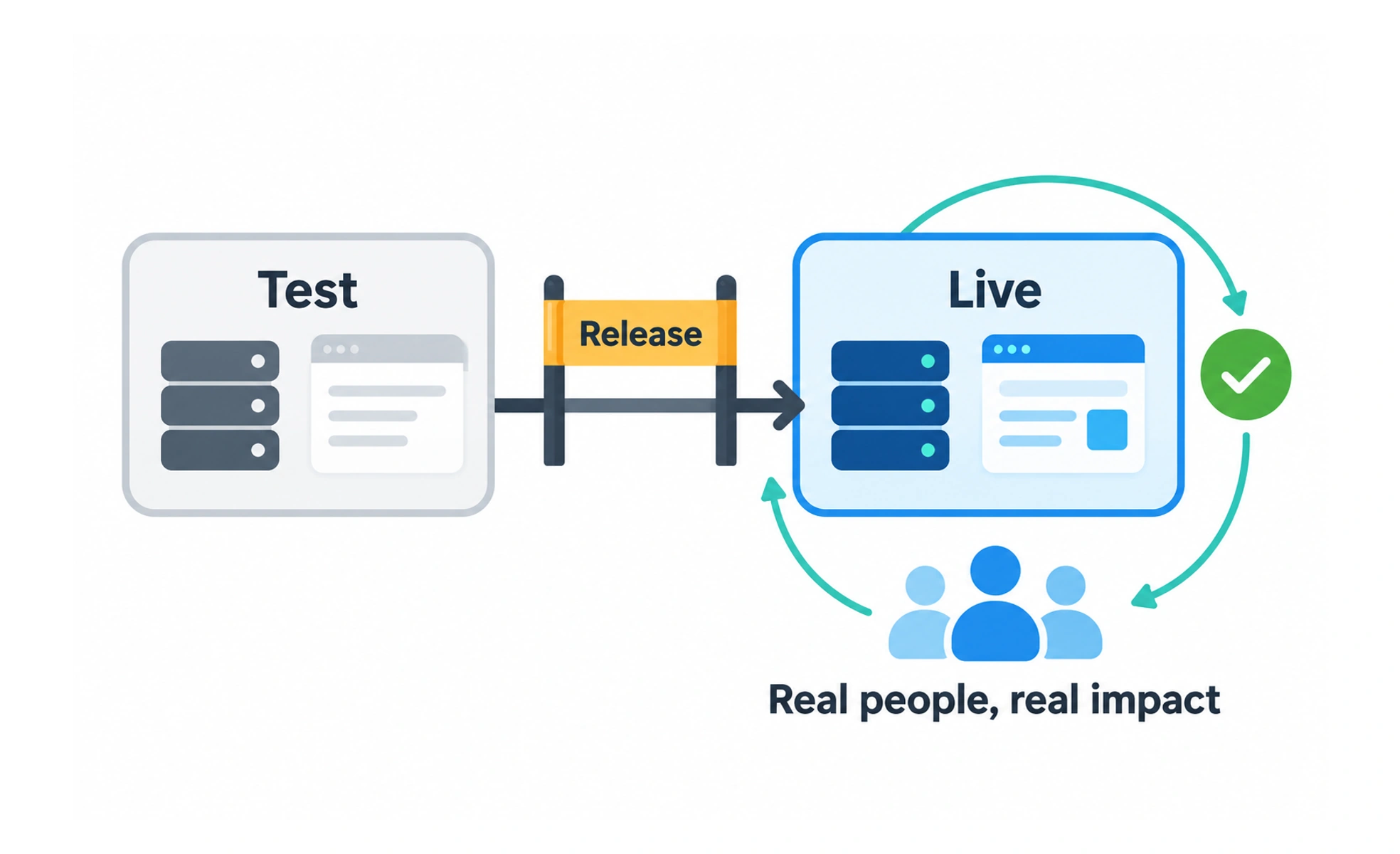
Production is the live environment where a service is used for real tasks and stores real operational data. Changes there affect people beyond the development team and need dependable release and recovery practices.
A restaurant kitchen serving customers has different consequences from a practice kitchen. Both use similar tools, but live service needs reliable operation and careful changes.
Identify the actual environment
Confirm which service, database, storage, and configuration a process uses. A local application can still connect to live data, so a localhost address does not guarantee isolation. Give environments clear identities and avoid assuming that a familiar filename or dashboard label proves where an operation will run.
Prepare changes for live use
Verify the intended behavior, relevant data changes, permissions, and compatibility before release. Define how deployment will proceed and how problems can be detected. A successful build provides useful evidence but does not prove that the live authentication, database, or external service configuration is correct.
Operate and recover responsibly
Monitor errors and meaningful outcomes, keep appropriate backups, and assign responsibility for incidents. Plan recovery for code and data effects separately. Reverting a screen does not automatically reverse messages already sent, records already changed, or files already removed.
Example: publishing glossary articles
A content import should preview its target and changes, preserve existing relationships, and produce a recovery record. After publication, verify stored content and user-facing reads. These steps make a live editorial change reviewable without confusing content publication with a separate application deployment.
Frequently asked questions
Key takeaways
- Confirm the real targets behind an environment.
- Verify configuration and data behavior alongside code.
- Observe meaningful live outcomes.
- Plan recovery for persistent and external effects.