

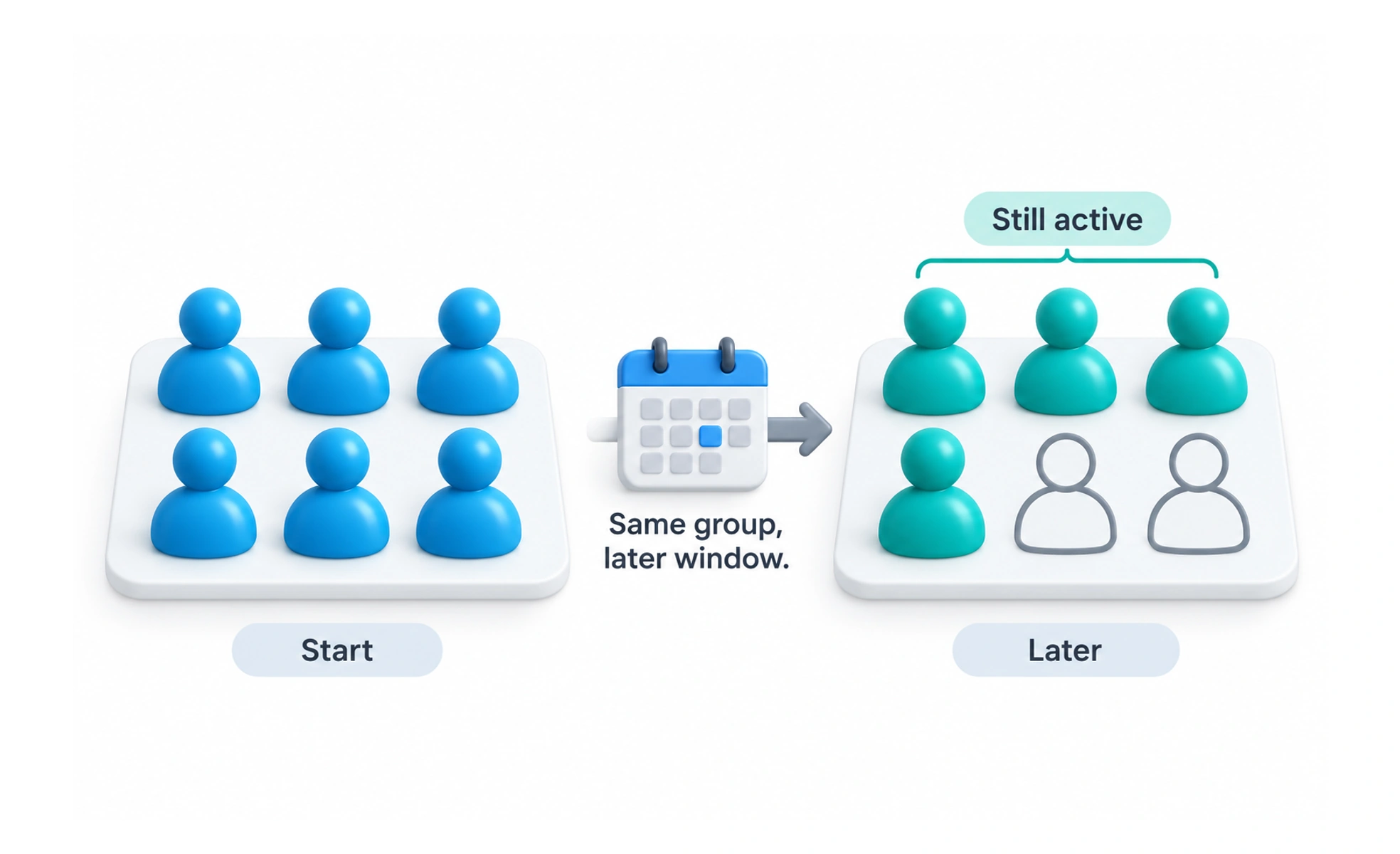
Retention rate measures the share of a defined group that remains a customer or returns to a meaningful activity over time. The activity and observation window should match the product’s purpose.
A class can track how many people from its first session attend later sessions. Keeping the starting group clear makes the pattern understandable.
Define what retained means
Subscription retention, account retention, and behavioral retention are different measures. Specify the event or state and the time window. Logging in may be an insufficient signal if the product promises useful work that happens after login.
Follow a consistent cohort
Choose a shared starting event and compare later activity for that group. Divide retained members by the original eligible cohort for the defined calculation. Explain whether the measure requires activity on a specific day, within a period, or at any later point, because those methods produce different results.
Match the natural usage cycle
A tax tool, weekly planning service, and daily messaging app have different reasons for return. Choose windows that reflect the real need instead of forcing every product into daily use. Recent cohorts also need enough observation time before their retention can be fairly compared.
Example: continued learning
A learning product can track whether people who completed a first lesson complete another useful activity in a later week. Compare content needs and acquisition sources, then investigate why people stop. A reminder may help some learners, while others need more relevant material or a clearer path.
Frequently asked questions
Key takeaways
- Define the retained state or meaningful return event.
- Keep cohort and time-window rules explicit.
- Use the product’s natural usage rhythm.
- Combine behavior with research about continuing value.