

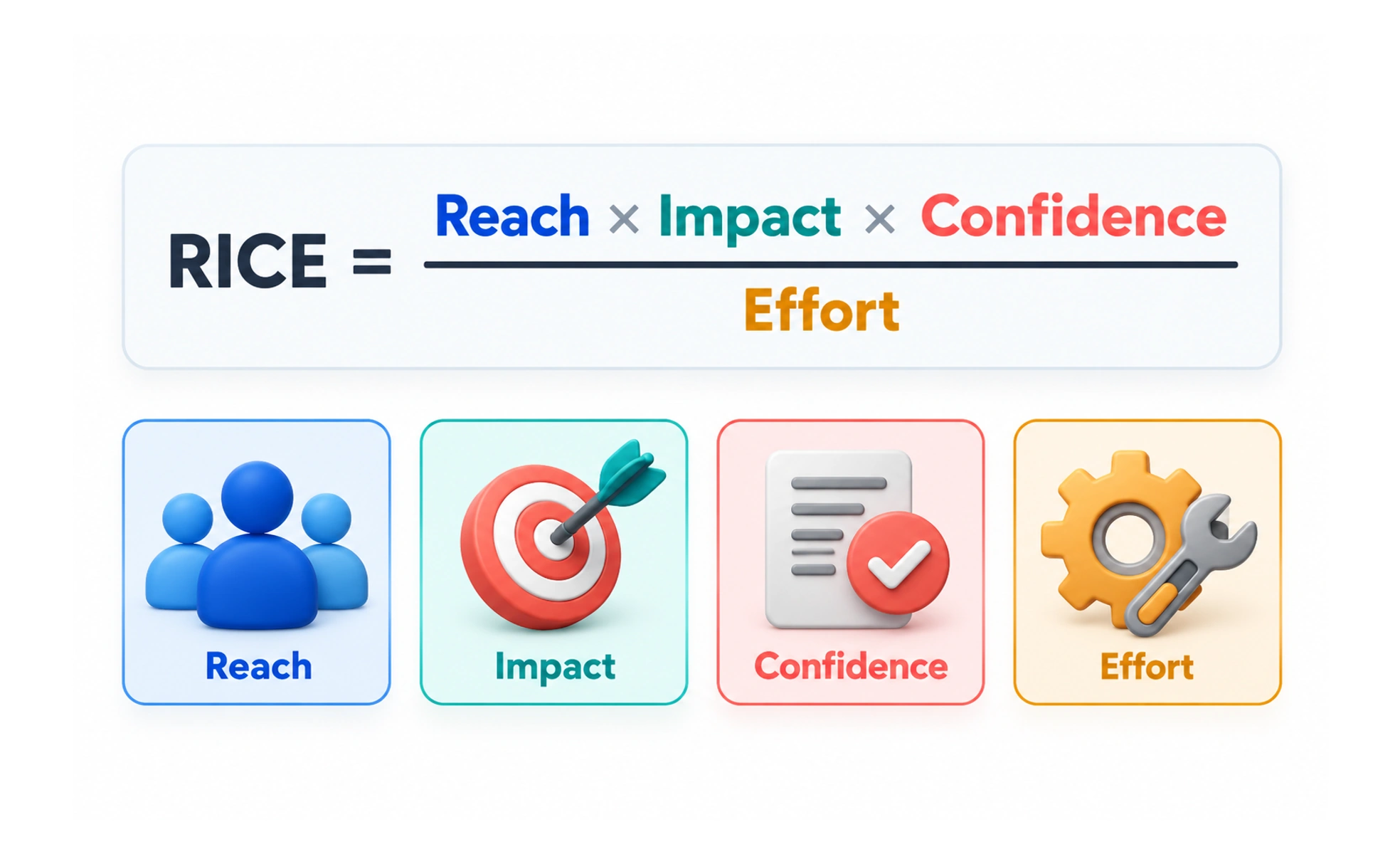
RICE is a prioritization model that compares ideas using reach, impact, confidence, and effort. It makes the assumptions behind an estimate visible so a team can discuss relative priorities.
Comparing repair jobs involves how many people benefit, how much the repair helps, how certain the estimate is, and the work required. RICE organizes a similar comparison for product ideas.
Use comparable inputs
Reach estimates how many people or events an idea affects within a defined period. Impact estimates the benefit per affected person against a chosen goal. Confidence reflects the evidence supporting the estimates. Effort represents the total work required, using a consistent unit across the options.
Calculate a relative score
The score is reach multiplied by impact and confidence, divided by effort. Express confidence consistently, such as a decimal, and use the same time horizon and impact scale for each idea. The result is a comparison aid; its apparent precision is limited by the quality of the inputs.
Document uncertainty and constraints
Record where estimates came from and which assumptions could change the order. Review large score differences and test sensitivity to uncertain values. Dependencies, essential maintenance, and commitments may require a different sequence even when one idea has a higher score.
Example: improving saved lessons
A team can compare a clearer save control with a saved-content search improvement. Estimate how many learners encounter each problem in the same period, how much the change might help, and the work involved. If impact is mostly a guess, lower confidence and gather evidence before treating the ranking as decisive.
Frequently asked questions
Key takeaways
- Use consistent definitions and a shared time horizon.
- Calculate reach × impact × confidence ÷ effort.
- Record evidence and uncertainty behind estimates.
- Use the score alongside judgment and dependencies.