

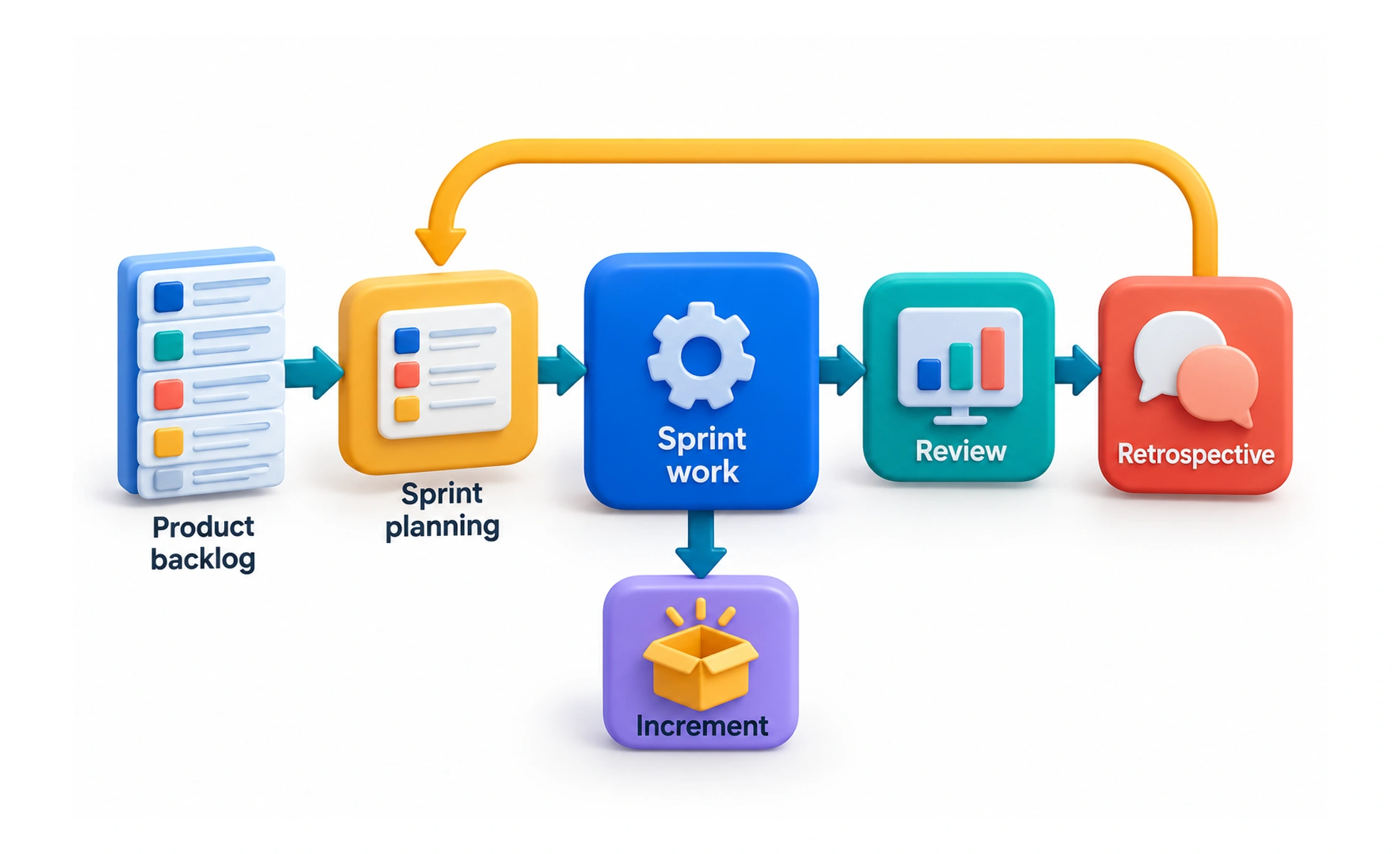
It organizes cross-functional teams around distinct roles, daily standups and sprint retrospectives. Scrum emphasizes continuous inspection and rapid adaptation to deliver working increments.
Think of it as a relay racing team that runs short, timed laps. After every lap, the runners gather briefly to review baton handoffs, adjust pacing and plan the next lap together.
How it works
Scrum structures product delivery into repeating two-week or four-week development cycles.
- Sprint planning sessions define the team goal and select high-priority backlog stories for the upcoming sprint.
- Daily standup syncs keep teammates aligned by reviewing yesterday progress, today commitments and active blockers.
- Sprint reviews and demos showcase working software increments directly to business stakeholders for feedback.
- Sprint retrospectives provide dedicated time for the team to reflect on collaboration and improve internal processes.
When to use it
Deploy Scrum when building complex digital products with evolving requirements and cross-functional teams.
- Fast-moving product squads need predictable delivery rhythms to coordinate engineers, designers and product managers.
- Uncertain technical environments benefit from frequent testing and incremental releases rather than big-bang launches.
- User experience integration aligns design discovery tracks one sprint ahead of technical engineering execution.
- Continuous feedback loops allow teams to adjust product direction based on real customer feedback every two weeks.
Common mistakes
Teams frequently misapply Scrum by following rigid rituals while ignoring authentic Agile principles.
- Treating Scrum as micromanagement, using daily standups as status interrogations rather than peer alignment.
- Ignoring technical debt and design polish to meet arbitrary sprint velocity targets set by project managers.
- Excluding UX designers from sprint ceremonies, isolating discovery research from the engineering development loop.
Frequently asked questions
Key takeaways
- Scrum organizes software delivery into time-boxed sprints typically lasting two to four weeks.
- Core ceremonies include sprint planning, daily standups, sprint reviews and retrospectives.
- Cross-functional teams commit to delivering working software increments at the end of every cycle.
- Integrate UX discovery alongside delivery sprints to prevent building features users do not want.