

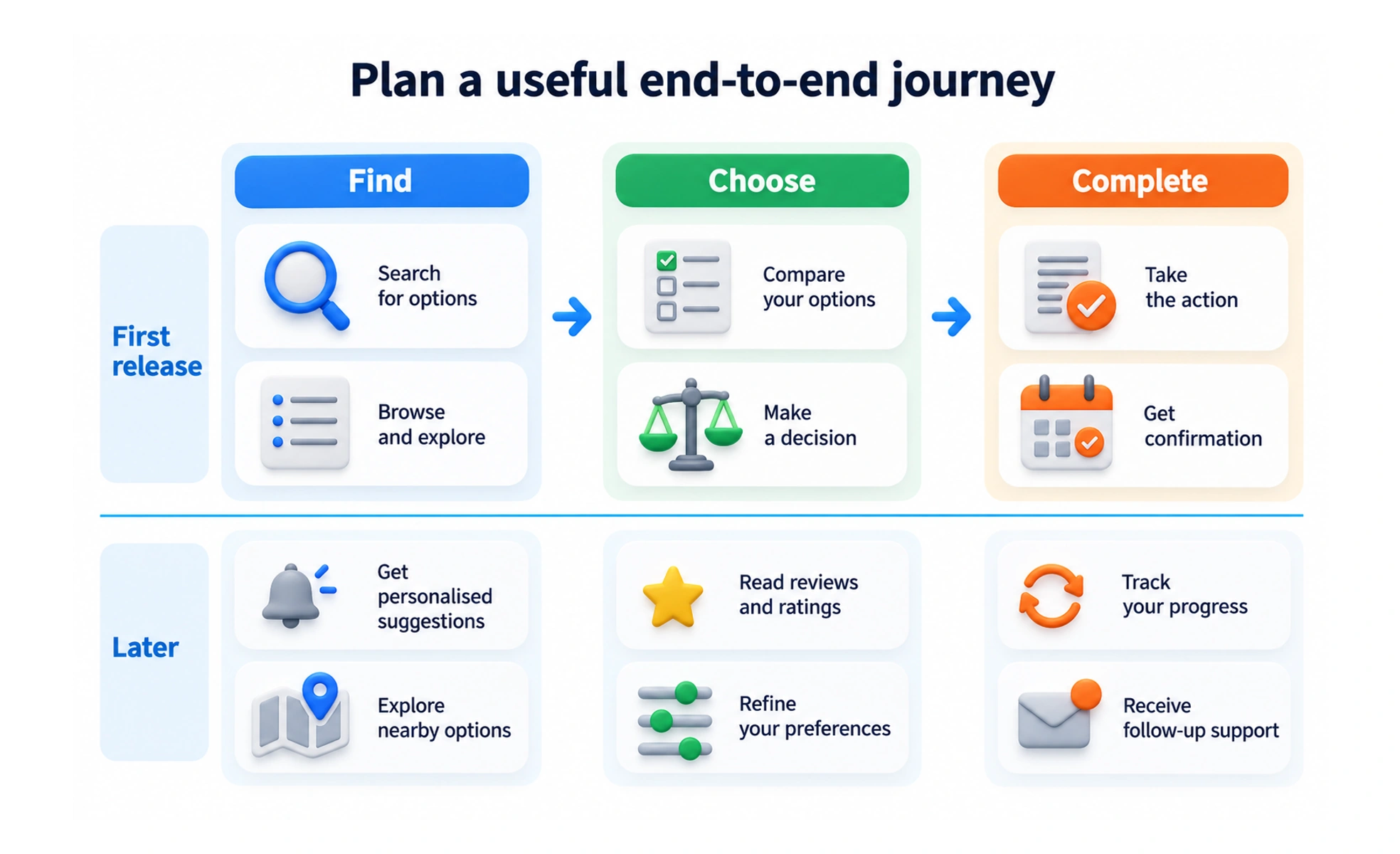
A story map lays out the user journey from left to right and groups related tasks beneath each activity. It helps a team discuss what must work together and decide which slice can deliver a complete, useful outcome.
A travel itinerary shows the journey’s major stops and the actions needed at each one. A story map provides a similar shared view of the steps people take with a product.
Map the user’s activities
Start with the person and goal, then describe the major activities in sequence. Keep the map focused on a real journey rather than on the organization’s internal departments. Research and existing product behavior can help the team make the sequence realistic.
Break activities into tasks
Under each activity, add the tasks and decisions people need to complete. These details show where a workflow has gaps, repeated steps, or unclear transitions. The map should use language the team can discuss and validate.
Plan a coherent release slice
A release slice should let someone achieve a meaningful outcome across the journey, even if it supports fewer cases. Prioritize by user value, risk, dependencies, and learning. Avoid delivering a collection of disconnected fragments simply because they are easy to build.
Keep the map open to change
A story map is a planning aid, not a promise that every task will ship. Update it when research or delivery changes the team’s understanding. Use it to make trade-offs visible and to identify assumptions that need further investigation.
Frequently asked questions
Key takeaways
- Organize the map around a user goal and sequence of activities.
- Use tasks to expose workflow gaps and dependencies.
- Plan a coherent outcome rather than disconnected feature fragments.
- Revise the map as evidence and constraints change.