

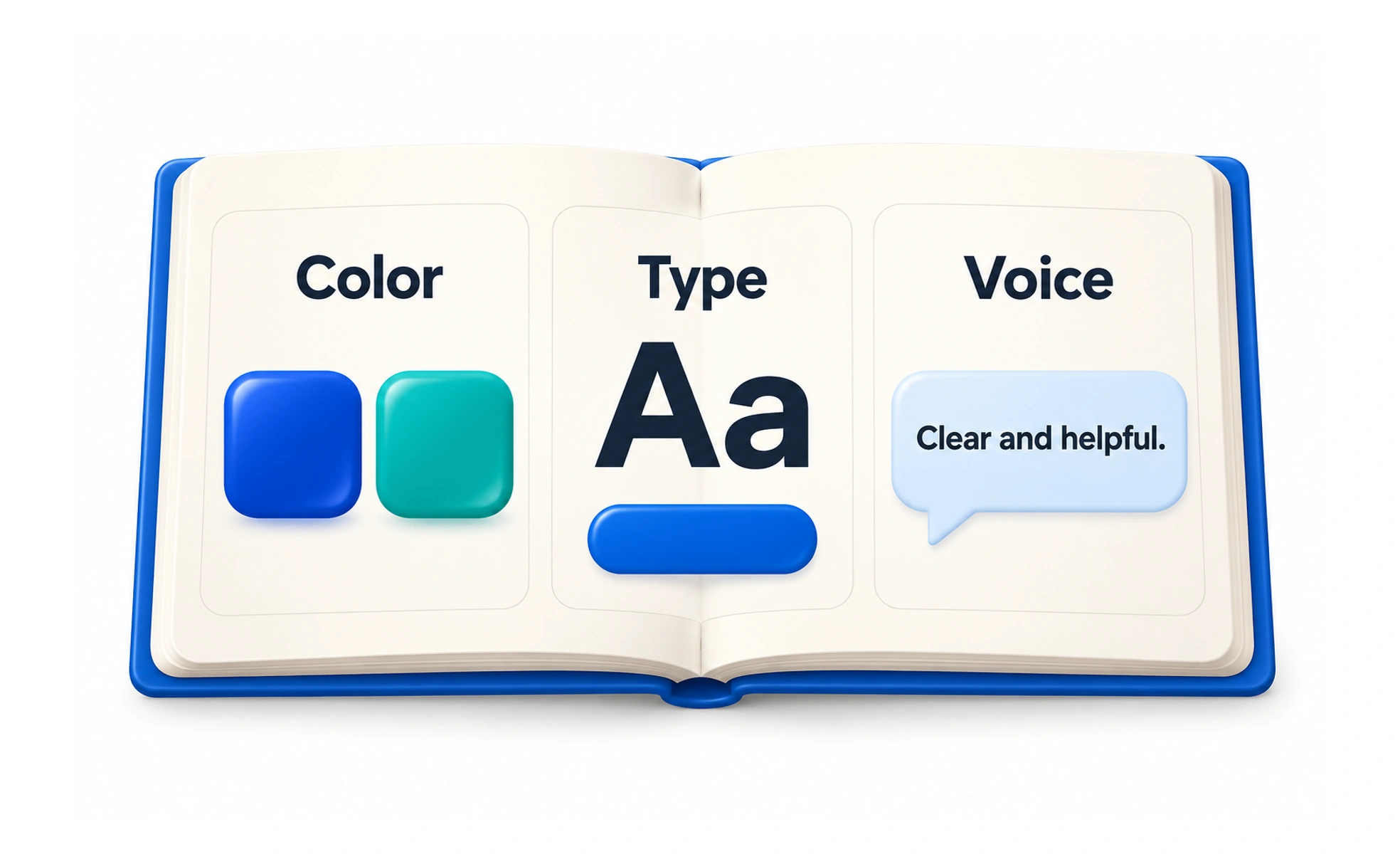
A style guide documents visual and language choices that help a product or organization communicate consistently. It explains the intended use of styles so teams can apply them across real situations.
A shared recipe explains ingredients and methods, not just a photograph of a finished dish. A useful style guide likewise describes how and why a design choice should be used.
Document reusable decisions
Include the foundations and patterns that teams repeatedly need, such as typography, color, spacing, imagery, voice, and component use. Show examples that make correct and incorrect applications clear. Keep guidance connected to product goals and accessibility requirements rather than presenting taste as an unexplained rule.
Make guidance practical
Explain names, values, context, and implementation details where they help teams use the system. Offer examples for common states and screen sizes. Guidance should support a decision in the moment, not require people to study a long document before they can perform a routine task.
Maintain the guide with the product
Identify owners, version history, and a way to propose changes. When a pattern changes, note migration needs and affected components. A guide that is disconnected from the code or design source can become stale, so teams should know which artifact is authoritative for each kind of decision.
Distinguish the guide from the system
A style guide explains standards and examples. A design system may also include coded components, tokens, governance, contribution processes, and product-specific implementation. The guide can be one part of a design system, but publishing a document alone does not create a maintained system.
Frequently asked questions
Key takeaways
- Explain reusable visual and language choices.
- Use practical examples and accessible guidance.
- Keep ownership and change history clear.
- Treat a style guide as one possible part of a broader design system.