

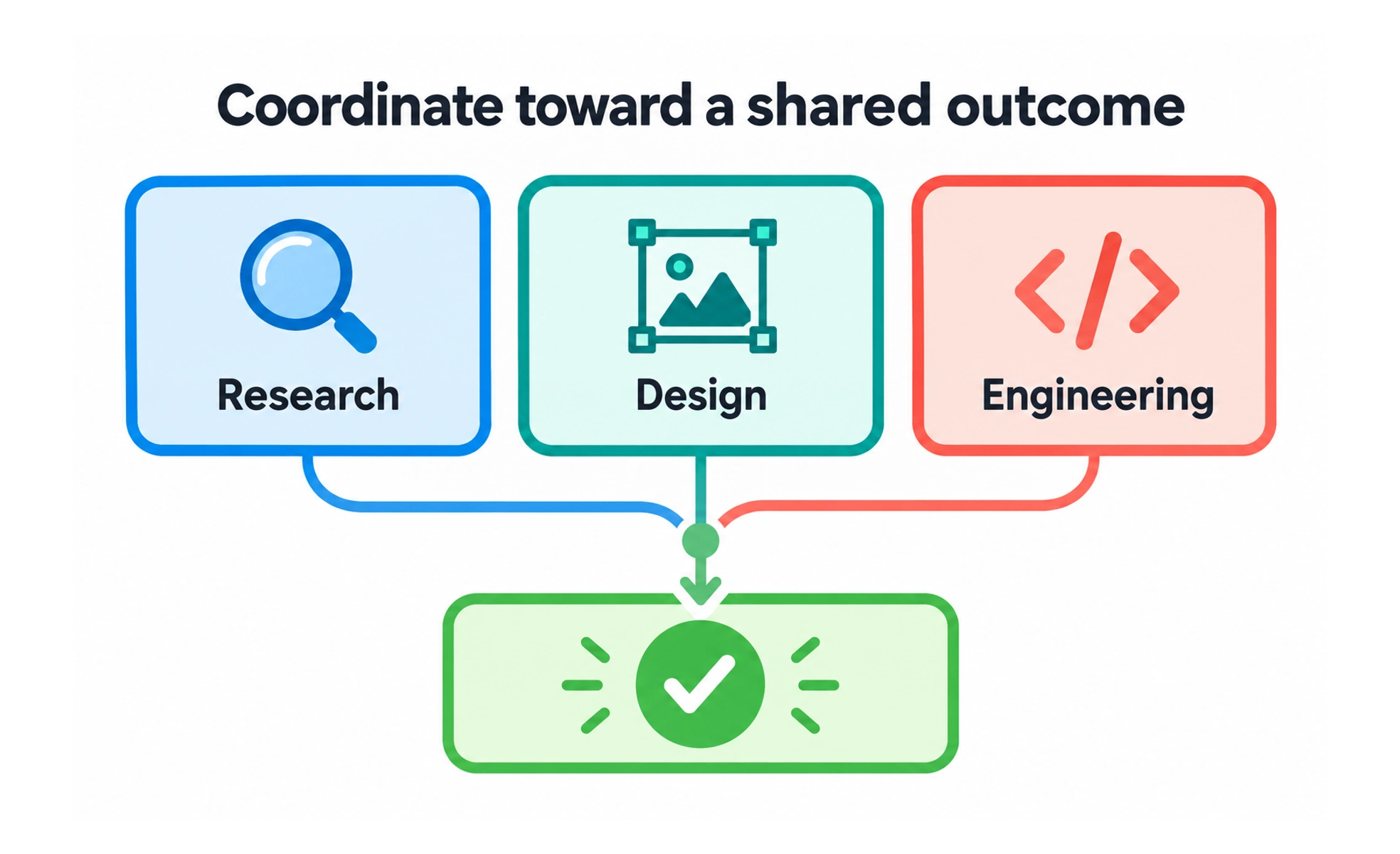
In digital product teams, designers, engineers and product managers combine complementary perspectives to build cohesive software. High-performing teams cultivate psychological safety, mutual accountability and clear role ownership.
Think of it as a pit crew in a Formula One motor race. Tire changers, fuelers and mechanics execute their specialized tasks in split-second synchronization to get the driver back on track.
How it works
Effective digital product teamwork thrives on mutual trust, shared goals and transparent communication cadences.
- Shared success metrics unites engineering, design and product management under common customer outcome targets.
- Psychological safety encourages team members to ask questions, propose unconventional ideas and admit mistakes without fear.
- Role clarity with overlap establishes clear functional boundaries while encouraging healthy pair-design and pair-coding.
- Asynchronous transparency utilizes shared Slack channels, Figma comment threads and Jira boards to prevent information silos.
When to use it
Cultivate strong teamwork practices across all modern agile product development environments.
- Cross-functional squad rituals pairs designers and developers during sprint planning to evaluate technical feasibility early.
- Continuous discovery loops conducts user interviews with both a researcher and an engineer present to build collective empathy.
- Complex incident triage resolves urgent production bugs through rapid, blameless coordination between ops and UX teams.
- Design system scaling aligns multi-squad contributors to maintain shared component libraries without duplicating effort.
Common mistakes
Organizations frequently sabotage teamwork by fostering competitive internal incentives and isolated silos.
- Working in functional silos, tossing design mockups over the wall to developers without ongoing collaborative dialogue.
- Tolerating brilliant jerks, allowing high-performing individual contributors to demean peers and destroy squad psychological safety.
- Rewarding individual heroes over squad achievements, incentivizing personal vanity projects rather than shared team outcomes.
Frequently asked questions
Key takeaways
- Teamwork combines diverse functional expertise across design, engineering and product management.
- Psychological safety is the single strongest predictor of high-performing multidisciplinary teams.
- Break down functional silos by pairing designers and engineers throughout the development lifecycle.
- Align team incentives around shared customer outcomes rather than siloed functional outputs.