

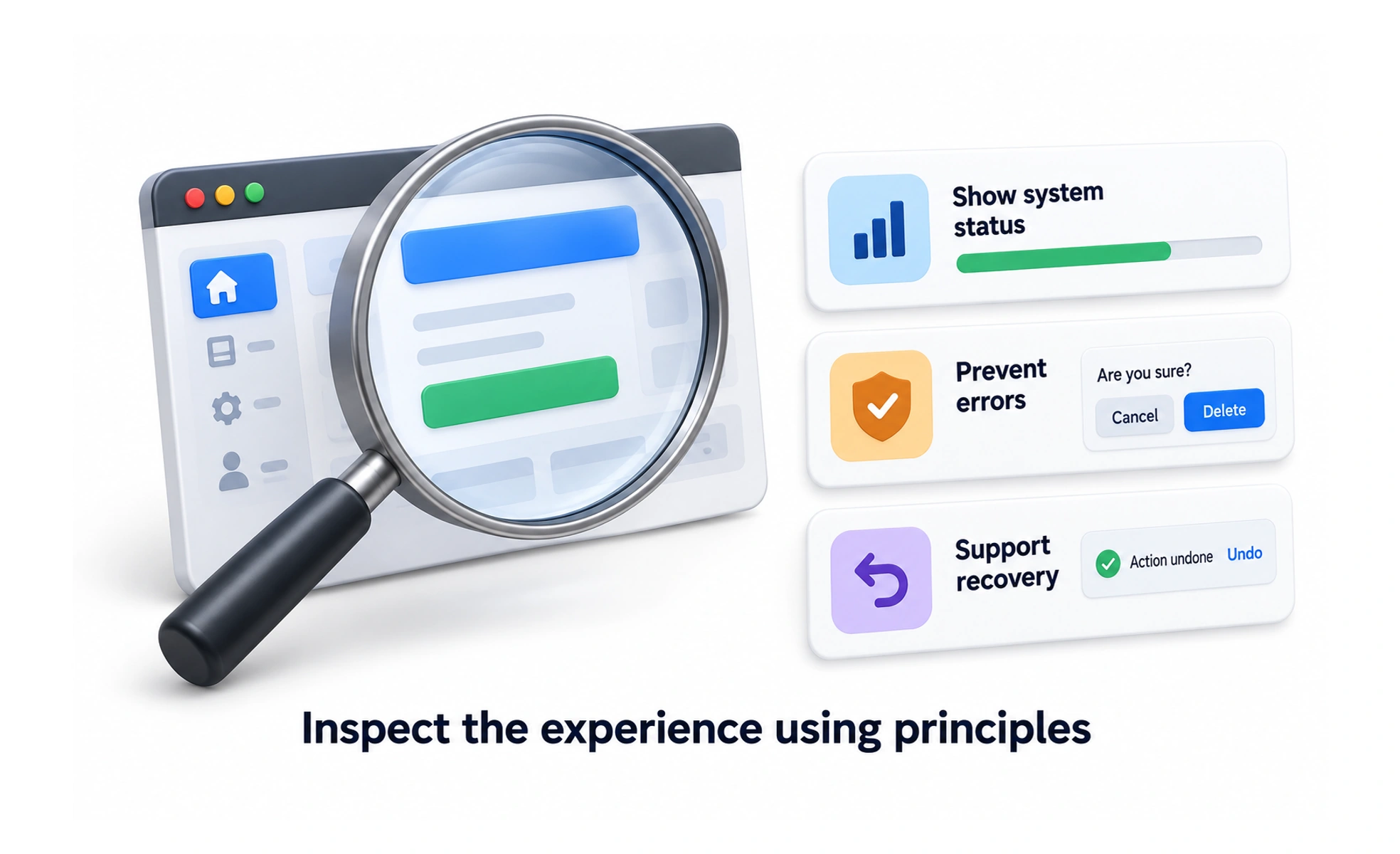
A heuristic helps a reviewer ask a useful question: can someone tell whether their change was saved? It does not prove that an interface works for its audience. A review identifies concerns that can be investigated and improved.
Use principles as questions
Jakob Nielsen’s ten usability heuristics are a widely used set. They cover areas such as understandable feedback, consistency, user control and recovery from mistakes. The principles are general, so applying them requires attention to the actual task.
Instead of writing “poor consistency,” identify which controls behave differently and why that could confuse someone. A principle gives the review a direction; the observation makes the finding useful.
Walk through meaningful states
Review a realistic task from beginning to end, including conditions that are easy to overlook.
- What happens while a request is processing?
- Can someone recover after choosing the wrong item?
- Does the error explain what to do next?
- Are familiar terms used consistently?
Record the location, problem and likely consequence. Separate an observed defect from a prediction about how users might respond.
Example: removing a saved lesson
A learner removes a lesson from a list. The row disappears, but a connection failure prevents the change from being saved. After reloading, the lesson returns without explanation.
A reviewer flags the missing failure feedback and recovery. The team could restore the row with a clear message and retry option. This finding is more actionable than simply scoring the screen against a checklist.
Combine inspection with evidence
A heuristic review can find issues before a full study is practical. It cannot tell you how frequently a problem occurs in your audience.
Discuss severity using the consequence and available evidence. Later testing may confirm, refine or reject a predicted problem. Avoid presenting a reviewer’s judgment as a measured failure rate.
Frequently asked questions
Key takeaways
- Use heuristics to guide inspection, not certify usability.
- Describe concrete problems and consequences.
- Include loading, failure and recovery states.
- Validate important predictions with user evidence.