

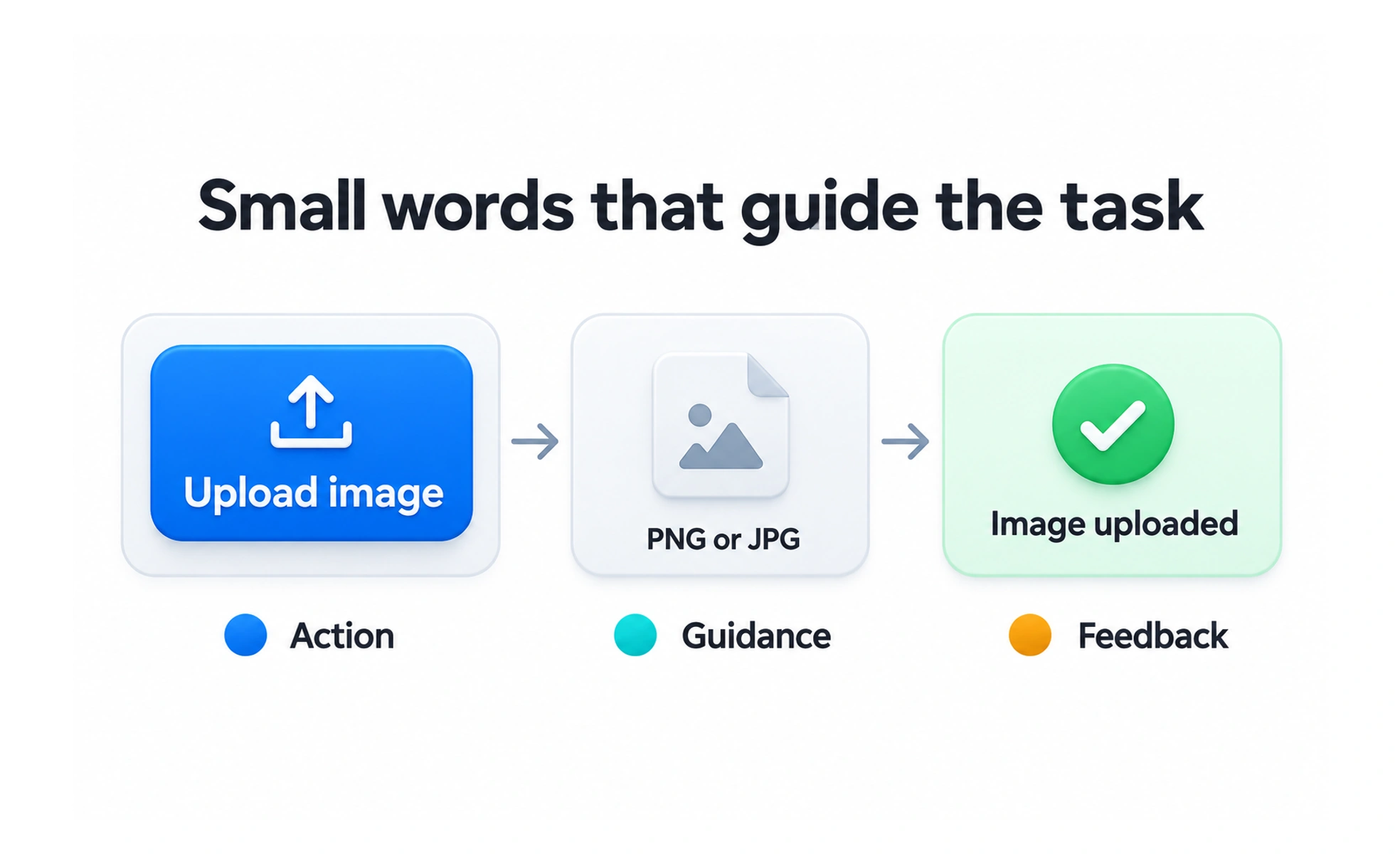
A button label, field hint and error message can decide whether someone continues confidently or gets stuck. Microcopy is short because it appears within a task, but the reasoning behind it may require careful work.
Write for the moment of decision
Identify what the person needs to know right now. “Create account” tells them more than “Submit.” A password hint can explain a requirement before the person encounters an error.
Useful microcopy reduces uncertainty without overloading the screen. Put important information near the action or field it explains instead of expecting people to find it in a distant help article.
Make the words match the behavior
A label sets a promise. “Save changes” should save the changes; “Delete account” should not quietly mean sign out. If an action has important consequences, explain them clearly before it happens.
For errors, describe the problem and the available recovery. Avoid blaming the person or exposing an internal error code as the only explanation. Preserve their work so the instruction to try again is practical.
Example: a verification email
After sign-up, the page explains where the verification email was sent and what the person should do next. If delivery fails, it says the message could not be sent and offers a real retry.
“Email sent!” would be misleading when the provider rejected the request. Accurate feedback matters more than cheerful wording. A short cooldown explanation can also clarify why the resend control is temporarily unavailable.
Review in the actual interface
Test microcopy with real states, long addresses and different languages. Read it alongside the control it describes. A clear sentence in a document may become ambiguous when placed between two buttons.
Keep the voice recognizable, but let the situation determine the tone. A serious failure needs a calm explanation; a joke can make someone feel their lost work is not being taken seriously.
Frequently asked questions
Key takeaways
- Explain the action or condition at the point it matters.
- Use labels that accurately predict behavior.
- Make errors specific, calm and recoverable.
- Review text inside the real interface and its states.