

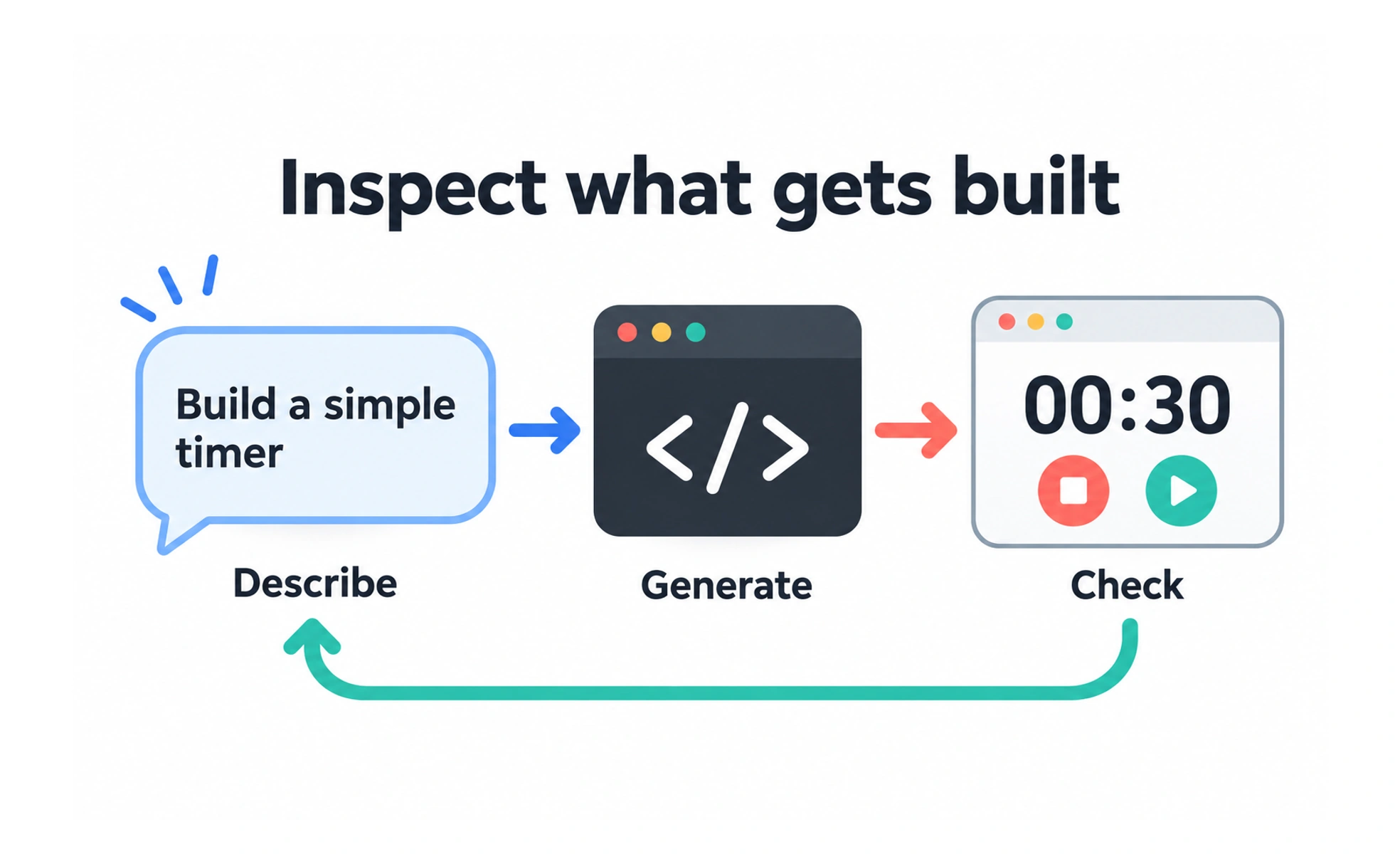
Vibe coding is an informal term for creating software largely by describing desired behavior to an AI and iterating on the generated result. The term is used loosely, often with limited inspection of the code itself.
Directing a builder from the appearance of a model can quickly explore an idea, but the visible result does not reveal whether the structure underneath is dependable.
Recognize the exploratory benefit
Natural-language iteration can help people try an interaction, test a rough idea, or produce a small prototype quickly. The useful result may be learning rather than a releasable application. State that purpose so a convincing demonstration does not acquire unwarranted claims about reliability.
Distinguish appearance from correctness
Generated software can show success while saving nothing, use fixtures instead of real data, or omit permission checks. Inspect important code and trace behavior through the service and database. A working screenshot provides limited evidence about failure handling and operational quality.
Introduce engineering accountability
Before real use, establish ownership, maintainable structure, appropriate tests, and a review of consequential behavior. Use small changes that can be understood and recovered. AI assistance can support disciplined engineering, while accepting code without understanding creates a different risk profile.
Frequently asked questions
Key takeaways
- Use rapid generation to explore and learn.
- Do not infer correctness from appearance.
- Review consequential code and stored behavior.
- Make the prototype-to-product transition explicit.