

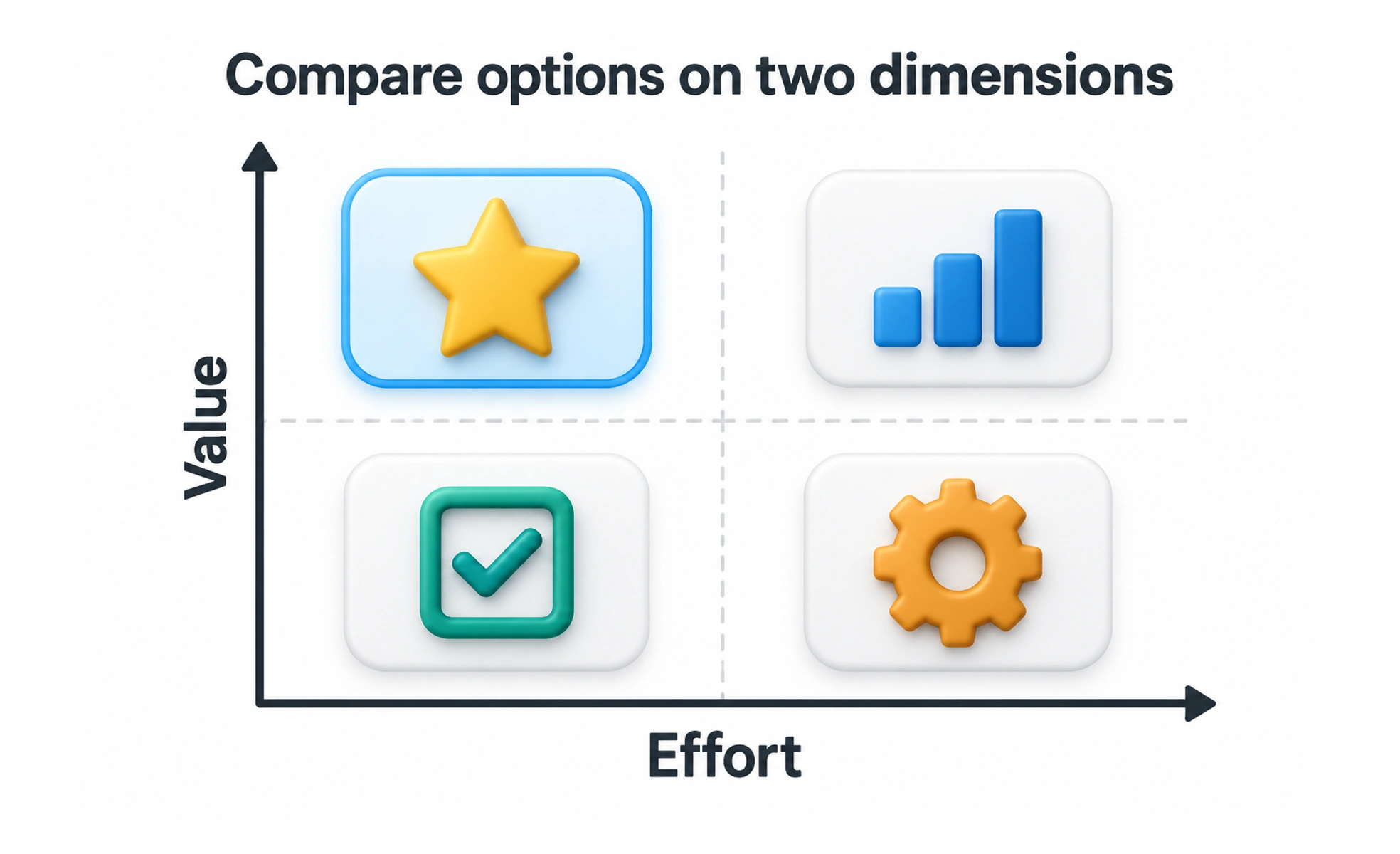
By plotting features into four quadrants, teams instantly separate high-impact quick wins from complex strategic bets and low-value distractions. It democratizes roadmap debates and builds collaborative team alignment.
Think of it as sorting personal belongings into four boxes before moving house. You divide items into daily essentials, valuable keepsakes, cheap spare junk and things to donate immediately.
How it works
The 2x2 matrix divides product opportunities into four distinct strategic action quadrants.
- Quick wins (high value, low effort) should be prioritized immediately to deliver fast user delight and team momentum.
- Major projects (high value, high effort) represent strategic bets requiring careful design discovery and dedicated engineering sprints.
- Fill-ins (low value, low effort) can be tackled during slow sprint cycles or assigned to junior engineers as practice tasks.
- Time wasters (low value, high effort) should be ruthlessly discarded or deprioritized from the product roadmap.
When to use it
Deploy a 2x2 matrix whenever team backlogs become cluttered with competing stakeholder proposals.
- Post-brainstorming triage organizes dozens of raw workshop sticky notes into a realistic, ranked execution plan.
- Quarterly roadmap planning aligns engineering leads and product managers on which major initiatives deserve quarterly resources.
- Design debt remediation identifies quick visual polish items that deliver disproportionate aesthetic impact for minimal coding time.
- Stakeholder alignment workshops provides visual transparency on why pet feature requests cannot be built immediately.
Common mistakes
Facilitators frequently compromise 2x2 matrices through subjective and uncalibrated axis definitions.
- Clustering everything into the top-left quadrant, claiming every single feature is both maximum impact and minimum effort.
- Estimating effort without engineers present, guessing technical complexity without verifying architecture requirements.
- Treating the matrix as immutable math, ignoring strategic company goals that justify pursuing difficult, low-efficiency bets.
Frequently asked questions
Key takeaways
- A 2x2 matrix evaluates features across two dimensions, most commonly customer value and development effort.
- The four quadrants are quick wins, major projects, fill-in tasks and time wasters.
- Involve engineers and designers jointly to balance realistic technical effort against true user value.
- Use the matrix to facilitate constructive debate rather than treating quadrant placement as absolute truth.