

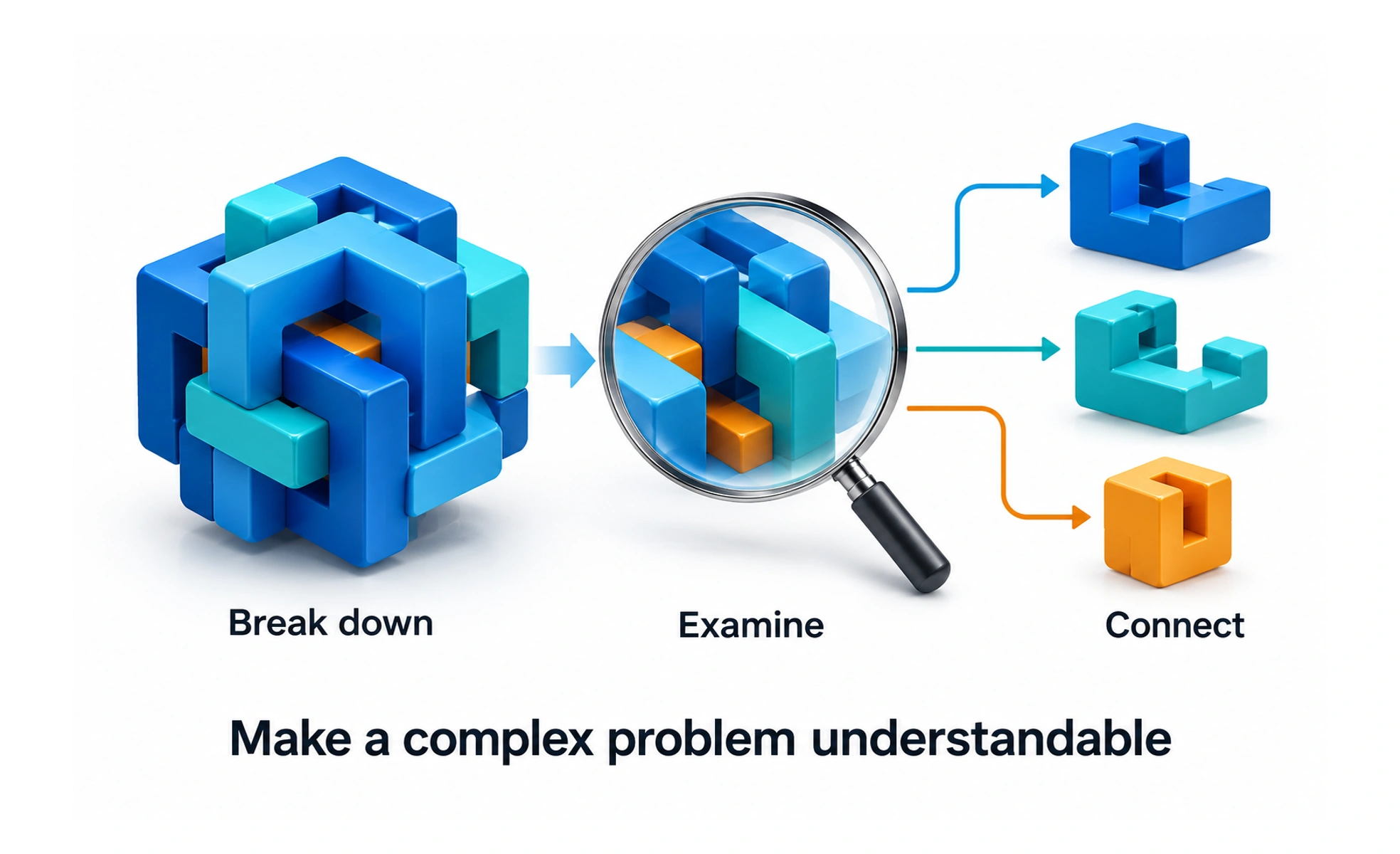
In UX, analytical thinking allows practitioners to interpret quantitative telemetry, audit user flows and detect subtle behavioral biases. It balances intuitive creative empathy with structured, evidence-based reasoning.
Think of it as a watchmaker disassembling a mechanical timepiece. By inspecting each gear, spring and escapement separately, the watchmaker discovers exactly which cog causes the watch to run slow.
How it works
Analytical thinking employs formal cognitive decomposition to examine complex software systems.
- Deconstruction breaks massive user workflows into individual screens, micro-interactions and backend API states.
- Pattern recognition identifies recurring user errors, navigation bottlenecks and behavioral drop-offs across large data sets.
- Hypothesis formulation translates vague design hunches into testable statements that can be verified through experiments.
- Logical deduction draws objective conclusions based on empirical telemetry rather than subjective aesthetic preferences.
When to use it
Apply analytical thinking whenever designing complex systems or diagnosing unexpected user behaviors.
- Complex information architecture organizes thousands of enterprise documents into logical, intuitive navigational hierarchies.
- Conversion funnel troubleshooting identifies why ninety percent of shoppers abandon a multi-step checkout sequence.
- A/B test statistical analysis evaluates whether a conversion lift is statistically significant or merely random variance.
- Heuristic usability auditing systematically evaluates interfaces against established cognitive principles and standards.
Common mistakes
Practitioners often misapply analytical thinking by ignoring the emotional, irrational reality of human nature.
- Assuming users act entirely rationally, designing interfaces for hypothetical logical robots rather than emotional humans.
- Overlooking qualitative context, relying strictly on quantitative numbers without talking to users to discover motivation.
- Over-complicating simple solutions, building elaborate data models when a simple intuitive interface change would suffice.
Frequently asked questions
Key takeaways
- Analytical thinking deconstructs complex challenges into component elements to evaluate cause and effect.
- It balances creative intuition with structured, evidence-based evaluation of user behavior.
- Use analytical methods to interpret quantitative analytics and structure complex information architecture.
- Pair logical analysis with human empathy to remember that users make decisions based on emotion and habit.