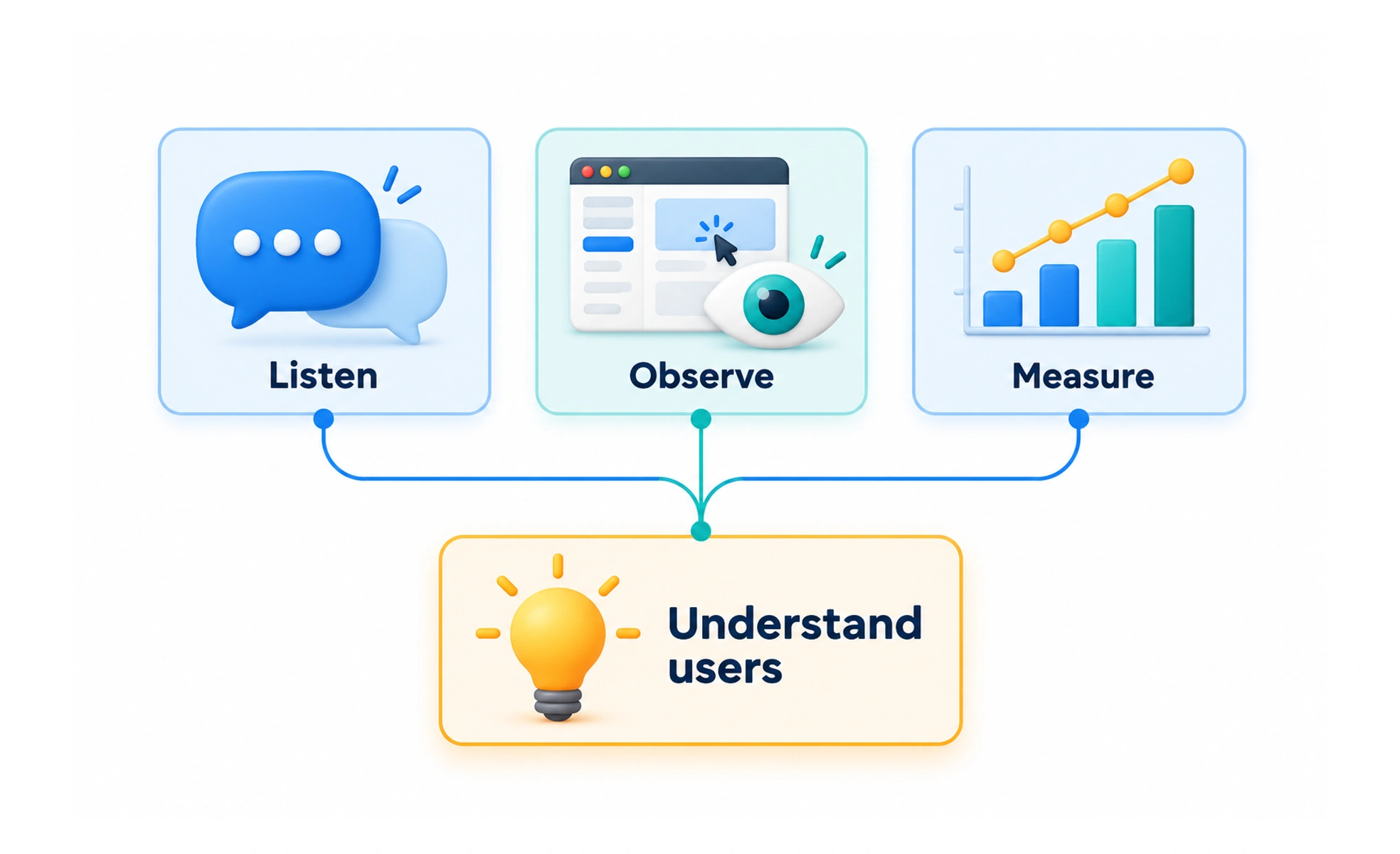
It uses qualitative methods like interviews and usability testing to understand why people behave the way they do. It also uses quantitative methods like surveys and analytics that measure how widespread a pattern is. The discipline exists to replace assumptions with evidence before a team commits to building anything. Good research programs combine both kinds of evidence. Qualitative work generates hypotheses about user needs. Quantitative work validates whether those hypotheses hold at scale. Research is not a single activity but a set of methods. Each method suits a different question. Interviews go deep with a small number of people. Surveys reach many people but stay shallow. Usability testing shows where a design fails in practice. Analytics reveal what users actually do when nobody is watching. The most common failure modes are confirmation bias and leading questions. Generalizing from too few participants is another. Collecting findings that never inform any decision is the last.
Think of it like this: a product team that skips research is like a doctor prescribing medication based on what the patient said they want. The doctor never examines what is actually wrong.
Why it happens
Without research, product and design decisions rest on assumptions and guesses. Teams end up building things that may look good or seem logical but do not actually serve users well. Research matters because it reveals real user needs that people often cannot articulate directly. It reduces the economic risk of building the wrong thing. It prevents teams from solving imaginary problems. It informs design choices with evidence. It builds empathy by putting real user contexts in front of the team. It validates decisions continuously rather than only at the start. The most expensive mistake in product development is building something users do not want or need. Research is the cheapest way to catch that mistake before significant investment.
Types
Research falls along several axes. The best programs combine methods from each.
Qualitative versus quantitative: qualitative work explores the why and how of user behavior through interviews, observations, and usability testing. It is smaller in scale and not statistically representative, but it generates rich insight. Quantitative work measures and validates patterns at scale through surveys, analytics, and A/B testing. It answers how many, how often, and how much. It may not explain why a pattern exists.
Attitudinal versus behavioral: attitudinal research captures what users say. This includes their beliefs, preferences, and stated needs. Behavioral research observes what users actually do. Actual behavior often differs from what people report. Both are informative. The gaps between them are themselves informative.
Generative versus evaluative: generative research happens early and explores the problem space. It covers user needs, behaviors, contexts, and pain points. It informs what to build. Evaluative research happens later and tests designs, prototypes, and products. It informs how to improve what has been built.
How it works
User interviews are one-on-one conversations that explore experiences, needs, behaviors, and pain points. They are open-ended and non-leading. They focus on understanding the user's perspective rather than validating the team's assumptions.
Surveys are structured questionnaires that collect data from a larger sample. They measure prevalence, segment users, and validate qualitative findings. They are limited in depth.
Usability testing observes users as they attempt tasks with a product or prototype. It reveals where users struggle and what causes confusion. It is one of the most directly actionable methods because it shows exactly where the product fails.
Contextual inquiry observes users in their natural environment. It reveals the context of use, including the environment, tools, interruptions, workflows, and social factors that shape interaction.
Card sorting asks participants to organize topics into groups. It informs information architecture and navigation.
Diary studies ask participants to log experiences and behaviors over time. They reveal longitudinal patterns that short interactions miss.
Analytics analyzes product usage data to reveal patterns, problems, and opportunities at scale. It does not explain why.
A/B testing compares two versions of a design or feature. It provides causal evidence about the impact of a change.
Collecting data is only the first step. Research must be analyzed and synthesized to generate insights. Qualitative data is analyzed through coding, thematic analysis, and affinity diagramming. Quantitative data is analyzed using statistical methods. Synthesis combines findings into a coherent understanding. It connects data points into insights and produces actionable recommendations. Findings must be shared through reports, presentations, or workshops. Research that sits in a report without informing decisions is wasted effort.
Common mistakes
Confirmation bias: designing or interpreting research to confirm existing beliefs rather than learn the truth. This is the most common and dangerous pitfall.
Leading questions: questions that suggest the answer or push participants toward a particular response. Leading questions produce misleading data.
Generalizing from limited data: drawing broad conclusions from a small or unrepresentative sample. Qualitative research especially should not be overgeneralized.
Asking users what they want: users are often poor at predicting what they would want. Research should focus on understanding needs and behaviors, not just collecting feature requests.
Neglecting non-users: focusing only on current users and missing the needs of potential users, former users, or users who rejected the product.
Research as a checkbox: treating research as a formality rather than a genuine effort to understand users. Superficial research can be worse than no research if it creates false confidence.
Not acting on findings: collecting research that sits in a report without informing decisions. Research must be communicated and acted upon.
Wrong method for the question: using a method that does not answer the question at hand. For example, using surveys when the question requires deep qualitative understanding.
Frequently asked questions
Key takeaways
- UX research is the systematic study of user behaviors, needs, and motivations, combining qualitative and quantitative methods.
- It reduces risk, prevents building the wrong thing, and informs design and product decisions with evidence.
- Common methods include user interviews, surveys, usability testing, contextual inquiry, card sorting, diary studies, analytics, and A/B testing.
- Good research starts with clear goals, the right methods, and the right participants.
- Research must be analyzed, synthesized, and shared to have impact.