

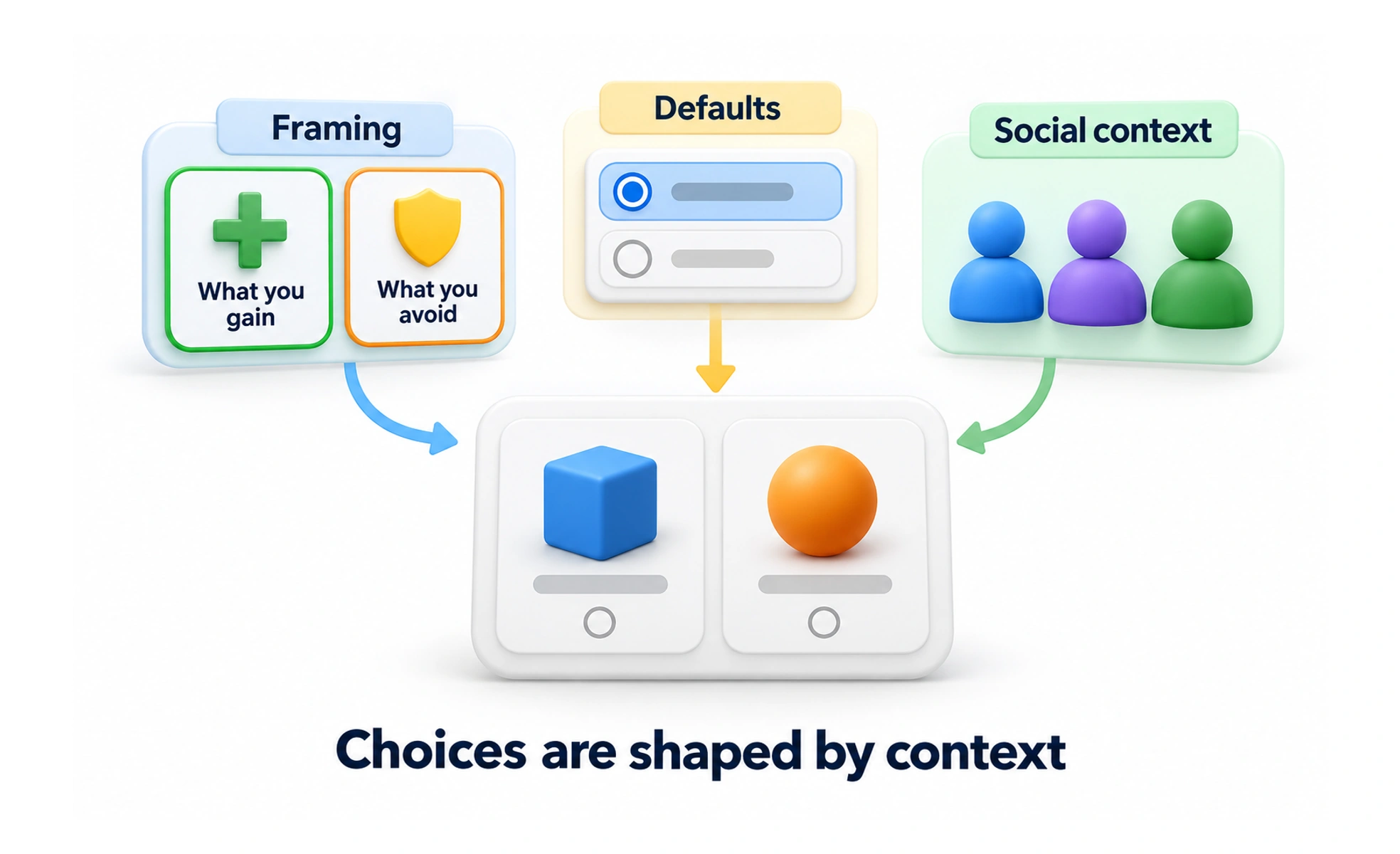
People do not always compare every option with unlimited time and information. How a choice is presented, what someone already owns and what they expect from others can affect decisions. Product teams can use this perspective to ask better questions about choices, costs and commitments.
Look at the decision environment
Start with the actual choice. What information is visible? Is an option preselected? Can a person compare the total cost, or only a small part of it?
A default can matter because accepting it requires less effort than changing it. That does not tell you what every customer wants. A team must still consider whether the default is appropriate and whether alternatives are understandable.
Distinguish a helpful prompt from pressure
A reminder about an unfinished task may help someone achieve a goal they already chose. A misleading countdown or hidden recurring charge can instead push a decision through confusion.
Ask whose goal the design serves and what happens after the click. A short-term increase in conversion is not enough if customers later feel misled or cannot undo a choice.
Example: choosing a learning reminder
A learner wants to practice regularly. During setup, the product explains its reminder options and lets the learner choose a suitable time or decline. It later provides an easy way to change that preference.
The team can compare whether the reminder supports returning to useful practice. It should also watch opt-outs and complaints, rather than treating more notifications as success by itself.
Test rather than promise an effect
Behavioral findings depend on the people and conditions studied. Do not attach a guaranteed uplift to a named bias.
- State the behavior you hope to support.
- Explain costs and defaults clearly.
- Keep refusal and reversal practical.
- Measure outcomes that matter after the initial choice.
Ethical review and product judgment remain necessary even when a tactic increases a metric.
Frequently asked questions
Key takeaways
- Examine how choices, defaults and costs are presented.
- Do not assume one effect applies to everyone.
- Support goals people can understand and choose.
- Consider downstream outcomes and the ability to reverse a decision.