

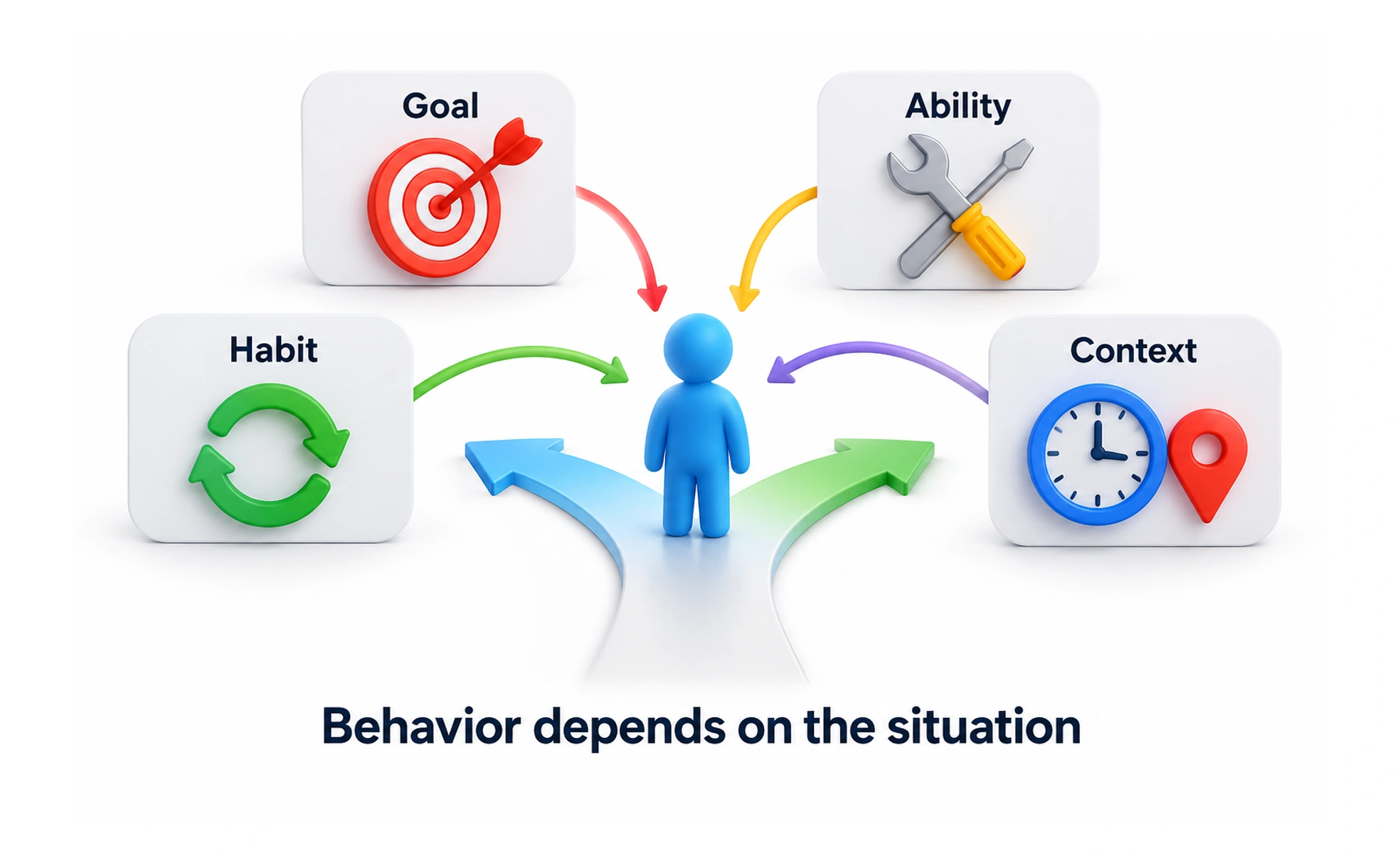
In product work, behavior gives you evidence about how a design fits real life. Someone may say that a checkout is easy, then abandon it when a delivery charge appears. Both the explanation and the observed action are useful, but they tell you different things.
Observe the situation, not a stereotype
People do not use products under identical conditions. A familiar task at a desk can become difficult when a person is distracted, using one hand or worried about making a costly mistake.
Describe the circumstances around an action. “Could not find the cancellation option on a phone” gives the team more to investigate than “Users are impatient.” Avoid turning a single observation into a fixed personality trait.
Separate observation from explanation
Record what happened before deciding why it happened. A person clicking a label repeatedly might expect it to be interactive, miss a small control or be experiencing a device problem.
- Note the action and the point in the task.
- Ask neutral questions about what the person expected.
- Compare behavior across relevant situations.
- Check whether an interface or service constraint explains the difficulty.
Behavioral patterns can suggest a hypothesis. They do not establish that every person will behave the same way.
Example: repeatedly checking an order
A team notices frequent visits to an order-tracking page. It could interpret this as engagement and add more promotional content. Interviews reveal that customers cannot tell whether their delivery has been delayed.
The repeated visits signal uncertainty. A clearer status and a reliable update may reduce page visits while improving the experience. More interaction is not always a better outcome.
Use the evidence responsibly
Improve comprehension and control rather than exploiting confusion. Make costs and consequences visible, and allow people to correct mistakes. A design that increases clicks by hiding the exit may damage trust.
Revisit your interpretation when the audience or context changes. Research findings describe the people and conditions studied; they are not universal laws about human nature.
Frequently asked questions
Key takeaways
- Describe behavior together with its context.
- Keep observations separate from your explanation of them.
- Combine observed actions with neutral follow-up questions.
- More clicks or repeat visits can signal friction rather than value.