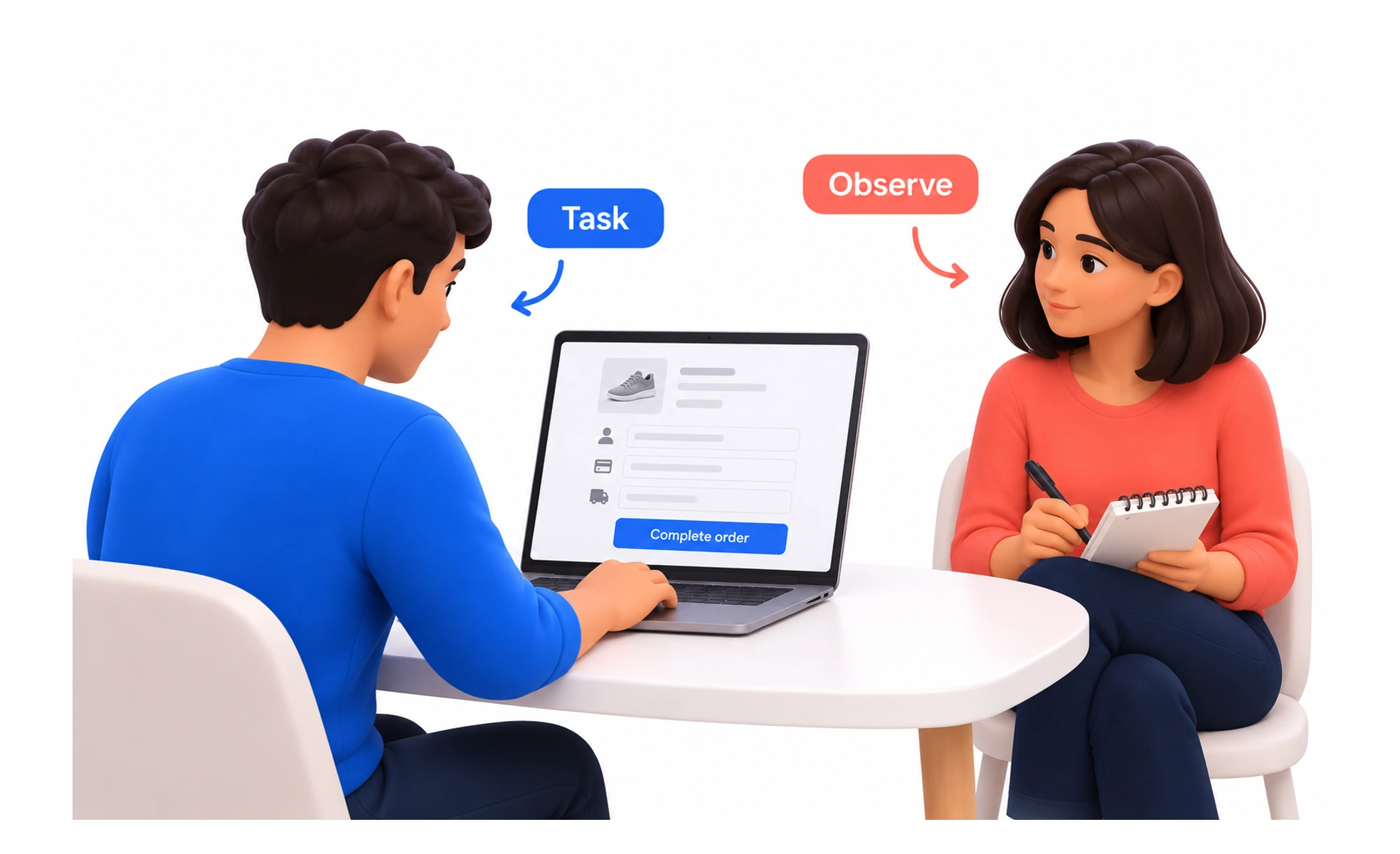
The people who build a product cannot judge whether it is usable. They know the terminology and where everything lives, and that knowledge cannot be unlearned. Testing borrows the eyes of someone who does not have it.
Think of it like this. You cannot proofread your own writing properly, because you read what you meant rather than what is on the page. Someone else spots the missing word in seconds.
How it works
A moderator sets a task, then stops talking. The participant attempts it while thinking aloud. The moderator watches and resists the strong urge to help.
That restraint is the whole method. The moment someone says "it is in the top right", the finding is destroyed, and the finding was the point.
Afterwards, patterns across participants get written down specifically enough to act on. "Three of five people looked in the main navigation before finding settings under the profile menu" is something a team can fix. "Navigation was confusing" is not.
Types
- Moderated. A researcher runs the session live and can follow surprises. Richest data, slowest to arrange.
- Unmoderated. Software sets the task and records the screen. Faster and cheaper, but you cannot ask why someone did something.
- Remote. Now the default. Removes geography as a limit on who you can recruit.
- In person. Still worth it when physical context or subtle hesitation matters.
- Guerrilla. Approaching people informally in a public place. Fast and rough, unsuitable when you need a specific type of user.
Common mistakes
- Helping. Every hint erases the problem you were there to find.
- Testing too late. A prototype is the cheapest place to discover a structural mistake. After launch is the most expensive.
- Letting the participant feel judged. Say plainly at the start that the product is being tested and they cannot get it wrong. People who feel examined stop behaving normally.
Frequently asked questions
Key takeaways
- Say plainly that the product is being tested, not the person.
- Silence from the moderator is the method, not awkwardness.
- Report the specific behaviour you saw, never a summary judgement.
- Test on a sketch. It is cheapest to fix before anything is built.