

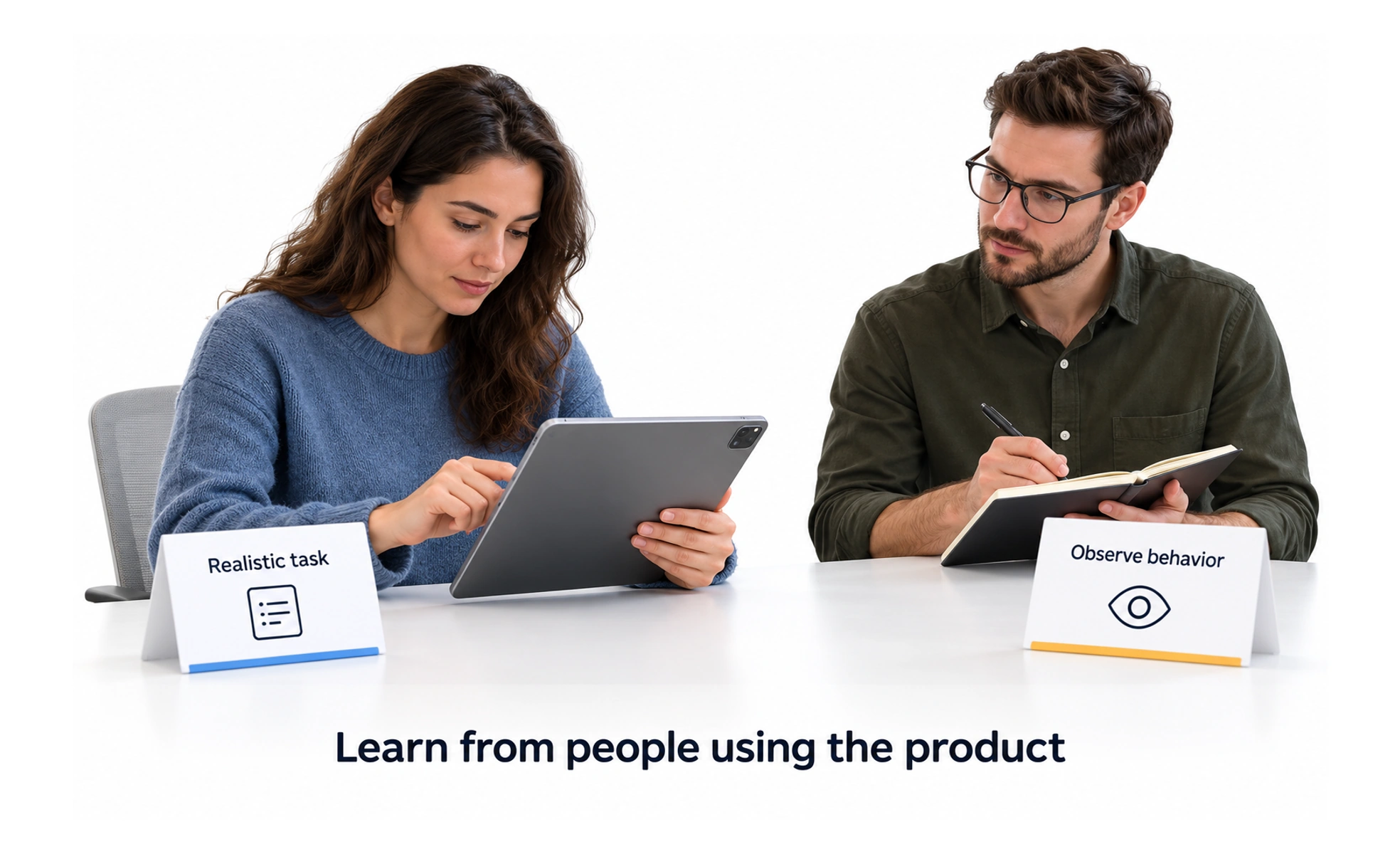
User testing puts an idea, prototype, or product in front of people who resemble its intended users. A facilitator gives a task, observes what happens, and asks neutral questions so the team can find where the experience is clear, confusing, or incomplete.
It is like watching someone follow a new map through a building. Their route and questions reveal where the map needs clearer landmarks; asking whether they like the map alone would reveal much less.
Start with a decision to inform
Write down what the team needs to learn before recruiting anyone. A focused question might be whether people can compare two plans, find a setting, or understand what happens after submitting a form. This keeps the session small enough to interpret and prevents testing from becoming a general request for opinions.
Choose participants and tasks carefully
Recruit people whose experience is relevant to the decision, and give them realistic tasks without teaching them the interface. A task should describe a goal rather than a sequence of clicks. For example, ask someone to change a delivery address instead of telling them which menu to open.
Observe without leading
Let participants think aloud if that feels comfortable, but do not rescue them at the first pause. Note what they expected, where they hesitated, what they completed, and what support they needed. Ask open questions after a task; leading questions can make a confusing design appear successful.
Turn observations into product decisions
Look for patterns across sessions, then describe the evidence, its impact, and a possible response. A small study can expose usability problems, but it cannot estimate how common those problems are across an entire population. Share limitations and retest important changes.
Frequently asked questions
Key takeaways
- Define the decision and learning question before sessions.
- Use realistic tasks that describe goals, not clicks.
- Observe behavior and avoid coaching participants.
- Treat small studies as diagnostic evidence, not population estimates.