

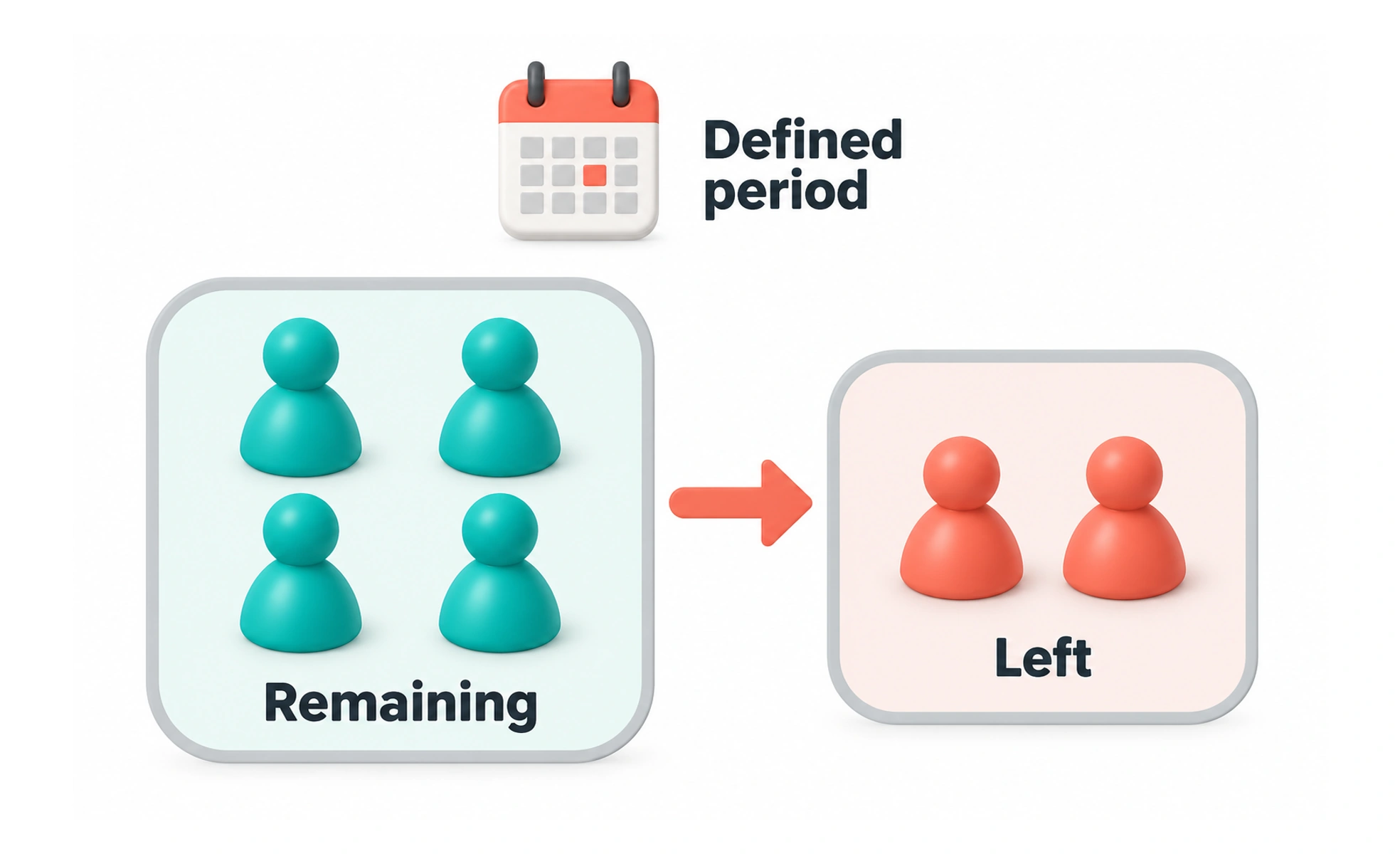
Churn describes the loss of customers, subscribers, or recurring revenue over a defined period. A churn measure needs a clear definition of what counts as leaving and which starting group is being measured.
A club tracks how many existing members leave during a month. New members arriving during that month should not hide the departures from the original group.
Define the kind of loss
Customer churn and revenue churn answer different questions. Losing several small accounts can produce a different pattern from losing one large account. State whether leaving means cancellation, subscription expiry, inactivity, or another event, and use that definition consistently.
Choose the population and period
A simple customer churn rate divides customers lost from the starting group by customers in that group at the beginning of the period. Label the time window and how reactivation is handled. Other revenue-based measures require their own rules for contraction and expansion.
Investigate reasons and segments
Separate avoidable product problems from changes in customer need and payment failures. Compare cohorts, plans, tenure, and relevant use cases without exposing small groups. Ask for context through respectful research rather than making cancellation difficult to improve the reported number.
Example: a learning subscription
A learner may cancel after reaching a short-term goal, because content is unsuitable, or because a payment fails. Those situations require different responses. Look at prior value, cancellation feedback, and billing events before assuming every departure indicates the same experience problem.
Frequently asked questions
Key takeaways
- Distinguish customer loss from revenue loss.
- Define leaving, starting population, and time period.
- Investigate causes and segment differences.
- Improve value and recovery without obstructing cancellation.