

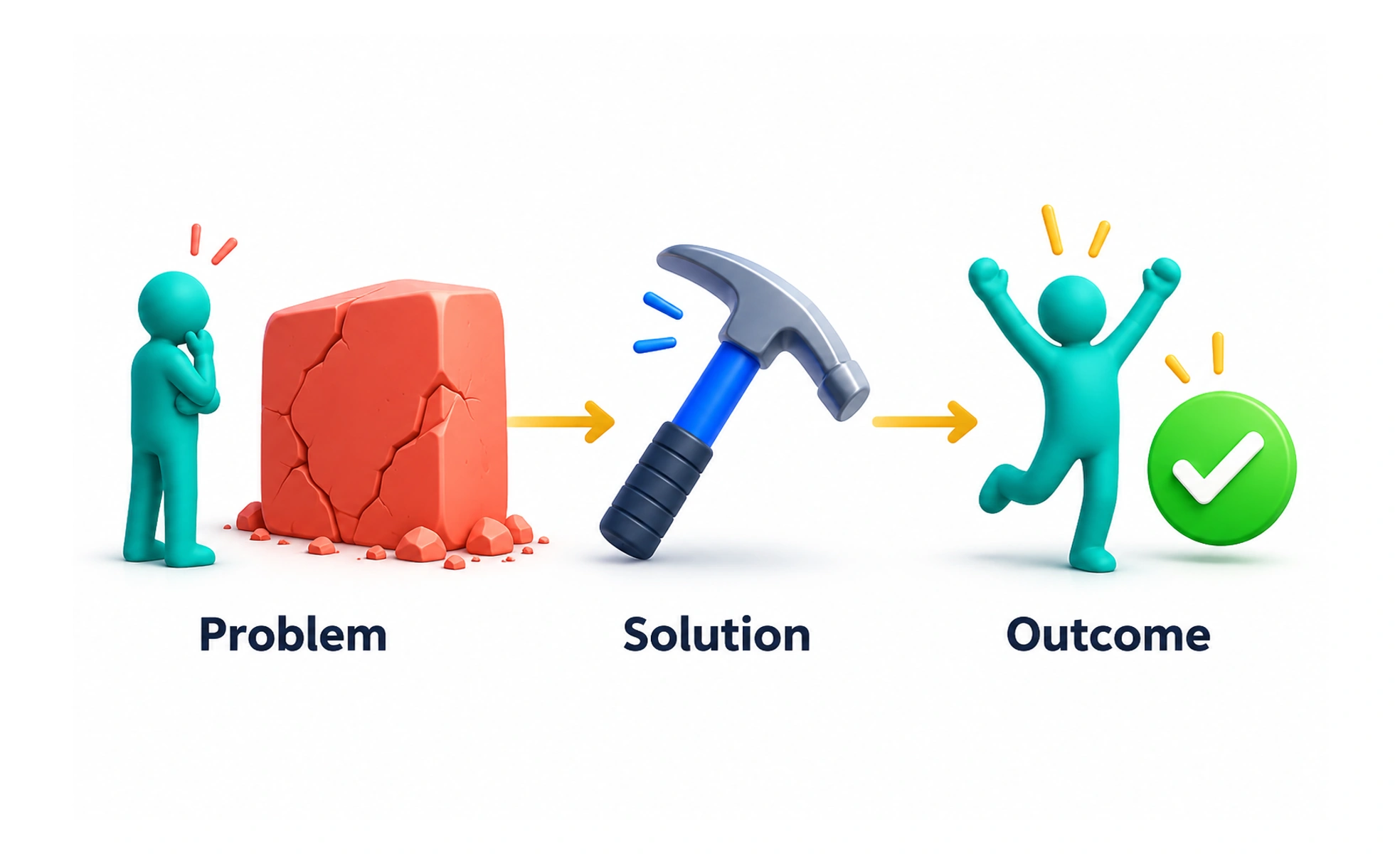
Product thinking connects a user’s problem with a useful outcome and a sustainable way to deliver it. It helps teams decide what deserves to be built and how to judge whether it works.
A good restaurant starts with the people it wants to feed and the experience it wants to offer. Buying a new oven is useful only when it helps that purpose.
Start with the situation
Describe who has the need, what they are trying to achieve, and what gets in their way today. Look at their current alternatives, including manual work or doing nothing. A feature request can start a conversation, but research is needed to understand the situation behind it.
Connect user value and business value
A useful product must help people while remaining practical to operate. Consider how a better user outcome supports retention, revenue, reduced cost, or another relevant business goal. Make that connection explicit so the team can explain why an idea matters and which tradeoffs it accepts.
Turn assumptions into learning
List what would have to be true for an idea to succeed. People may not need the solution, understand it, trust it, or be willing to change their routine. Use interviews, prototypes, and measured experiments to reduce the most important uncertainty before making a large commitment.
Example: saving lessons
A team might propose a bookmark button because learners lose useful lessons. Product thinking asks when that happens, how learners currently find material again, and whether saving improves later retrieval. The team can test the interaction and measure return visits to saved lessons rather than treating button clicks alone as success.
Frequently asked questions
Key takeaways
- Understand the user’s situation before choosing a feature.
- Connect user outcomes with a sustainable business goal.
- Identify and test important assumptions.
- Judge results by useful behavior, not delivery alone.