

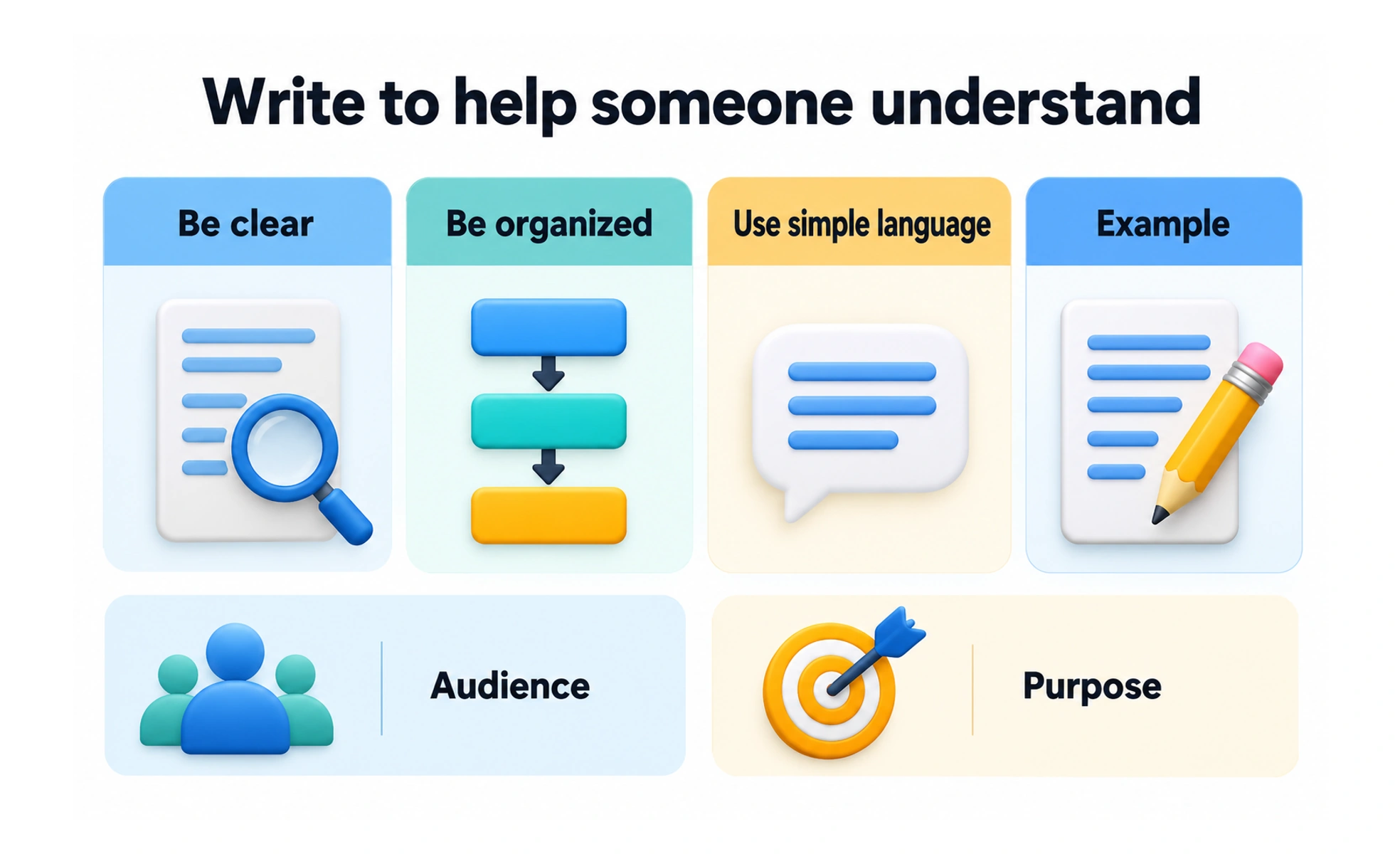
Good writing starts with a question the reader needs answered. It explains the idea at an appropriate level, uses concrete examples and removes wording that adds effort without adding meaning. The goal is understanding, not sounding impressive.
Decide what the reader should learn
Write the purpose before the article. For a glossary entry, the reader may need to recognize a concept, distinguish it from a similar term and apply it in a small decision.
Choose the explanation around that purpose. A long history of the term may be accurate but unhelpful when someone needs to decide whether to use a particular design pattern today.
Explain the idea in a useful order
Begin with a direct definition. Follow with the context needed to understand it, then an example and any important limits. Explain unfamiliar terms when they first appear.
- Prefer familiar words where they express the meaning accurately.
- Keep each paragraph focused on one idea.
- Use headings that tell the reader what comes next.
- Replace broad claims with specific explanations.
Short sentences can help, but length alone does not establish clarity. Preserve the connections that make an explanation easy to follow.
Example: explaining an empty state
An article about empty states can show a new project list with no projects. It explains what the person sees, why nothing is there and which next action is useful.
This is stronger than repeatedly calling the pattern “intuitive.” The example gives the reader something to recognize and apply. A later section can explain how a genuine empty result differs from a failed request.
Edit for accuracy and usefulness
Check every claim, remove repeated ideas and read the text aloud. Ask whether the example really supports the definition. Keep original sources for claims that need evidence, and distinguish an illustrative scenario from a measured result.
Do not rewrite another article sentence by sentence and call the result original. Build the explanation around the reader’s need and your own structure, examples and reviewed understanding.
Frequently asked questions
Key takeaways
- Define the audience and learning goal first.
- Explain concepts in a connected order with concrete examples.
- Use plain language without losing important distinctions.
- Review accuracy and remove repetition before publication.