

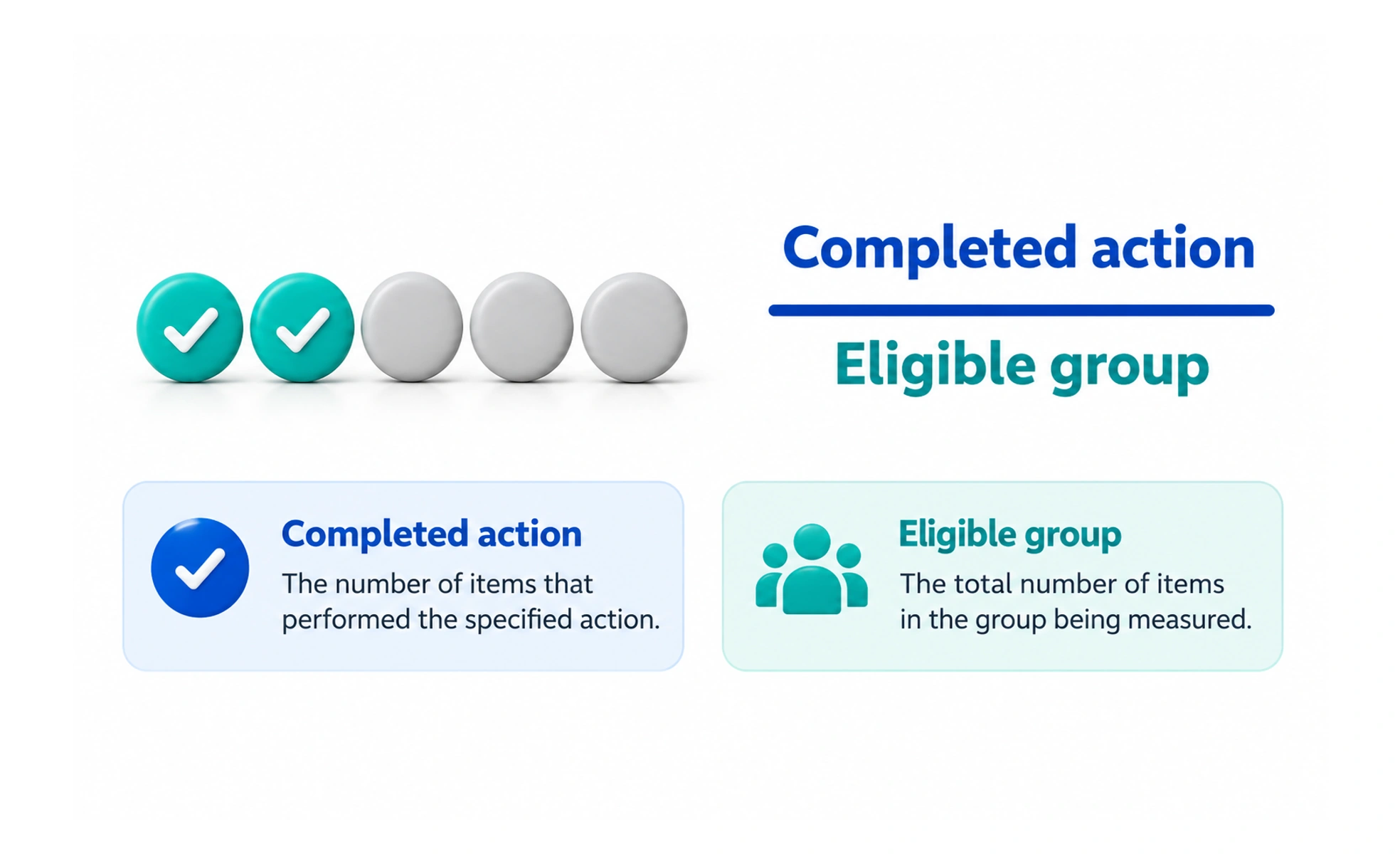
Conversion rate is the share of an eligible group that completes a defined action during a specified period. Its meaning depends on the action, denominator, and measurement rules.
If 20 of 100 people who receive an invitation attend an event, attendance conversion is 20 percent for that invited group.
Define the action and eligible group
Specify what counts as conversion, such as a completed purchase or first successful lesson. Identify who had a reasonable opportunity to perform it. Visits, sessions, people, and accounts create different denominators, so label the chosen unit clearly.
Calculate within a clear window
Divide the number of eligible units that converted by the total eligible units, then multiply by 100 for a percentage. State the observation window and whether each unit can count once or multiple times. Make sure people have enough time to convert before comparing recent and older groups.
Interpret the surrounding experience
A rate can change because traffic quality, audience, price, or product behavior changed. Compare relevant segments and check the underlying counts. Optimizing conversion should also preserve informed choice, successful use, and reasonable cancellation or refund behavior.
Example: lesson starts
If 80 of 200 eligible learners who see a course overview start a lesson within seven days, the defined conversion is 40 percent. That result does not show whether they completed the lesson or found it useful. Pair it with downstream outcomes and investigate barriers before choosing a redesign.
Frequently asked questions
Key takeaways
- Define the conversion and denominator precisely.
- Use a consistent time window and counting rule.
- Read percentages alongside counts and segments.
- Check downstream value and informed user choice.