

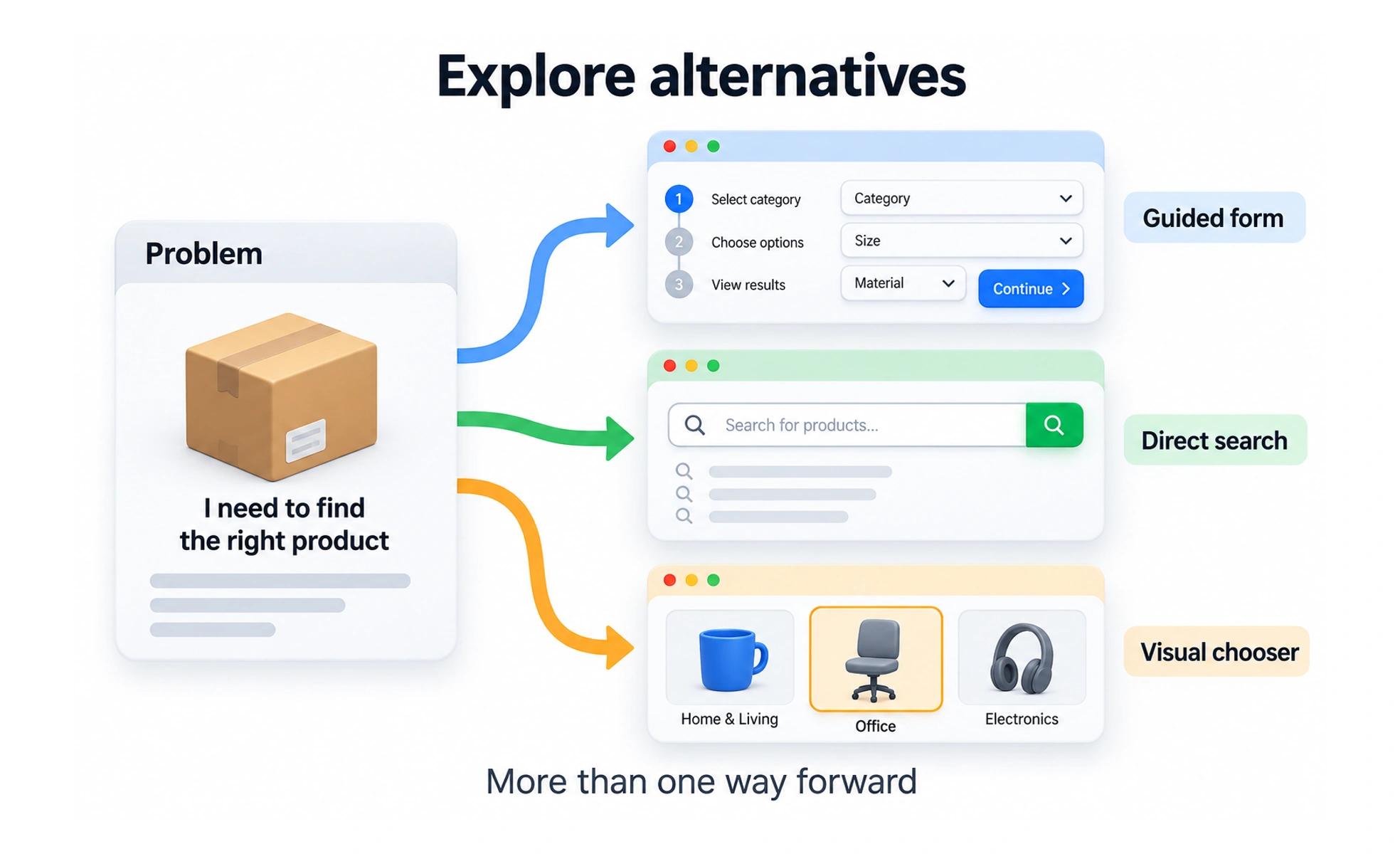
In product design, it connects seemingly unrelated concepts to uncover fresh solutions. It combines divergent brainstorming to explore possibilities with convergent selection to find what works.
Think of it as cooking without a recipe book. Instead of following familiar instructions, you look at unexpected ingredients in your pantry and combine flavours in a delightful new way.
How it works
Creative thinking in design alternates between expanding options and refining practical solutions.
- Divergent thinking suspends early judgment to generate a wide, unconventional volume of potential ideas.
- Lateral association borrows mechanisms from different industries, such as adapting gaming reward loops into education.
- Challenging orthodoxies questions fundamental assumptions, asking why a workflow requires forms or passwords at all.
- Convergent evaluation selects the most promising concepts and tests them rapidly against technical constraints.
When to use it
Deploy creative thinking techniques when incremental adjustments fail to solve stubborn design bottlenecks.
- Initial concept generation breaks out of competitor copycat patterns during early product exploration.
- Design sprint workshops uses Crazy Eights sketching exercises to generate dozens of alternative layouts fast.
- Overcoming technical constraints discovers clever UX workarounds when legacy backends cannot support real-time sync.
- Brand differentiation crafts distinctive interactive moments that make a product memorable in crowded markets.
Common mistakes
Teams often confuse creative thinking with unconstrained, impractical artistic indulgence.
- Creating novel solutions for solved problems, like reinventing the shopping cart icon, which just confuses users.
- Judging ideas too early during divergent brainstorming, silencing team members before good concepts emerge.
- Falling in love with cleverness while ignoring whether the concept genuinely makes life easier for the user.
Frequently asked questions
Key takeaways
- Creative thinking generates novel and useful solutions to difficult human problems.
- Great product creativity alternates between divergent exploration and convergent validation.
- Borrowing proven patterns from unrelated industries is one of the most reliable creative engines.
- Creativity must serve usability; never reinvent standard conventions just to look different.