

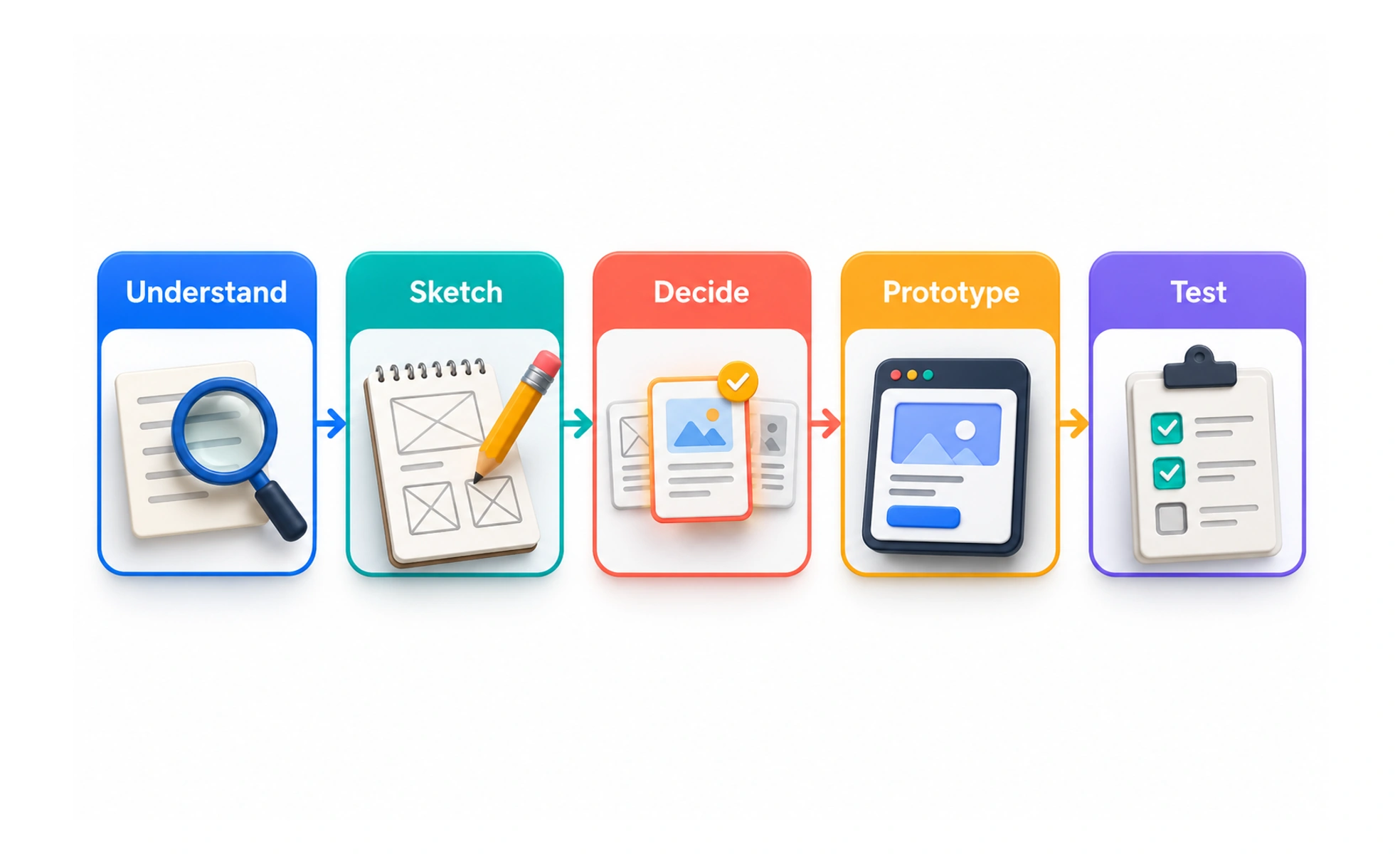
Developed at Google Ventures, it compresses months of potential debate into a single focused workweek. Teams map problems, sketch divergent solutions, choose the best ideas, build a realistic prototype and test with real users.
Think of it as a time machine for product teams. Instead of arguing in conference rooms for quarters, the team fast-forwards into the future to see their prototype tested on Friday.
How it works
The classic five-day design sprint follows a rigorous, day-by-day collaborative sequence.
- Monday maps the challenge by gathering expert interviews, defining long-term goals and selecting a target focal point.
- Tuesday sketches solutions through structured brainstorming techniques like Crazy Eights and detailed solution sketches.
- Wednesday decides the winning path using dot-voting heatmaps and creating a storyboard for the prototype.
- Thursday builds a realistic prototype in Figma, focusing on surface realism while faking backend mechanics.
- Friday tests with five users, interviewing target customers one-on-one to uncover clear behavioral patterns.
When to use it
Initiate a design sprint when tackling high-stakes challenges with high uncertainty.
- Kickstarting new product initiatives aligns founders and engineering leads around a concrete customer experience.
- Unblocking stalled feature debates replaces weeks of inconclusive meetings with empirical user test recordings.
- Entering unfamiliar market sectors tests customer appetite for novel value propositions with minimal capital expense.
- Redesigning critical conversion flows validates ambitious new checkout or onboarding patterns before development.
Common mistakes
Facilitators frequently compromise sprint outcomes by neglecting essential preparation steps.
- Failing to recruit test participants in advance, leaving the team with nobody to interview on Friday afternoon.
- Over-engineering the prototype on Thursday, attempting to code real databases rather than simulating realistic UI flows.
- Allowing endless debate on Wednesday, failing to empower the designated Decider to make authoritative choices.
Frequently asked questions
Key takeaways
- A design sprint compresses months of strategic debate into five focused days of building and testing.
- The process follows Monday mapping, Tuesday sketching, Wednesday deciding, Thursday prototyping and Friday testing.
- Testing with just five representative users reveals roughly eighty-five percent of core usability issues.
- Sprint prototypes prioritize realistic facade appearance over functional backend code to maximize speed.