

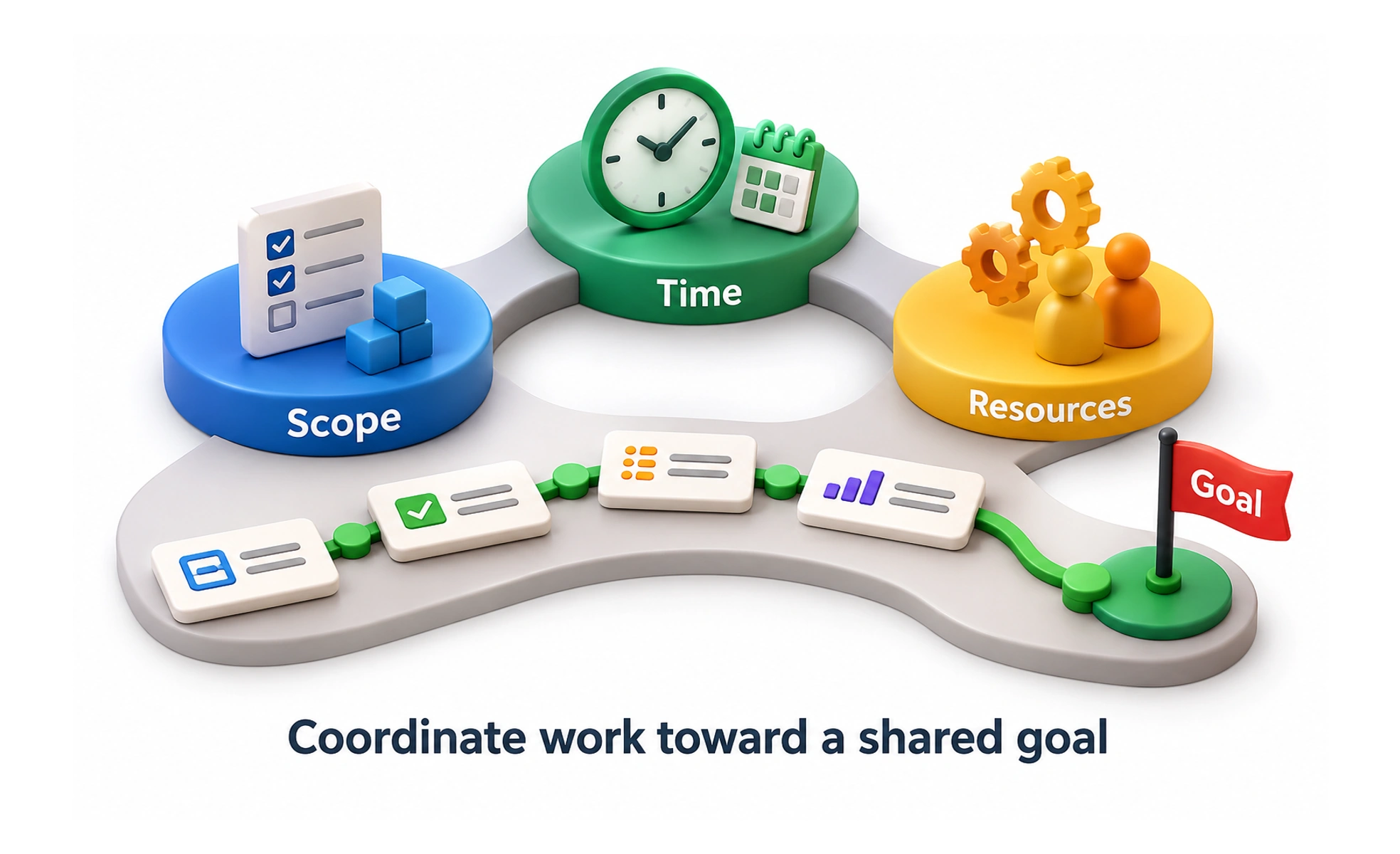
Project management coordinates people and work to achieve a defined result within constraints. It includes planning, dependencies, risks, communication, and the decisions needed to keep delivery useful and realistic.
Organizing an event requires more than a date and a checklist. People, suppliers, timing, costs, and unexpected changes all need coordination.
Clarify the result and constraints
Agree on what the project should achieve, who benefits, and how completion will be judged. Record important limits such as budget, time, capacity, and required quality. A shared understanding reduces the chance that different people deliver different interpretations of the same request.
Plan dependencies and responsibilities
Break the work into manageable parts and identify which parts depend on others. Make ownership and decision responsibilities clear. A schedule is more credible when it reflects actual capacity, review time, and dependencies rather than assuming every task can start immediately.
Manage uncertainty openly
Track risks, assumptions, and changes that could affect the outcome. Discuss them early enough to choose a response. Status updates should explain progress, blockers, and decisions needed; a green indicator is unhelpful if it hides a problem until the deadline arrives.
Example: launching a course
A course launch may depend on reviewed content, working assessments, media processing, and support guidance. A project plan connects those streams and includes acceptance checks. If editorial review takes longer than expected, the team can adjust scope or timing before learners encounter unfinished material.
Frequently asked questions
Key takeaways
- Agree on results and constraints.
- Plan around real dependencies and capacity.
- Make ownership and decision responsibilities explicit.
- Communicate risks and changes early.