

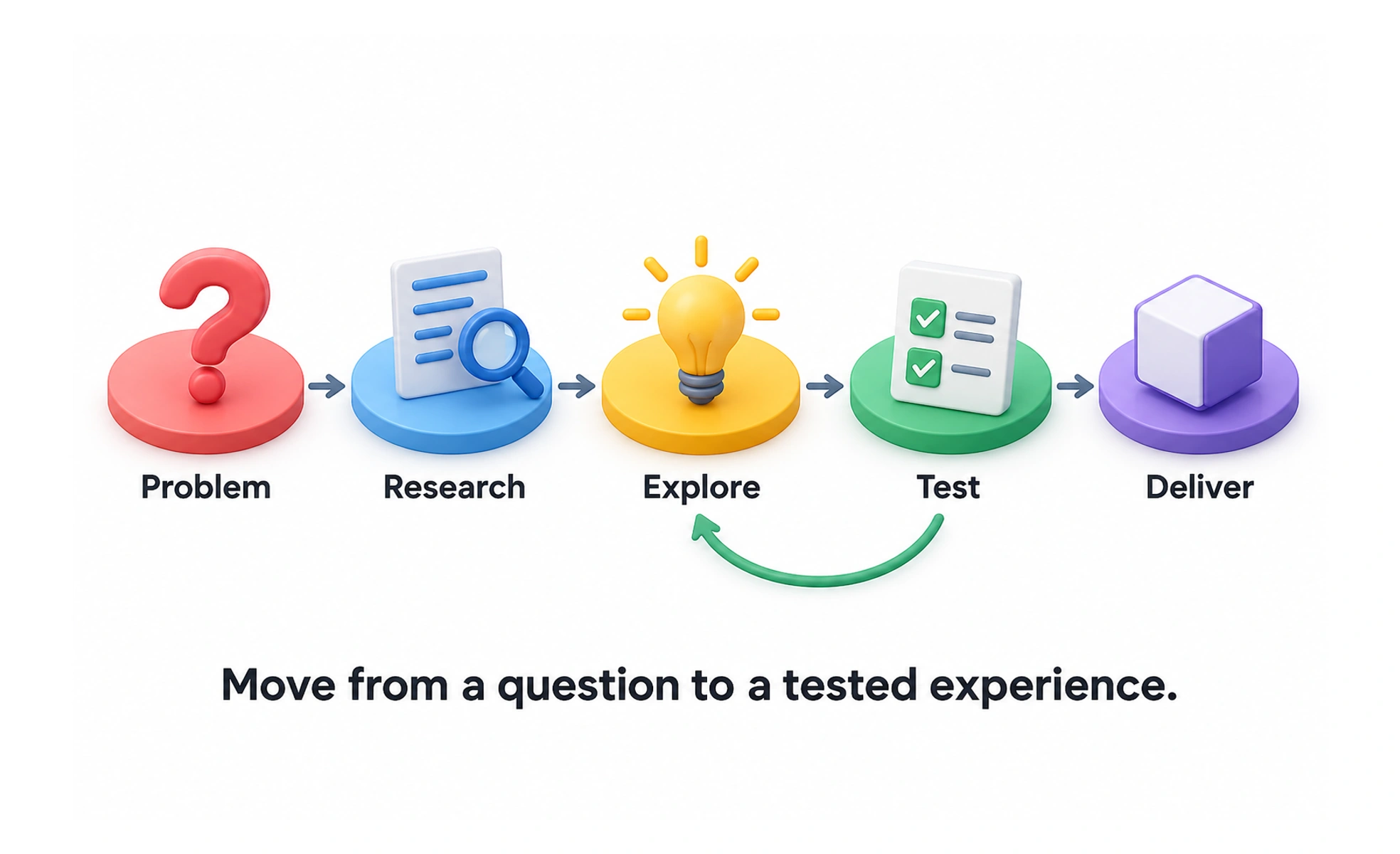
A workflow makes design work visible: how a team frames a problem, explores options, gets feedback, prepares implementation, and learns after release. It is a guide for coordination, not a fixed recipe that every project must follow.
A cooking workflow names the preparation, cooking, and tasting steps while allowing the cook to adapt to ingredients. A design workflow similarly provides coordination without requiring every problem to follow an identical path.
Make the stages match the work
A useful workflow may include discovery, definition, exploration, validation, implementation, and evaluation. Some projects need more research; others can improve an existing flow with a small test. The stages should reflect the uncertainty and risk of the actual problem.
Clarify roles and decision points
Teams need to know who contributes, who makes a decision, and what evidence is needed to move forward. Shared checkpoints reduce surprise, but too many approvals can slow learning. Make handoffs explicit when work crosses teams or disciplines.
Choose artifacts for communication
A brief, flow, prototype, component specification, or research summary should help someone make or implement a decision. Create only the detail the team needs. A polished artifact is not a substitute for agreement about behavior, constraints, and ownership.
Improve the workflow through reflection
Notice where work waits, reopens, or loses context. Ask whether the cause is unclear input, late feedback, missing ownership, or a tool problem. Adjust the workflow and review whether coordination improves without reducing the quality of decisions.
Frequently asked questions
Key takeaways
- Adapt workflow stages to the uncertainty and risk of the work.
- Clarify ownership and meaningful decision points.
- Create artifacts that support a real team decision.
- Improve process friction without adding unnecessary ceremony.