

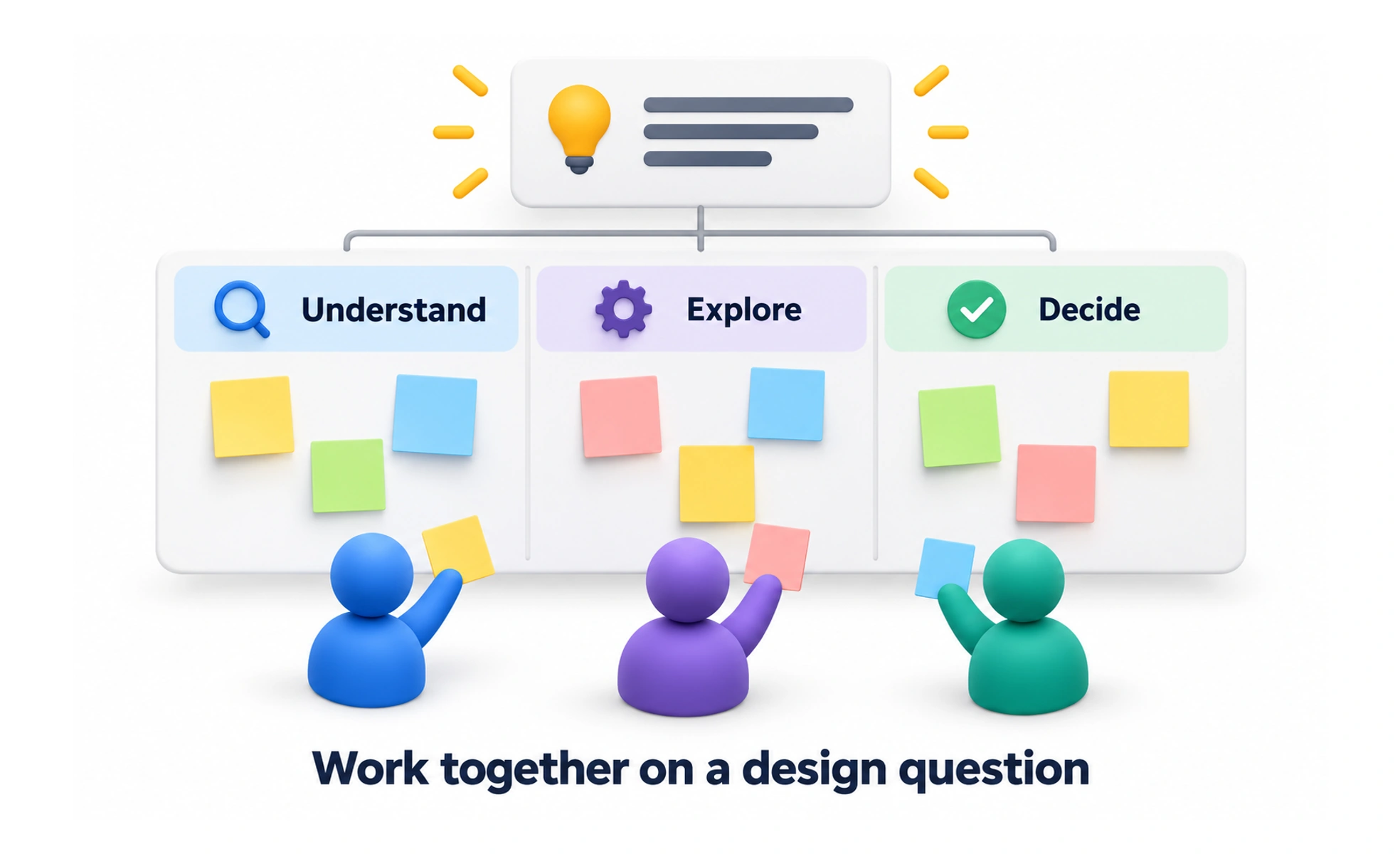
A design workshop is a structured session in which people work together on a design question. It can help a group build understanding, explore options, or make a decision with shared context.
A group working around a map can compare routes more effectively when everyone knows the destination and what decision must be made.
Choose a concrete outcome
Decide what the group should understand or decide by the end. A workshop to identify risks needs different activities from one intended to explore solutions. Check whether a live session is useful; some information sharing or review can happen more effectively in writing.
Prepare evidence and participants
Invite people whose knowledge or responsibilities matter to the question. Provide research, constraints, and useful pre-reading so the session does not begin from unsupported opinions. Explain the agenda and how the output will influence later decisions.
Balance exploration and selection
Give participants time to think independently before discussing ideas, then use clear criteria to compare options. Encourage different perspectives and make uncertainty visible. Voting can reveal preferences, but it does not validate an idea or replace the judgment of the accountable decision maker.
Example: improving first-time learning
A team can review onboarding evidence, map barriers, and sketch several ways to help learners reach value. The useful output might be a short set of assumptions to test. Record owners and next steps so the workshop changes the work rather than ending as a collection of sticky notes.
Frequently asked questions
Key takeaways
- Define the session’s intended outcome.
- Prepare relevant evidence and perspectives.
- Use activities that support the question.
- Turn outputs into owned next steps.