

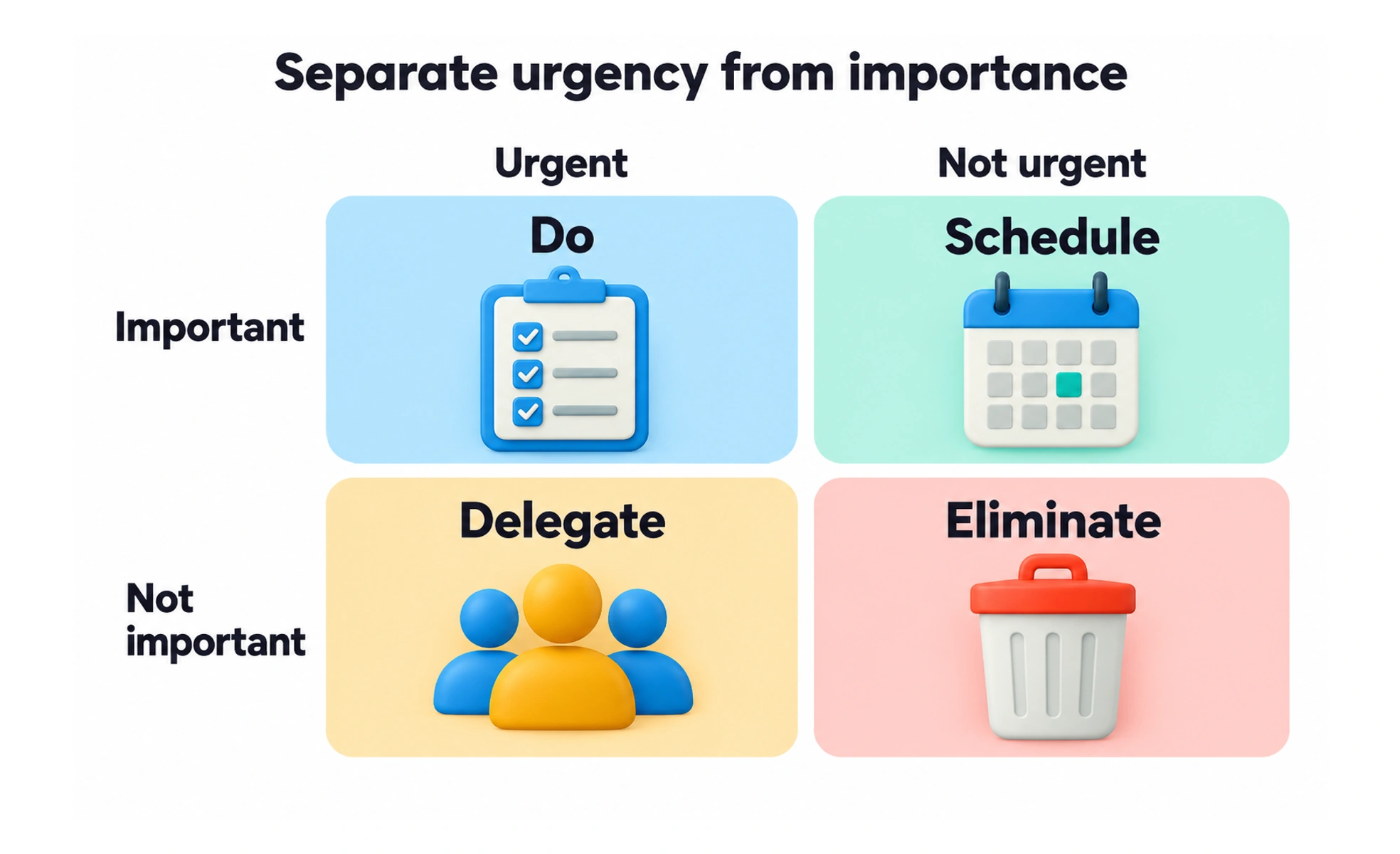
Attributed to Dwight Eisenhower, it distinguishes between pressing distractions and truly meaningful work. It guides designers and product leaders on what to do, schedule, delegate or delete.
Think of it as emergency room triage. A patient with severe bleeding gets treated immediately, a scheduled surgery is booked for tomorrow, and minor paperwork is delegated.
How it works
The matrix plots activities across two intersecting axes: urgency and importance.
- Quadrant 1: Do First (Urgent and Important) covers critical crises, server outages and pressing delivery deadlines.
- Quadrant 2: Schedule (Not Urgent but Important) covers strategic roadmapping, user research and design systems.
- Quadrant 3: Delegate (Urgent but Not Important) covers routine interruptions, ad-hoc requests and administrative chores.
- Quadrant 4: Delete (Not Urgent and Not Important) covers time-wasting trivia, vanity tasks and unproductive meetings.
When to use it
Use the Eisenhower Matrix whenever daily firefighting prevents you from making strategic progress.
- Daily workload planning helps designers protect uninterrupted deep-work focus for complex interface problems.
- Product roadmap triage filters incoming executive requests that feel urgent but lack true business value.
- Team leadership delegation identifies operational tasks that senior designers should hand off to empower juniors.
- Quarterly time audits reveals whether product teams are spending enough time in Quadrant Two.
Common mistakes
People routinely misclassify tasks because human brains naturally confuse urgency with importance.
- Treating everything as urgent, living in perpetual crisis mode and burning out team members.
- Neglecting Quadrant Two, postponing research and proactive design until technical debt explodes into an emergency.
- Failing to delete Quadrant Four activities, letting unproductive status meetings consume half the working week.
Frequently asked questions
Key takeaways
- The Eisenhower Matrix splits tasks into four quadrants based on urgency and importance.
- Urgent tasks demand immediate reaction; important tasks drive long-term value and goals.
- Quadrant Two (important, not urgent) is where high-impact design and strategy occur.
- Ruthlessly eliminate non-urgent, unimportant tasks to protect focused working time.