

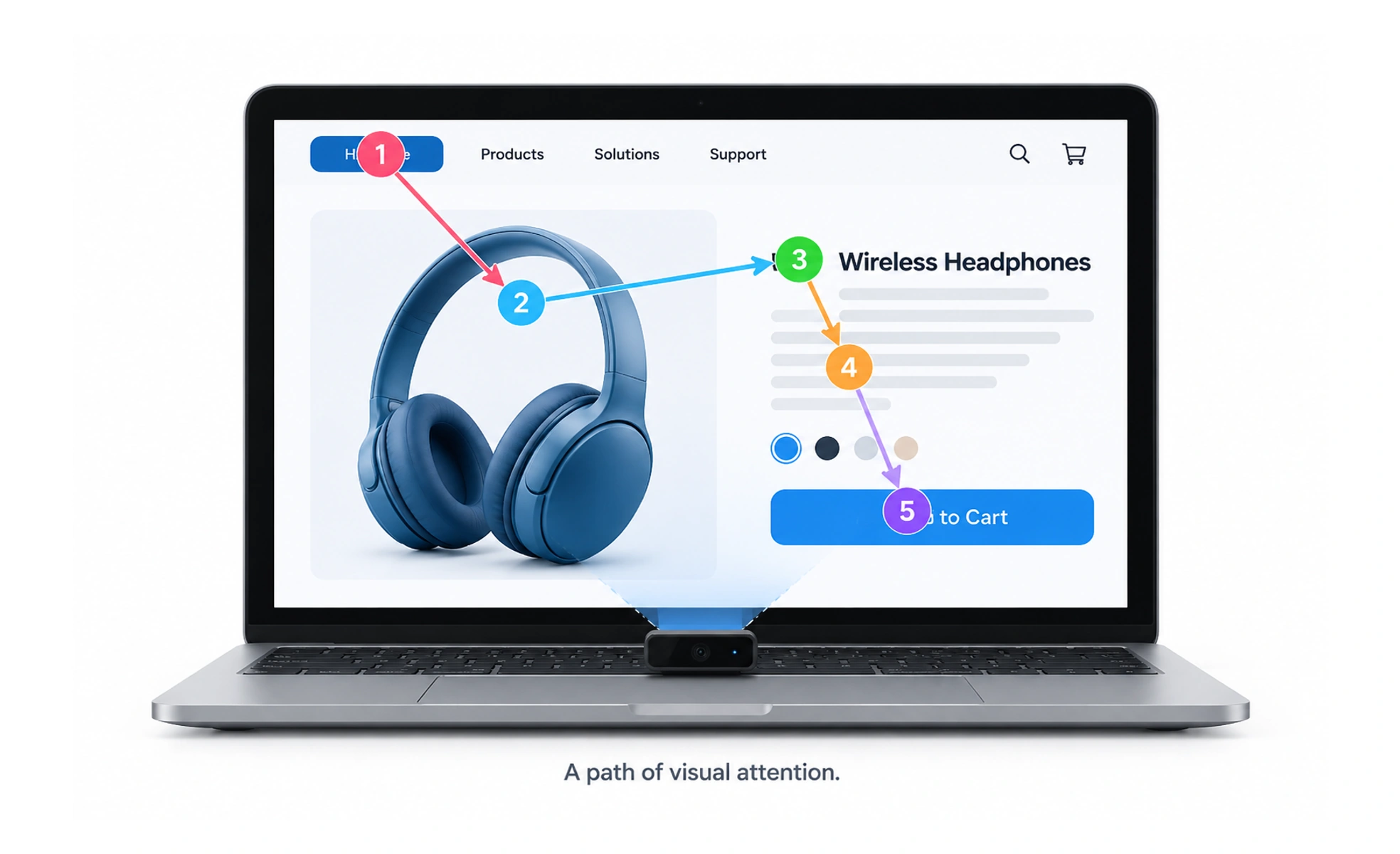
It can reveal patterns that are difficult to notice through ordinary observation, such as repeated looking between a total and its explanation. It does not read thoughts. Looking at an item does not establish that someone understood, liked or agreed with it.
Choose a question that needs gaze data
Start with the decision, not the equipment. If people cannot complete a form, ordinary task observation may already show the main difficulty. Eye tracking may be useful when the question concerns how visual information is found or compared.
Define the task and relevant screen areas before interpreting a visualization. A heatmap without a task or time context can be attractive but difficult to use responsibly.
Understand the measurement
A gaze plot shows a sequence of estimated looking positions. A heatmap combines looking data into a visual summary. Both depend on how the study was collected and processed.
Calibration, movement, equipment and the participant’s circumstances can affect data quality. Check missing or unreliable recordings before drawing conclusions. Avoid treating every colored region as a precise boundary of attention.
Example: comparing delivery options
Participants choose between delivery options with different dates and costs. The researcher notices repeated looking between the price column and a note beneath the table.
The team follows up with task outcomes and participant explanations. It discovers that the note changes which orders qualify for the displayed price. Moving that condition closer to the relevant option is a proposal to test, not a conclusion supplied by the heatmap alone.
Combine evidence and protect participants
Explain what will be recorded and how it will be stored. Gaze recordings can be sensitive research material, especially when combined with screen content.
- Check the quality of each recording.
- Compare gaze with actual task behavior.
- Ask about unclear moments without suggesting an answer.
- Report the limits of the sample and equipment.
Use the method when its extra detail helps a decision enough to justify the cost and setup.
Frequently asked questions
Key takeaways
- Eye tracking estimates gaze rather than thoughts.
- Interpret visualizations in the context of a task.
- Check calibration and recording quality.
- Combine gaze data with behavior and other evidence.