

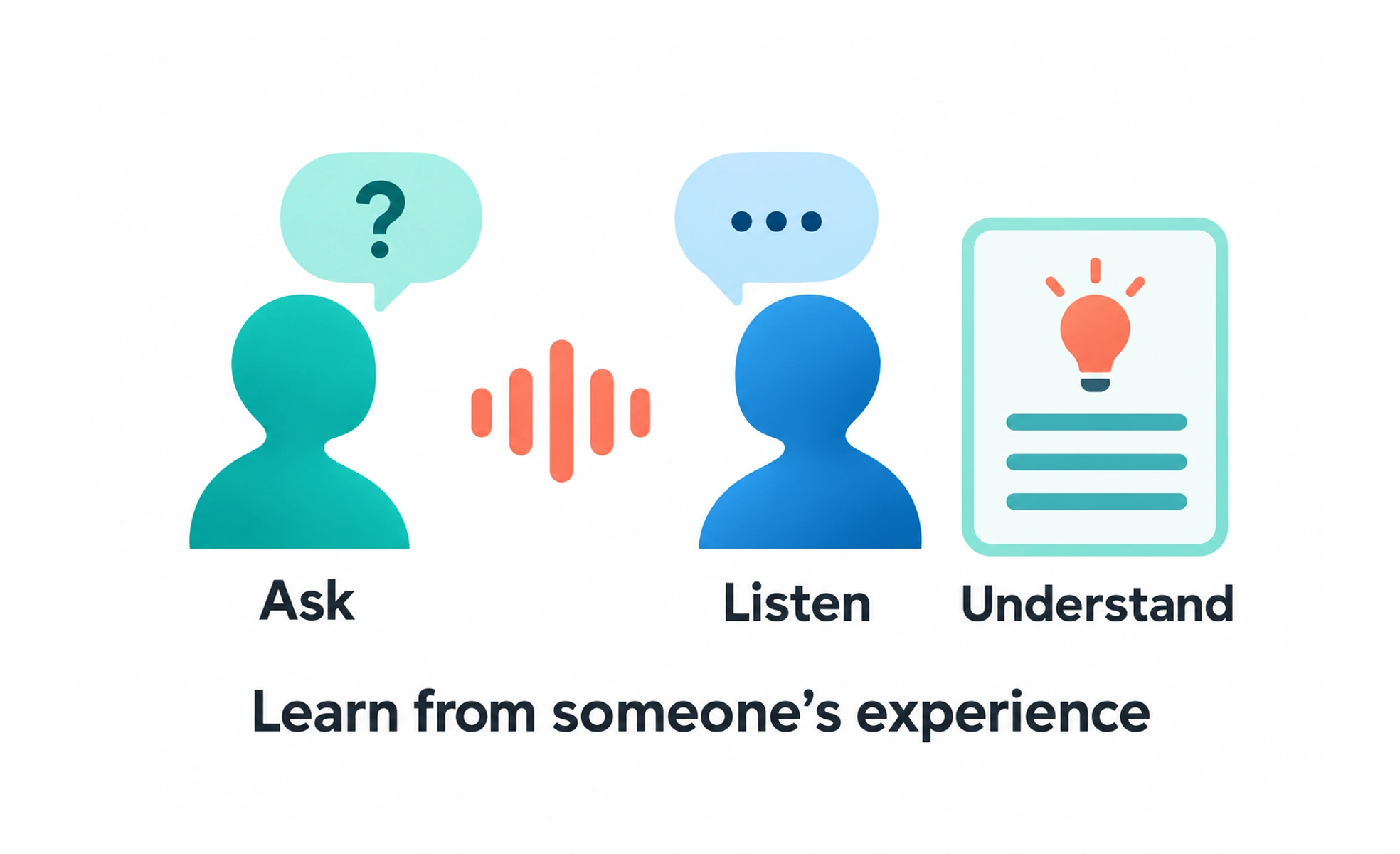
An interview is useful when you need to explore context: what happened, why it mattered and how someone handled it. It is different from persuading a customer to like an idea. Good questions leave room for an answer the team did not expect.
Ask about a real experience
Invite the participant to describe a recent, relevant situation. “Tell me about the last time you booked a repair” gives you a concrete starting point. “Would you use a better booking app?” asks for a prediction about an unclear future.
Prepare topics and follow-up prompts, but let the person explain their experience in their own terms. Avoid putting a positive or negative judgment into the question.
Listen for detail and uncertainty
Ask what happened before and after an important moment. Where appropriate and with permission, ask to see the materials used in the task. A calendar entry or confirmation message can make a remembered sequence clearer.
Do not assume a contradiction means dishonesty. Memory is incomplete, and people may use words differently from your team. Clarify gently instead of trying to win an argument.
Example: planning a group booking
A researcher asks someone to walk through their last group activity. The participant explains that choosing a time was easy, but collecting everyone’s preferences took several days.
The team had planned to improve the time picker. The conversation reveals an earlier coordination problem worth investigating. The interview does not prove how common that difficulty is, but it changes the questions the team needs to answer.
Protect the conversation
Explain the purpose, recording arrangements and how the information will be used. Participation should be voluntary, with a practical way to pause or decline a question.
- Record observations and quotations accurately.
- Keep personal details out of unnecessary circulation.
- Separate reported experiences from observed behavior.
- Check interpretations across other relevant evidence.
A careful interview produces learning, not permission to claim that every customer feels the same way.
Frequently asked questions
Key takeaways
- Explore recent experiences rather than vague predictions.
- Use neutral prompts and follow the participant’s account.
- Distinguish what people report from what you observe.
- Plan consent and responsible handling of research material.