

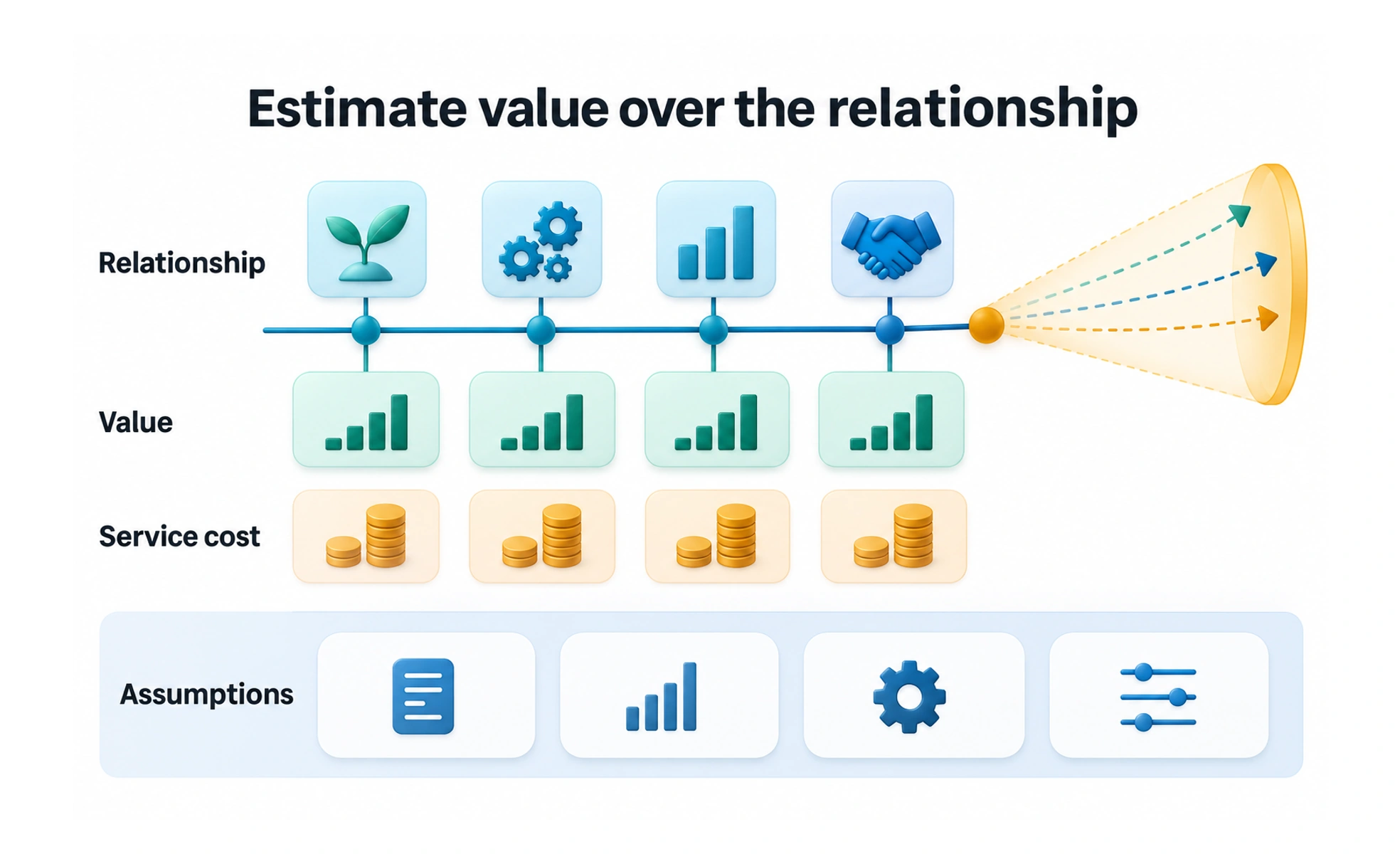
Lifetime value estimates the financial value a customer relationship may produce over time. The definition can use revenue or contribution after costs, so the model and assumptions must be stated clearly.
A shop considers what a regular customer may contribute across many visits, while recognizing that future visits and service costs are uncertain.
State what value includes
Specify whether the measure concerns revenue, gross profit, or another contribution definition. Include the relevant period and costs so readers can interpret it correctly. A revenue-based figure should not be presented as profit or as money already collected.
Choose a model suited to the relationship
Historical cohort totals can describe observed customer value, while predictive models estimate future behavior. Subscription and repeat-purchase businesses may need different approaches. Simple averages can conceal changes in customer mix, retention, pricing, or service costs.
Make assumptions visible
A forecast depends on how long customers remain, what they spend, and the costs of serving them. Test how plausible changes affect the estimate. Early products with little history should communicate wide uncertainty rather than report a precise lifetime value as an established fact.
Example: a subscription service
A team can compare observed revenue and support costs for customers who joined in different months. If a forecast assumes today’s retention continues indefinitely, the estimate may be fragile. Use it as one planning input and revisit it as longer-term cohort evidence becomes available.
Frequently asked questions
Key takeaways
- Define revenue or profit contribution explicitly.
- Distinguish observed value from predicted value.
- Use a model that fits the business relationship.
- Communicate sensitivity and uncertainty.