

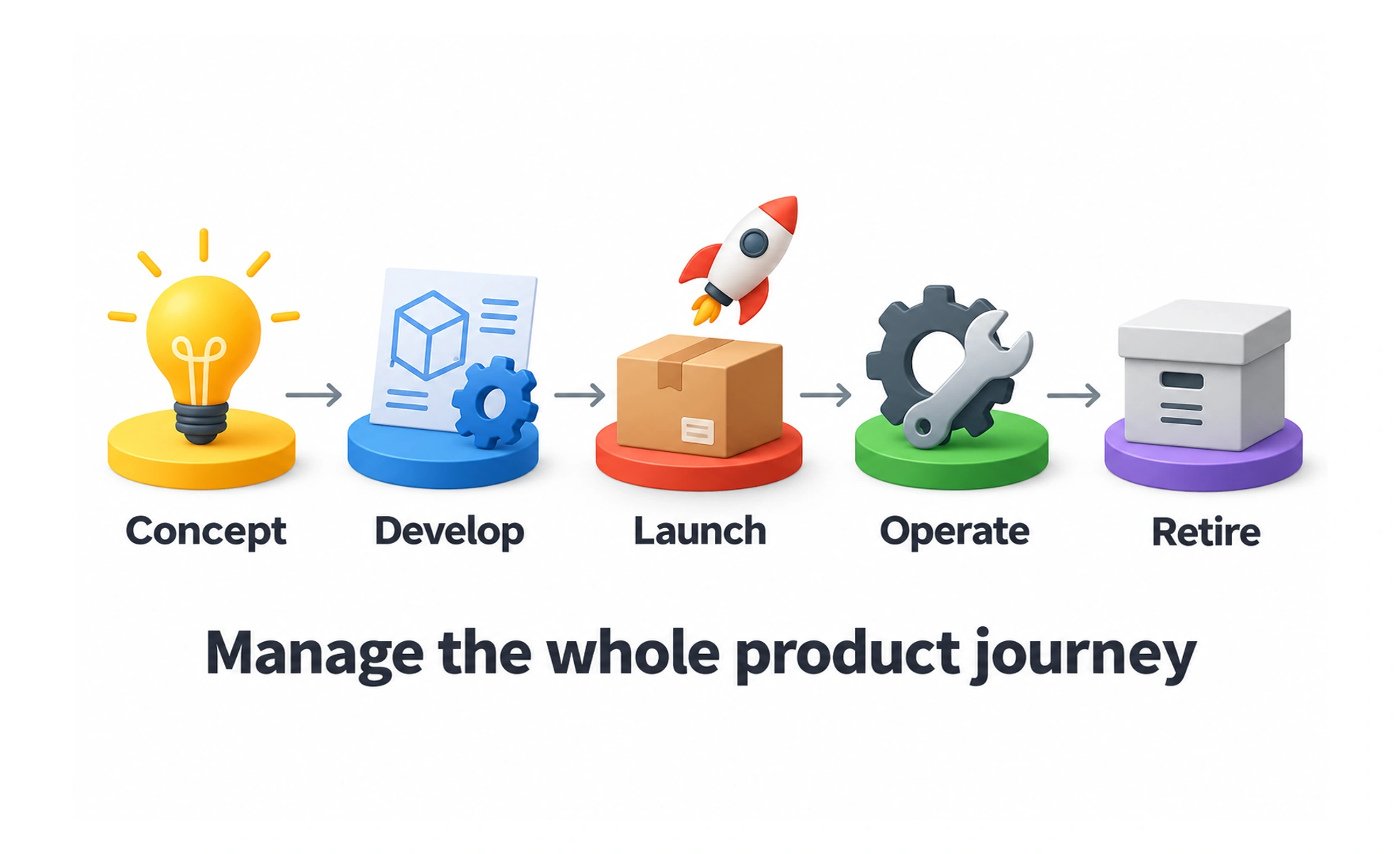
It maps introduction, growth, maturity and eventual decline. Understanding each phase helps product managers make sound decisions on feature investment, marketing and sunsetting.
Think of it as the life stages of a tree. It sprouts as a seedling, grows rapidly, bears fruit for years, and eventually declines as new species take over the forest.
Types
A classic product lifecycle progresses through four predictable chronological phases.
- Introduction focuses on establishing product-market fit, validating core hypotheses and acquiring early adopters.
- Growth features rapid customer adoption, expanding market share and scaling infrastructure to meet demand.
- Maturity sees stabilized growth, fierce competitive defense, operational efficiency and incremental optimization.
- Decline occurs when consumer habits shift or superior technologies render the legacy product obsolete.
When to use it
Apply product lifecycle models to allocate engineering resources and align leadership expectations.
- Portfolio investment decisions balance high-risk emerging products with steady, cash-generating mature platforms.
- Feature sunsetting strategy identifies when legacy features no longer justify maintenance and should be deprecated.
- Go-to-market planning adapts marketing messaging from educational awareness in introduction to competitive differentiation in maturity.
- Team hiring allocation directs exploratory agile designers to new products and systems engineers to mature scaling platforms.
Common mistakes
Product leaders frequently misjudge which phase their offering occupies, misallocating critical resources.
- Premature scaling pours massive marketing capital into user acquisition before reaching authentic product-market fit.
- Treating mature products as stagnant by cutting all UX investment, allowing nimbler challengers to steal customers.
- Prolonging sunsetting by keeping dead products on life support out of sentimental attachment, wasting engineering hours.
Frequently asked questions
Key takeaways
- The product lifecycle tracks four stages: introduction, growth, maturity and decline.
- Different lifecycle stages require distinct strategic goals, metrics and team capabilities.
- Premature scaling in the introduction phase is a primary cause of startup failure.
- Proactively retiring declining features frees resources for high-growth initiatives.