

It establishes clear consensus between stakeholders and delivery squads on what is essential for release. By explicitly defining what will not be built, it prevents scope creep under tight deadlines.
Think of it like this. When packing a backpack for a mountain hike, you must pack water, should pack warm layers, could pack a camera, and won't pack a heavy laptop.
How it works
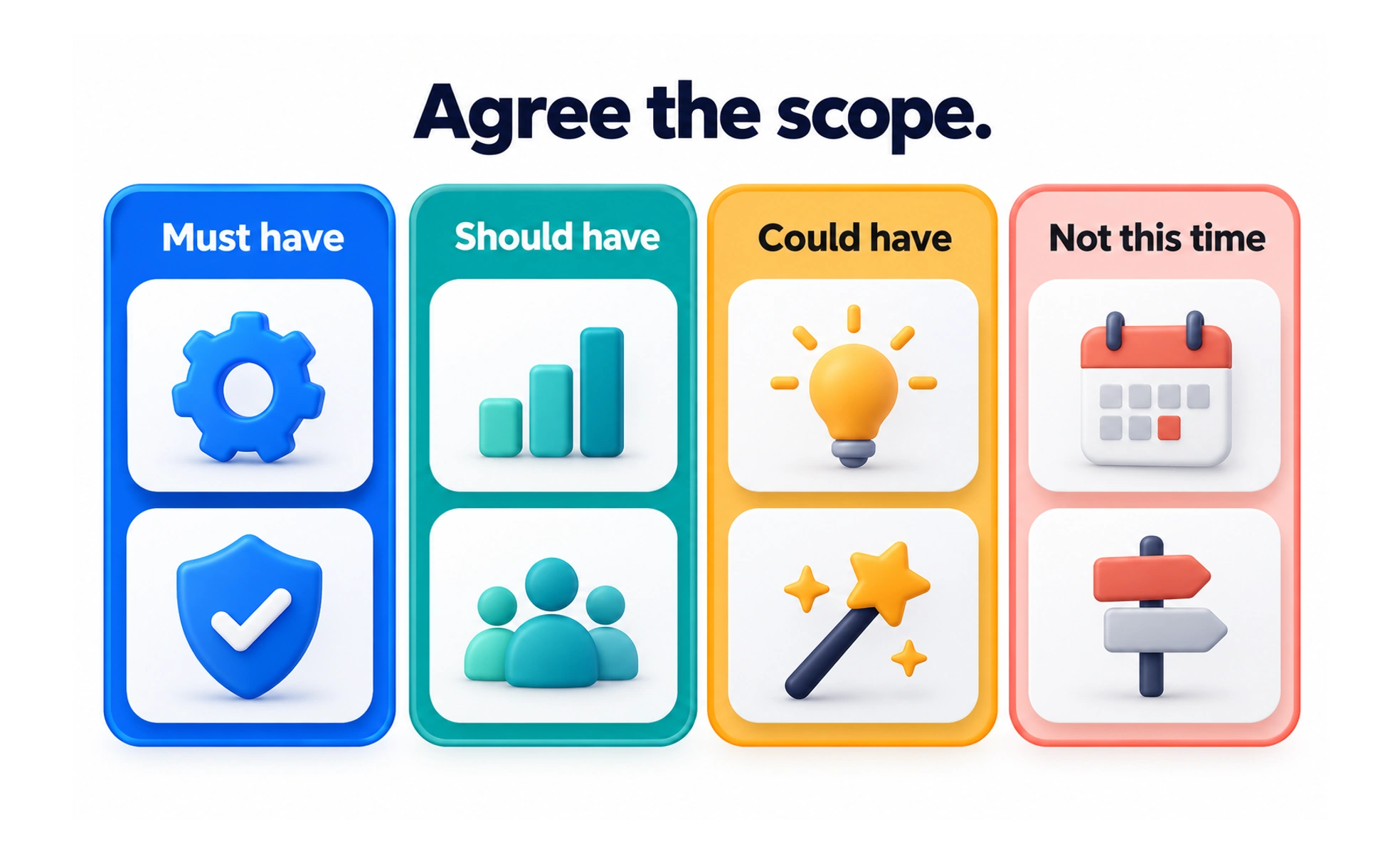
MoSCoW categorizes all project requirements into four unambiguous tiers of delivery priority.
- Must have features are non-negotiable legal, security or functional requirements without which the product cannot launch.
- Should have requirements add substantial value and should be included if possible, but workarounds exist if delayed.
- Could have items are desirable enhancements that will be delivered only if excess team capacity remains.
- Won't have (this time) initiatives are explicitly agreed to be out of scope for the current release window.
When to use it
Apply MoSCoW prioritization during release planning and fixed-deadline project kickoff sessions.
- Minimum viable product scoping defines the strict boundary between baseline utility and secondary polish.
- Managing executive expectations establishes formal written agreement on what will not ship in version one.
- Sprint overflow management identifies which 'could have' tickets can be dropped without harming the release.
- Design handoff alignment ensures engineers build core interactive flows before polishing decorative animations.
Common mistakes
Stakeholders frequently sabotage MoSCoW workshops by classifying almost every feature as a Must.
- Labeling everything as a Must have, which destroys prioritization and leaves teams with no flexibility.
- Neglecting the Won't have category, missing the opportunity to kill bad ideas and clarify scope boundaries.
- Failing to re-evaluate categories as new user testing feedback or technical constraints emerge during development.
Frequently asked questions
Key takeaways
- MoSCoW categorizes requirements into Must have, Should have, Could have and Won't have.
- Must have features must represent a realistic subset of capacity to preserve schedule flexibility.
- The 'Won't have' bucket is the most powerful tool for preventing creeping scope creep.
- It creates shared vocabulary and explicit agreement across engineering, design and executives.