

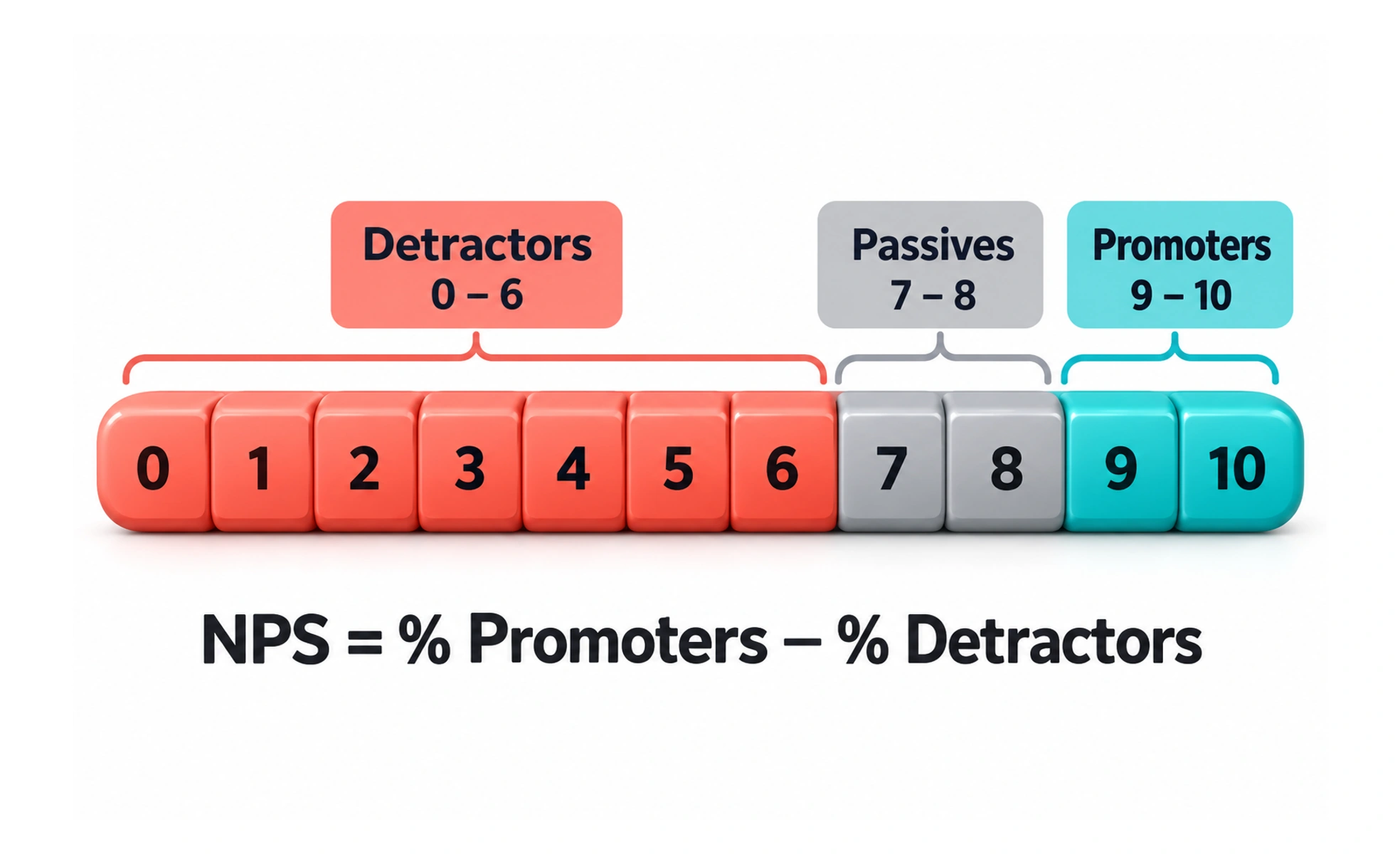
Net Promoter Score summarizes responses to a recommendation question on a zero-to-ten scale. It subtracts the percentage of detractors from the percentage of promoters to provide one view of reported customer sentiment.
A recommendation question is like a quick temperature reading. It can flag a change worth investigating, but it does not explain the entire condition of the experience.
Calculate the groups correctly
Responses of nine or ten are promoters, seven or eight are passives, and zero through six are detractors. Calculate each percentage using all valid responses, including passives in the denominator. Subtract the detractor percentage from the promoter percentage to obtain a score from minus 100 to 100.
Keep collection conditions comparable
Record who was invited, when they were asked, the wording, and the response count. Recent successes, support encounters, and survey placement can influence who responds. Changes in collection method can change the score even when the underlying experience has not changed.
Investigate the reasons
An optional explanation can reveal what respondents value or find difficult. Combine responses with other research and behavioral evidence. A reported willingness to recommend is not direct evidence of task usability, actual recommendations, or future revenue.
Example: comparing releases
A team can observe whether sentiment changes after a release while checking response mix and sample uncertainty. If only highly active customers received the new survey, a higher score may reflect selection. Read the reasons and investigate affected journeys before attributing the movement to the design.
Frequently asked questions
Key takeaways
- Use the standard groups and all valid responses.
- Keep survey context and sampling visible.
- Read explanations alongside the score.
- Treat NPS as one sentiment signal with limitations.