

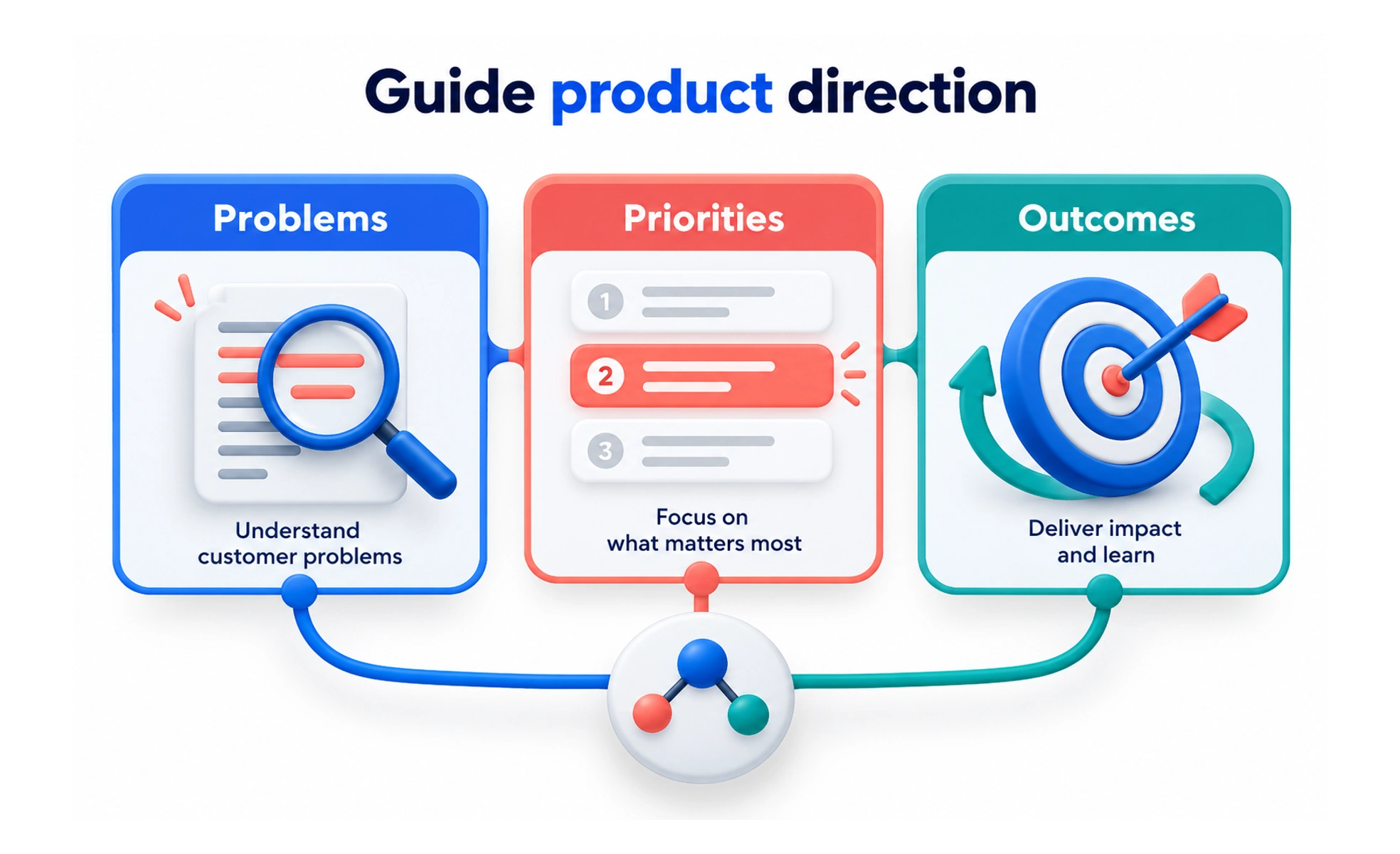
The unusual part of the role is carrying responsibility without command. A product manager answers for the product's success but usually manages nobody who builds it, so influence has to come from evidence and clarity.
Think of it like this. A conductor makes no sound. They are still responsible for how the orchestra sounds, and they get there by being clear rather than by playing louder.
How it works
The day is mostly talking to users and to the people who talk to users, reading behavioural data, and writing down what the team is doing and why in a form that survives being read by someone who was not in the room.
Then deciding what not to do, repeatedly, and explaining that to people who wanted it done.
Seniority tracks how much ambiguity you can absorb. A junior product manager owns a feature area with defined goals. A senior one is handed an unclear outcome and produces a defensible plan.
Common mistakes
- Becoming a ticket writer. Requests arrive from sales, support and leadership, get written up and passed to engineering. The team stays busy and the product loses direction.
- Saying yes to be liked. The distinguishing skill is declining most requests well, by understanding the problem behind them and explaining why it is not the best use of capacity now.
- Treating a scoring framework as a decision. It structures the argument. It does not settle it.
Trade-offs
Carrying responsibility without authority shapes everything about how the job is done.
- Persuasion costs time. Every decision has to be explained rather than instructed, which is slower. The upside is that a team which understands why will make good calls when you are not in the room.
- Proximity to the team against proximity to the business. Sitting close to engineering builds trust and context, but the strategic conversations happen elsewhere, and both need attending.
- Being decisive against being right. Waiting for certainty stalls the team. Deciding early sometimes means deciding wrong. The useful habit is making reversible decisions quickly and irreversible ones slowly.
Frequently asked questions
Key takeaways
- Responsibility without authority. Influence is earned through reasoning.
- Saying no well, with a reason, is the core competency.
- A backlog fed by whoever asked loudest is not a strategy.
- Seniority is measured in ambiguity absorbed, not surface area owned.