

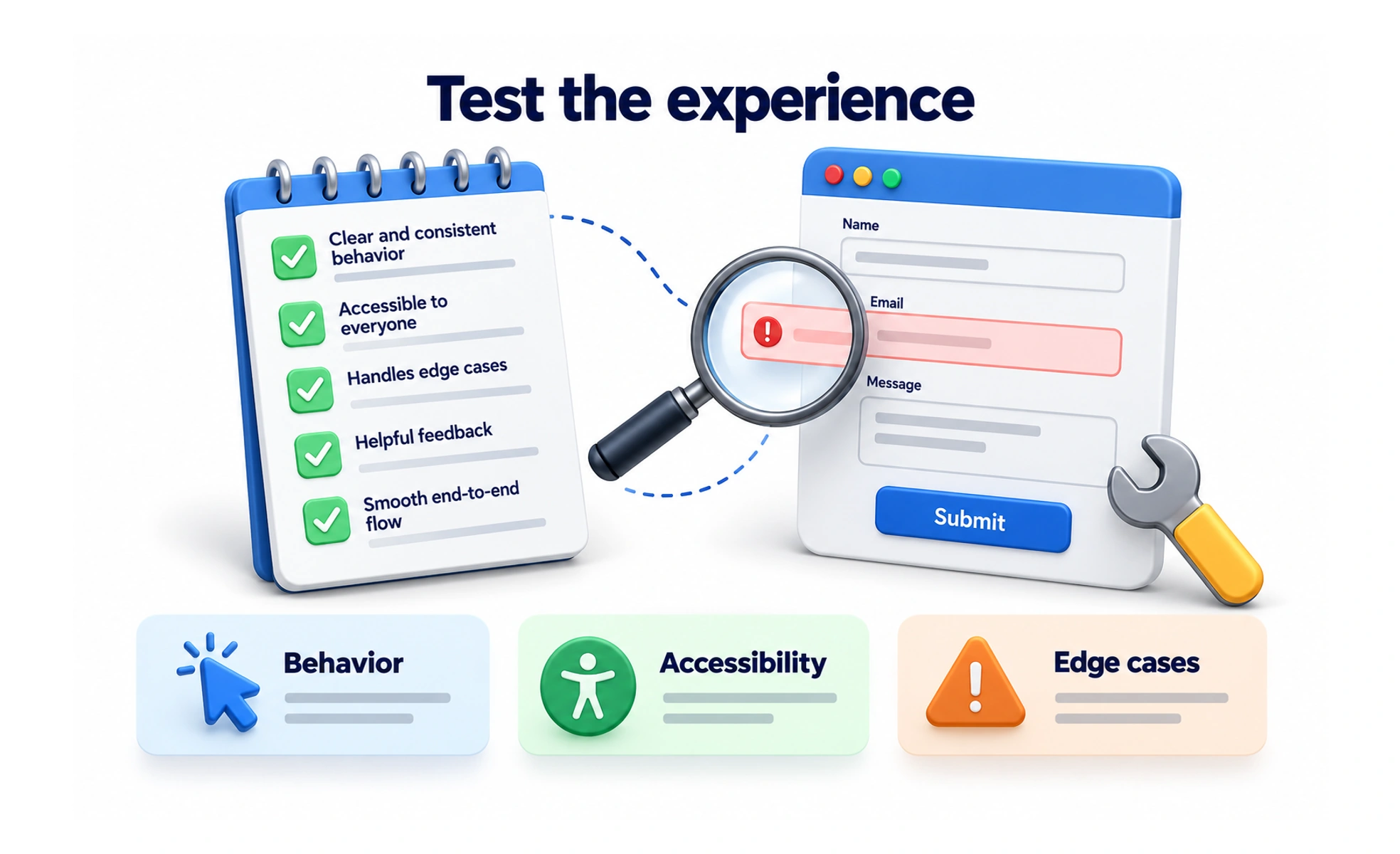
Quality assurance helps a team build confidence that a product meets its intended needs and quality expectations. Testing contributes evidence by checking behavior and investigating where the experience may fail.
Inspecting a bridge involves reviewing the design, checking materials, and testing important conditions. Product quality similarly depends on several forms of evidence.
Test risks and expected behavior
Start with the purpose of the change and the consequences of failure. Cover essential success paths, permissions, errors, and recovery. Prioritize checks that could reveal an important defect rather than collecting a large number of tests that repeat implementation details.
Combine different kinds of evidence
Automated checks can catch repeatable problems quickly, while exploratory use can reveal unexpected interactions or confusing behavior. Review accessibility, performance, data integrity, and visual states where they matter. A typecheck can pass while a database query or real user flow still fails.
Use realistic environments and data
Check relevant account roles, empty and populated states, long content, and supported screen sizes. Keep tests isolated so they do not damage real learner progress. Record which environment and cases were checked, and distinguish observed results from assumptions about untested behavior.
Example: notification persistence
A notification test can verify that a committed action creates one inbox item, that reading persists after reload, and that switching accounts never shows the previous inbox. Delayed responses and failures deserve attention because a happy-path click alone will not reveal state races.
Frequently asked questions
Key takeaways
- Choose checks based on meaningful risks.
- Combine automated, exploratory, and user-facing verification.
- Use realistic states without harming real data.
- Record evidence and the limits of coverage.