

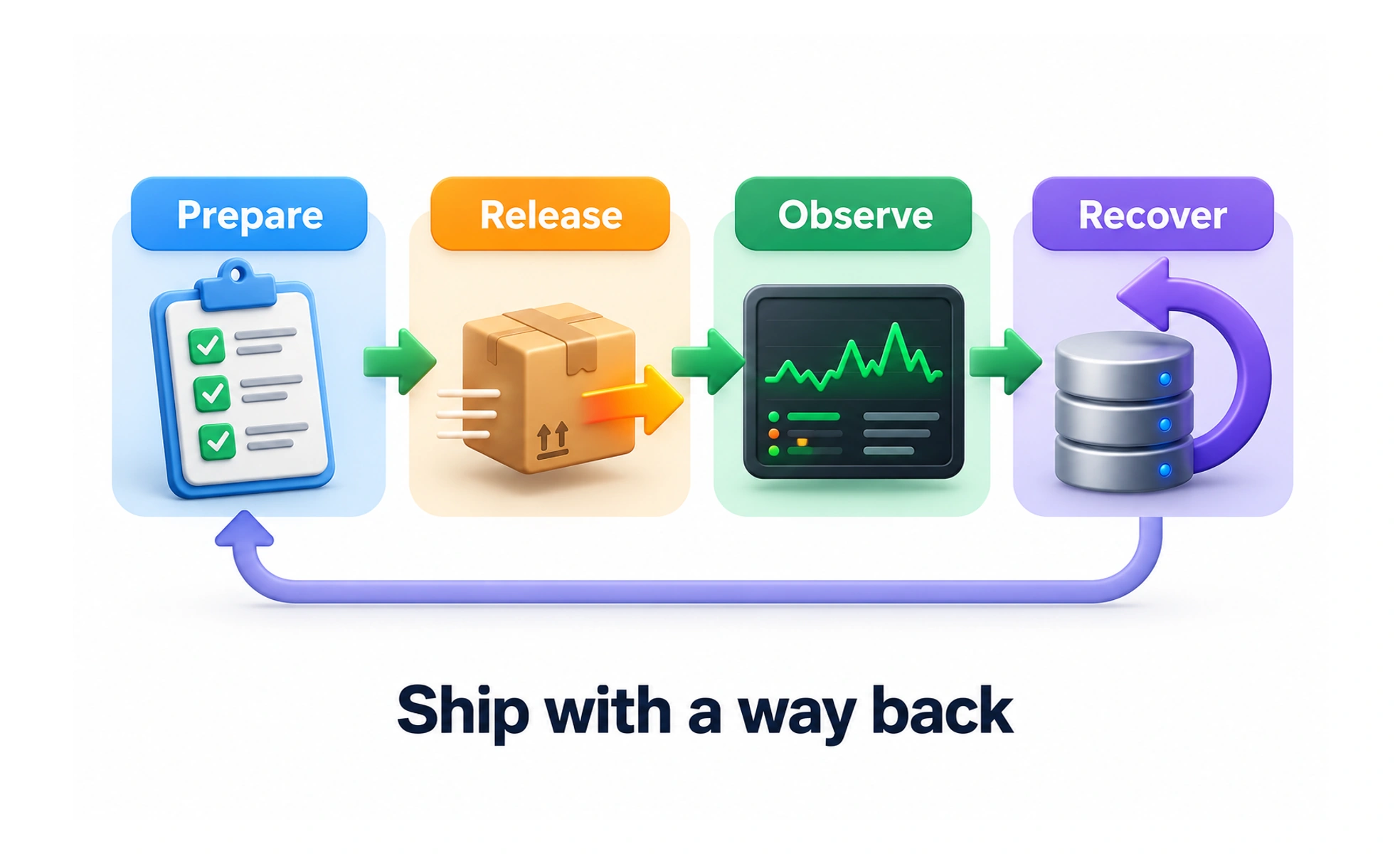
Release management coordinates the preparation, delivery, and observation of product changes. It helps teams introduce improvements while managing dependencies, operational risk, and recovery.
Opening a renovated station requires checking the building, signs, staff readiness, and passenger flow together. A software release also depends on more than moving files.
Define release readiness
Agree on the behavior, quality checks, and operational conditions needed before release. Include database changes, configuration, access, content, and support information where relevant. Passing compilation alone does not establish that the deployed experience will work through the interface and stored data.
Coordinate the sequence
Some changes must happen in a particular order so old and new components remain compatible. Record dependencies and identify who performs each step. Prefer changes that allow a safe transition rather than assuming every service can update at exactly the same moment.
Observe and prepare recovery
Decide which signals indicate a successful release and which require intervention. Prepare rollback or forward-fix steps that account for data and external effects. Keep the release record accurate about what was applied, when it happened, and what remains uncertain.
Example: an authentication change
A change to browser session handling may require the frontend to send proof before the backend enforces it. Deploying in the wrong order could block users. A release plan verifies compatibility, checks real sign-in behavior, and records recovery steps before enabling enforcement.
Frequently asked questions
Key takeaways
- Define readiness beyond a successful build.
- Sequence dependent code, data, and configuration changes.
- Observe real behavior after release.
- Prepare recovery and record actual rollout evidence.